pecking order

everyone knows their place

20 HP

A mixer for eight parts where you don't set levels: you set who's on top. Patch them in at anything from a whisper to 10 V and it seats each one a step under the hen above her, then holds her there like a fader would. One that pokes up past the rung above is pecked straight back down.

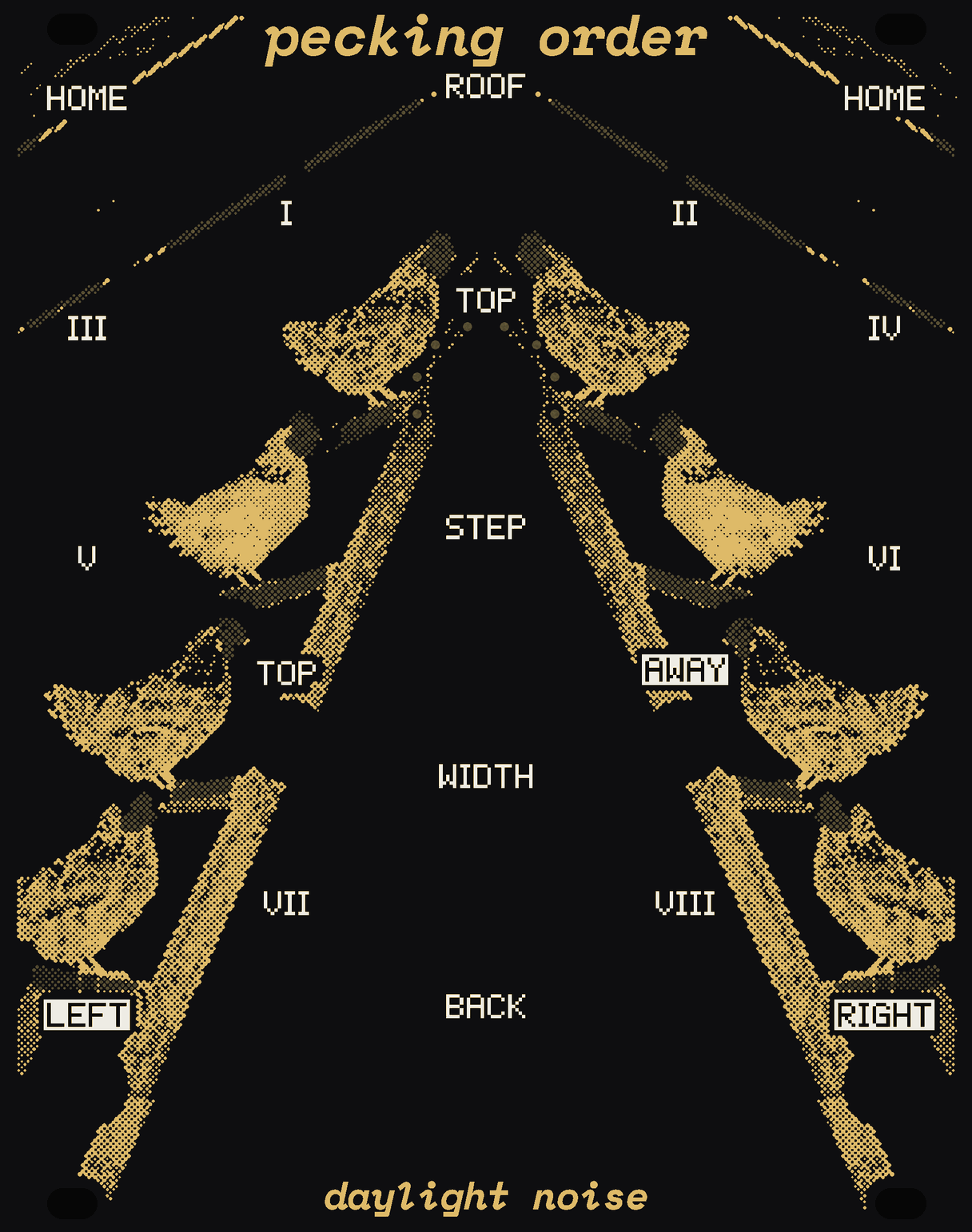
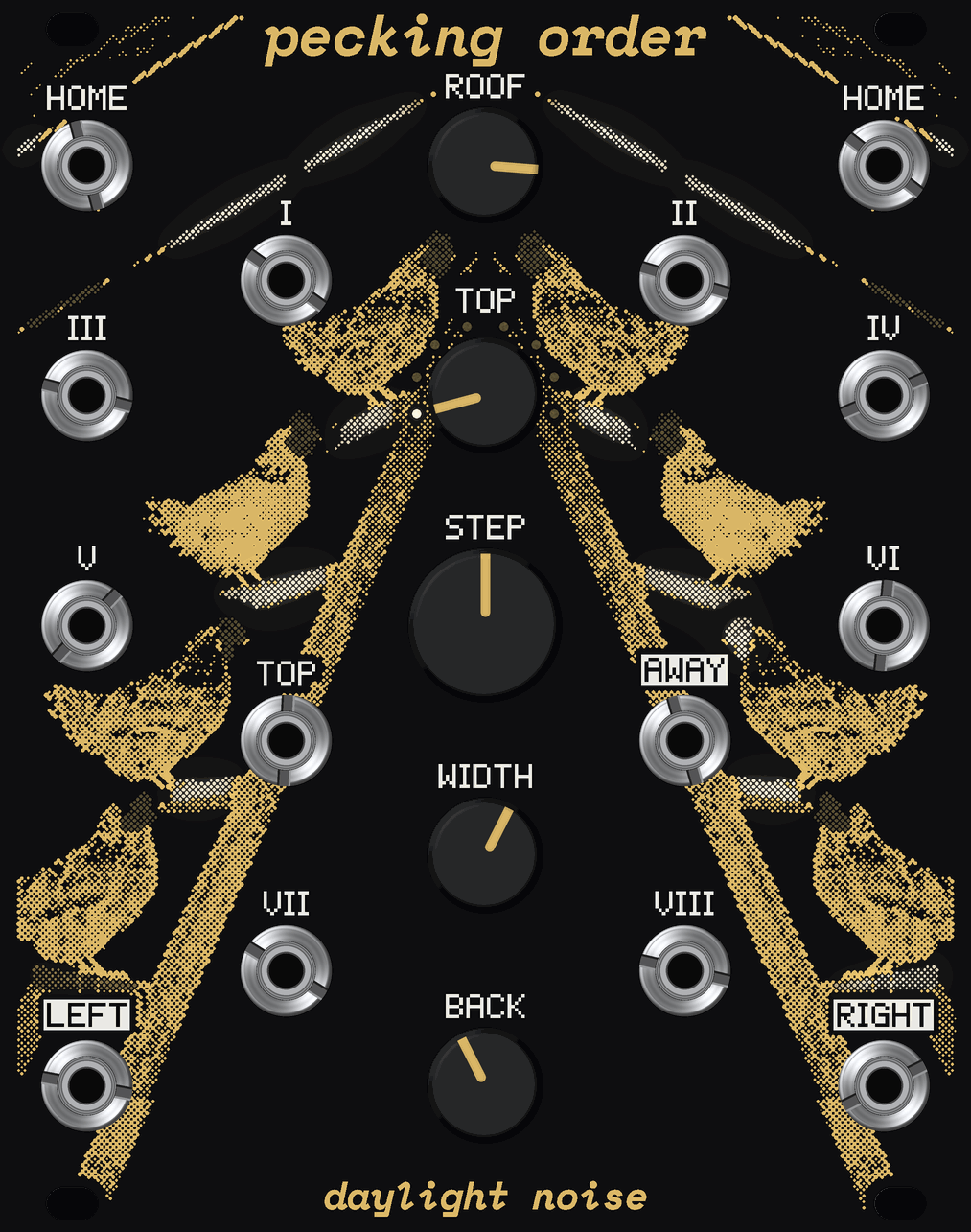
The PECKING ORDER panel: black, and in gold dots eight hens roosting up a ladder roost, four up each side to the top, two by two, under the boards of a pitched roof with light through its cracks. A jack by each hen, I to VIII; the knobs up the middle.

Turn a knob: drag it or tap either side of it, roll the wheel over it or use the arrow keys; a double click puts it back. TOP is a switch: it clicks from hen to hen the same ways. The patches step on by themselves until you touch anything.

A dark loop in D minor at 124 BPM: eight parts from a 0.15 V voice to a 9 V kick, and a reverb from AWAY back into HOME. Listen plays the patch from its top.

example patches

Everything PECKING ORDER does here is its engine, running in your browser; the module runs the same engine. The band is a stand-in rack, patched in at deliberately wild levels.
The order

Eight hens on a roost, a part in each. I is the top rung and VIII the bottom, in the jacks' order. Whatever's in the top hen leads, and every hen under her is seated a step quieter than the one above.

Finding her place

The yard

The roof

What comes out

PECKING ORDER mixed HOME TO ROOST and UNDER THE HUM, songs made on the line's modules alone.

Inside

One board sits 10 mm behind the panel with the jacks, the knobs, TOP's switch, 40 LEDs and the whole circuit on its front. Each rung, each head and each crack in the roof has its own cell in a black printed baffle, so a lit rung never lights the hen beside it. TOP's eight dots are lit from a small ring board round the switch's shaft, closed off from the rungs by a black printed cup. Three converters hear all ten inputs at once, 46,875 times a second, and an RP2350 mixes them on one core and runs the lights on the other.

The PECKING ORDER panel lit: every hen's rung lit evenly, a head flaring where a hen's just been pecked, light through the roof's cracks, its knobs, its switch and its jacks.

Drag it or use the arrow keys to turn it; click it to take it apart.

Specs

Format

Width
20 HP
Depth
20.8 mm behind the panel, plus the power cable's plug
+12 V
about 60 mA dark, 160 mA with the ladder sitting and the roof idle, 240 mA at the most (estimated)
−12 V
about 3 mA (estimated)
+5 V
not used
Controls
a big knob, 3 knobs, an eight-stop switch

I/O

I to VIII
the hens: audio, ±10 V, read to ±12 V; unpatched, silent
HOME
the return, left and right: audio, the same
TOP
CV, 1 V a rung, added to the switch, read to ±12 V
LEFT, RIGHT
the mix: audio, never over 5 V
AWAY
the send: audio, to ±10 V

Engine

Brain
RP2350 at 46,875 Hz, 32-bit float
The mix
digital: each hen from 5 Hz, flat to 15 kHz, 1 dB down at 18 kHz (estimated)
In to out
about 4 ms, 1.5 of it the roof looking ahead
The order
every hen's place, seat and peck 1,465 times a second
Light
48 white LEDs, 180 frames a second
Power cycle
every hen new to the roost; only the calibration is kept