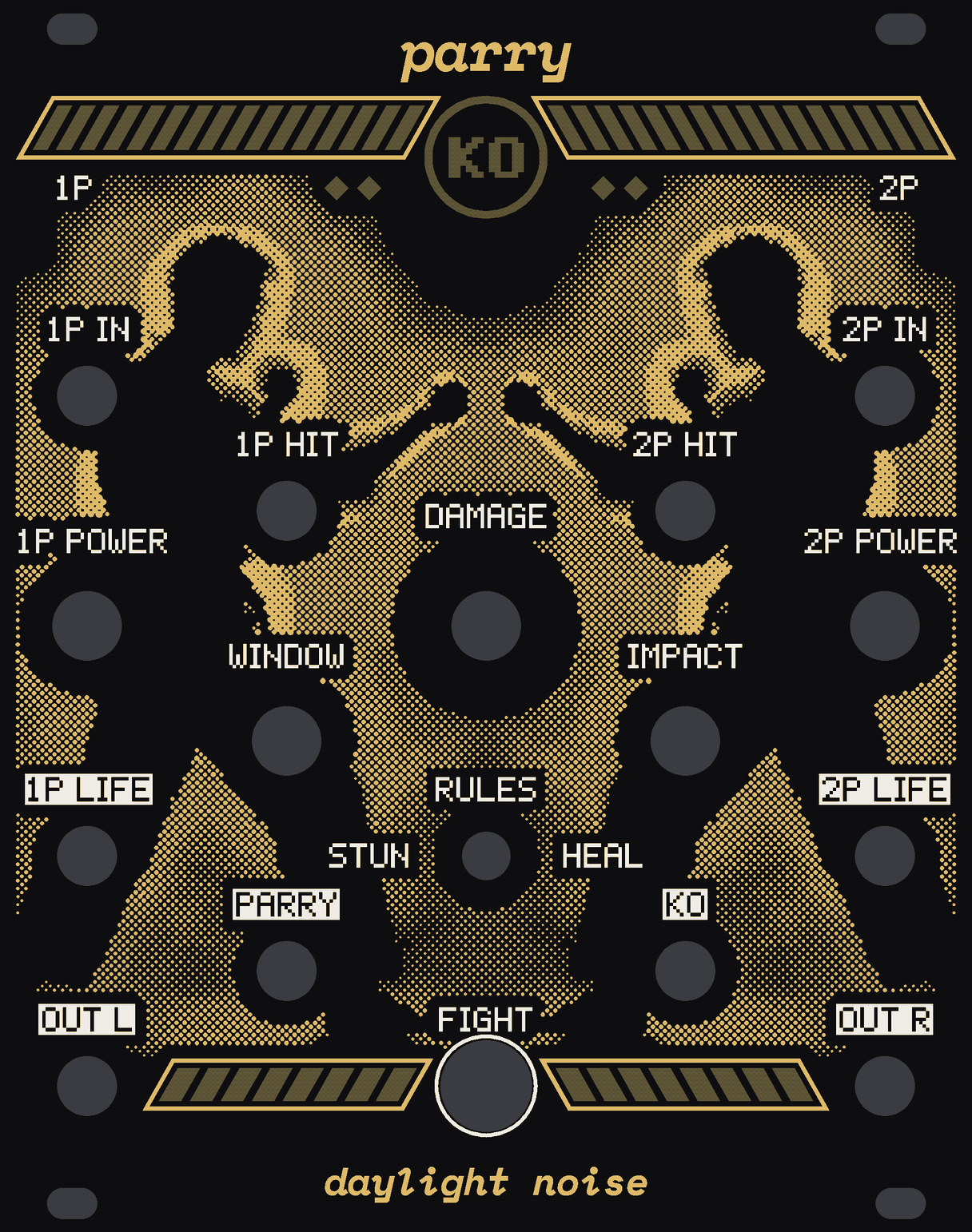
20 HP · two patches fight for the mix
Every rising edge on a HIT gate is an attack. The other side's sound freezes, shakes and loses life, and grows crunchier as it falls. Strike just before the other side and theirs glances off.
Turn a knob: drag it, roll the wheel over it or use the arrow keys; a double click puts it back. Press FIGHT for a new match, and flip RULES between STUN and HEAL.
example patches
The sound and the lights here are PARRY's own engine: the module's firmware, ported to the page and checked against it sample for sample. The drums, the bass, the arpeggio, the pad and the voices are stand-ins for the rest of a rack.
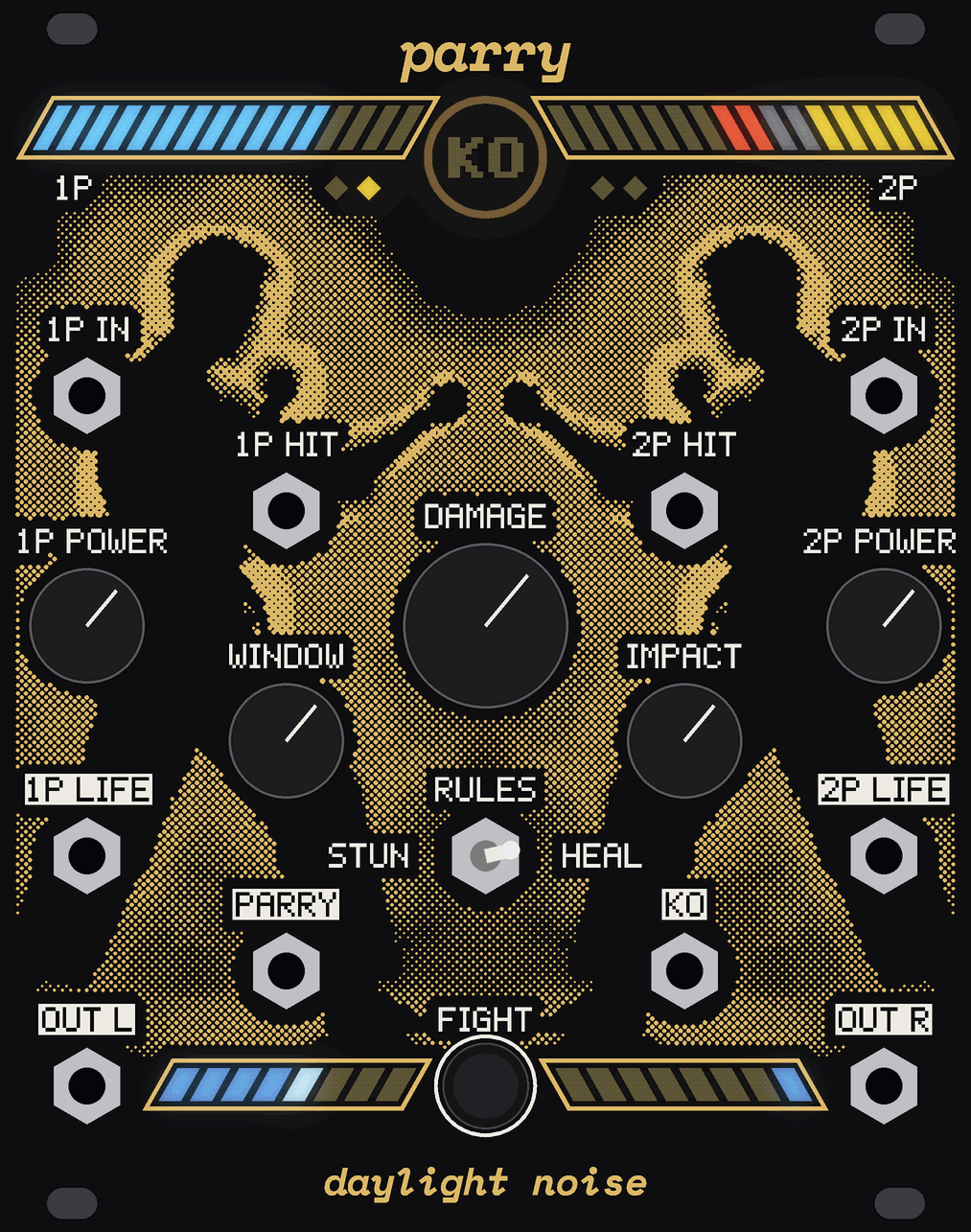
Each side gets a patch and a gate, and the gate's rising edges are its attacks: a kick and snare's triggers, a sequencer's accents, an envelope follower on a voice.
An attack lands at once. The other side's sound freezes for a few frames, the last instant held as it was, shaking, then jumps back to live; it dips and swells back over a tenth of a second; and it loses life, shown red at the end of its bar for a moment. The lower its life, the harder it's driven, the fewer bits it keeps and the quieter it gets.
Two edges within 3 ms of each other, two sequencers on one clock, trade: both land.
If a side's own edge came just before the other side's attack, inside WINDOW, the attack glances off. The attacker freezes instead, longer than a hit. The parrying side's sound rings bright for a moment, a resonance tuned from its own sound; its bar flashes blue, and PARRY fires. An edge that was parried can't parry.
Each parry fills a cell of that side's super meter along the foot. At eight the super fires on its next edge: the whole mix holds still, then a flurry of hits lands on the other side in time with the attacker's rhythm, and one last heavy one.
Life at zero is a KO: KO fires and the badge between the bars lights red. The loser drops out, the winner plays alone a while, and the next round starts on the next edge. Two round wins, the diamonds under the bars, take the match; then the winner plays alone longer, and a new match starts by itself.
Twenty HP, every part on the line's staggered grid and mirrored about the middle. The art is one fighter in a stance, backlit in haze, mirrored to face themselves across the spine, in gold dots on black. The HUD is the panel itself: 54 cells of bare circuit board lit from behind by sixty LEDs. The bars and the meters sit in outlines of bare gold, and a parry flashes the parrying side's bar blue.
One four-layer board sits 10 mm behind the panel, with the jacks, the knobs, RULES, FIGHT and sixty tiny RGB LEDs on its front and everything else on its back. A black printed baffle stands between, a cell under every window, so each cell lights only its own glass. An RP2350 runs the fight 46,875 times a second, both sides at once, and catches every gate's edge by interrupt, so an attack lands on the sample it came in on.
Drag to look around. Lift the panel: the knobs and the nuts go with it, and the baffle stays on the board, its cells lit down to their LEDs.