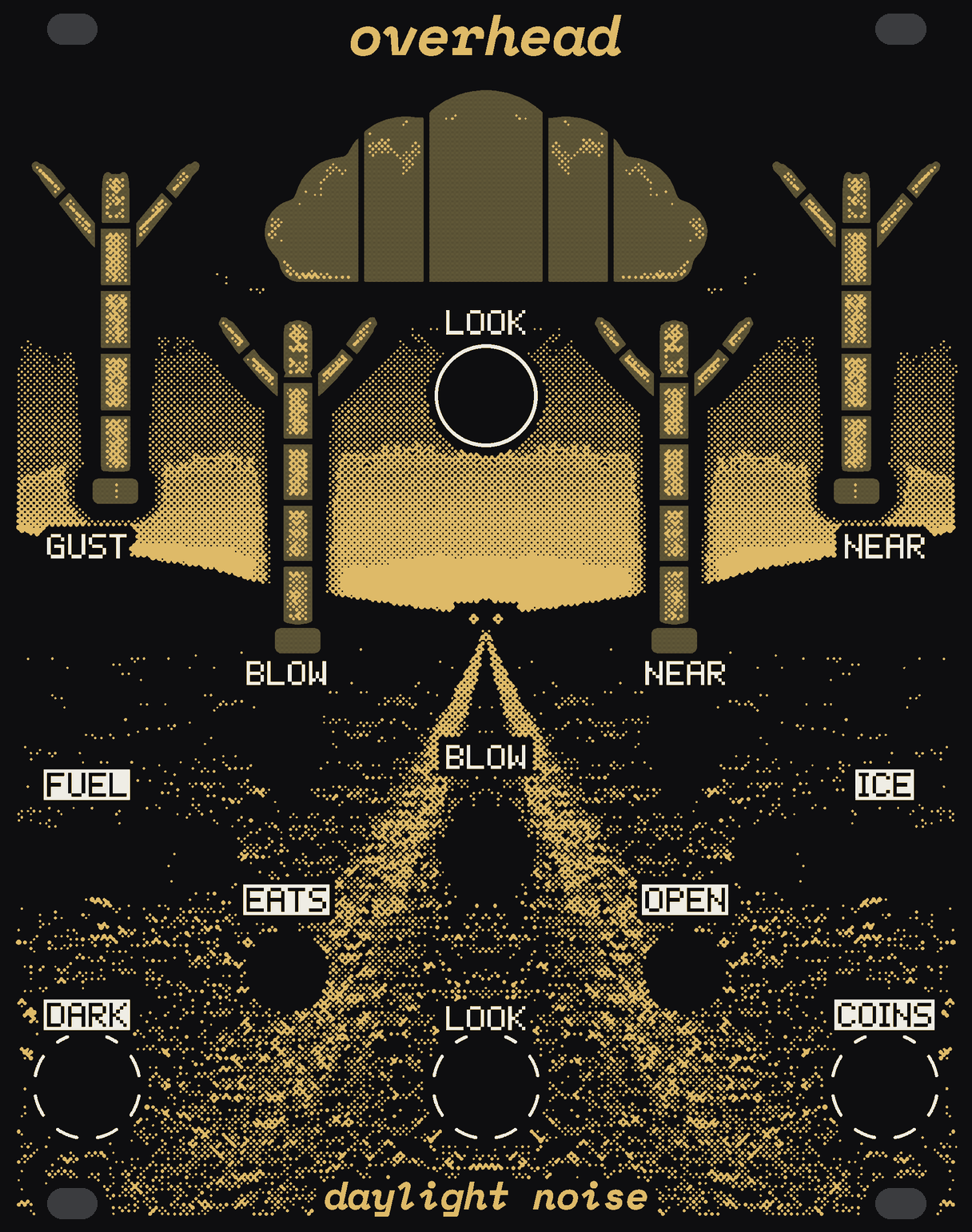
it's still up there
20 HP
Four tube men dance on their fans, each one's height a CV: they stand, fold over and whip back up. Over the lot hangs a cloud that hasn't moved all day. When it comes over, the fans stop one by one, the four sag to the ground, and what it couldn't keep comes down after.
Turn a knob: drag it or tap either side of it, roll the wheel over it or use the arrow keys; a double click puts it back. LOOK is a button: press it to bring the cloud now, or hold it to keep it there. The patches step on by themselves until you touch anything.
example patches
The tube men, the cloud and every out and light here are OVERHEAD's engine, the module's own code, running in your browser. The drums, the bass, the pad and the arpeggio are a stand-in rack.
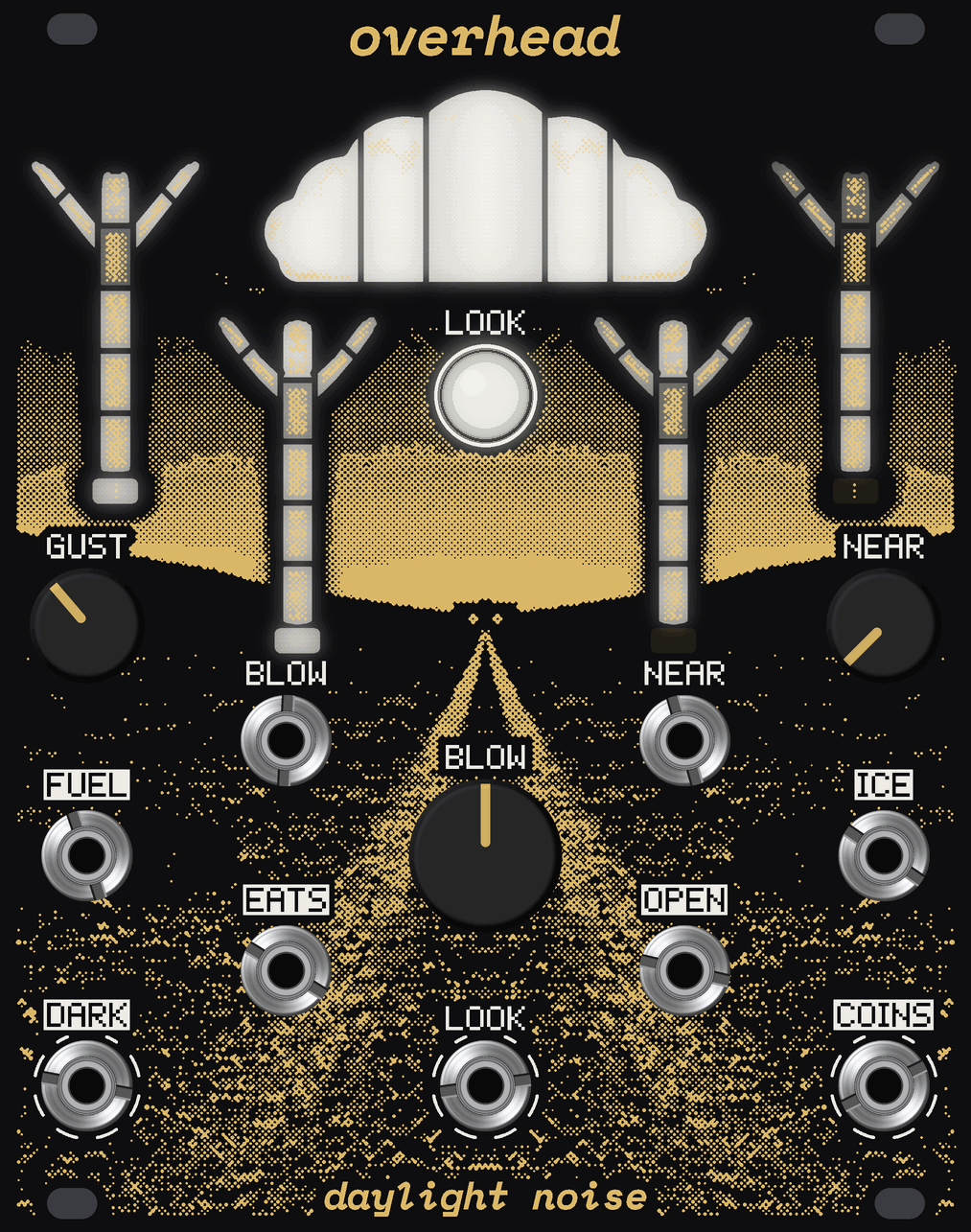
Each is a small model of the real thing: a fabric tube his fan fills. The air pushes him about; bent too far at the waist the tube kinks and he folds over, and the fold chokes his air until the pressure throws him back up. So his CV holds high, drops away and comes back hard: never an LFO, never plain noise.
As it comes over, the air goes still. Then its shadow crosses the lot from one side, stopping each fan a third of a second after the last, and the four sag and fold to the ground in a wave. The dark lasts three seconds with NEAR low and seven with it full; then the fans spin back up and the four rise again.
One board sits 10 mm behind the panel with everything on its front: the jacks, the knobs, LOOK, the 65 LEDs and the whole circuit, the USB-C in a notch in its bottom edge. Each cell of a tube man and each lobe of the cloud has its own chamber in a black printed baffle, lit by its own white LEDs, one LED on each channel of two drivers, so a tube man lights cell by cell as he stands and folds. An RP2350 runs the four of them and the cloud a thousand times a second, in 64-bit floating point.
Drag it or use the arrow keys to turn it; click it to take it apart.