orrery

they line up

20 HP

Six slow LFOs ride the orbits of a brass orrery, each a planet of light going round at its own speed. When three or more come into line with the sun, MEET fires its big gate: the big moment of a slow piece, and you can see it coming.

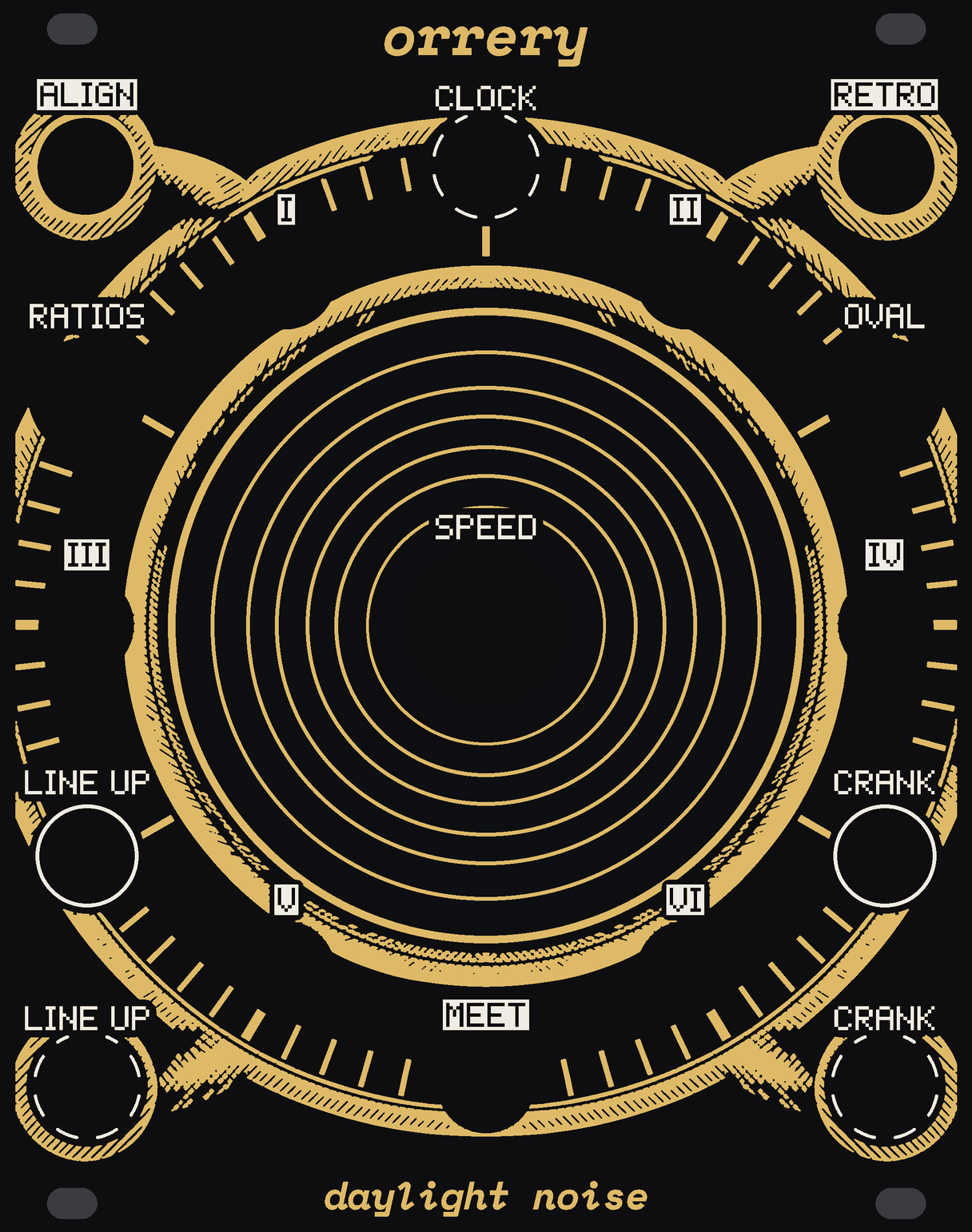
The ORRERY panel, black and gold: a brass orrery seen from straight above, drawn as a bold hand-inked illustration in solid gold, a broad round dial with graduation ticks between two hatched bands, and four curved hatched legs reaching out to the corners, a jack on each foot. Inside the dial a ring of bare glass round the big knob, split into six lanes by five thin gold veins, the planets' orbits, and a thinner ring of glass round the knob for the sun's glow. The twelve parts sit round the dial at the hours, the planets' six outs at one, three, five, seven, nine and eleven o'clock.

Turn a knob: drag it or tap either side of it, roll the wheel over it or use the arrow keys; a double click puts it back. Press LINE UP to bring them all into line; hold CRANK to wind them on. The patches step on until you touch anything.

Synthesised here. ORRERY makes no sound of its own: its outs move the parts of a stand-in rack.

example patches

ORRERY here is its engine as designed, in your browser: it hears only what comes into its jacks. The pulse, the pads, the glass, the drone, the lead and the bell are a stand-in rack.

Six planets

An LFO is a slow wave you patch into something to make it move: a filter opening and closing, a sound drifting left and right. ORRERY has six, and they're one machine: six planets going round a sun, the innermost fastest. Each planet's out is its height on the panel, from +5 V at twelve o'clock to -5 V at six, so each is a slow, smooth wave.

Because they're one machine, their waves keep a fixed family of speeds, and every so often they agree: several planets on one line from the sun. That's the moment ORRERY is for.

They line up

Speed, ratios and ovals

Line up and crank

Retro

From where we stand, the outer planets sometimes seem to stop in the night sky and go backward for a while, as we overtake them. RETRO is that: planet V as seen from planet III, the direction it's in, as a voltage. Most of the time it turns slowly one way; each time III catches V up, it turns back on itself before going on. Patched to a note, it's a tune that hesitates and retraces its steps.

In a rack

Specs

Format

Width
20 HP
Controls
a big knob (SPEED), two knobs (RATIOS, OVAL), two lit buttons (LINE UP, CRANK)
Lights
2 windows on 198 RGB LEDs: the six orbits' ring (192) and the sun's glow (6)
Replaces
a six-channel LFO, a clock divider making a polyrhythm, a gate for builds and a slow envelope
Parts
a demo for now: the line's knobs, jacks and buttons, no board yet

Inputs

CLOCK
gate: a pulse a sixteenth
LINE UP
gate: each rising edge brings all six back into line
CRANK
CV, -5 to +5 V: backward to sixteen times as fast

Outputs

I to VI
each planet's height, ±5 V
MEET
gate: 4 V two planets passing, 8 V three or more in line
ALIGN
CV, 0 to 8 V: how lined up they are
RETRO
CV, ±5 V: planet V as seen from planet III