one of the stars

first light to green land

28 HP

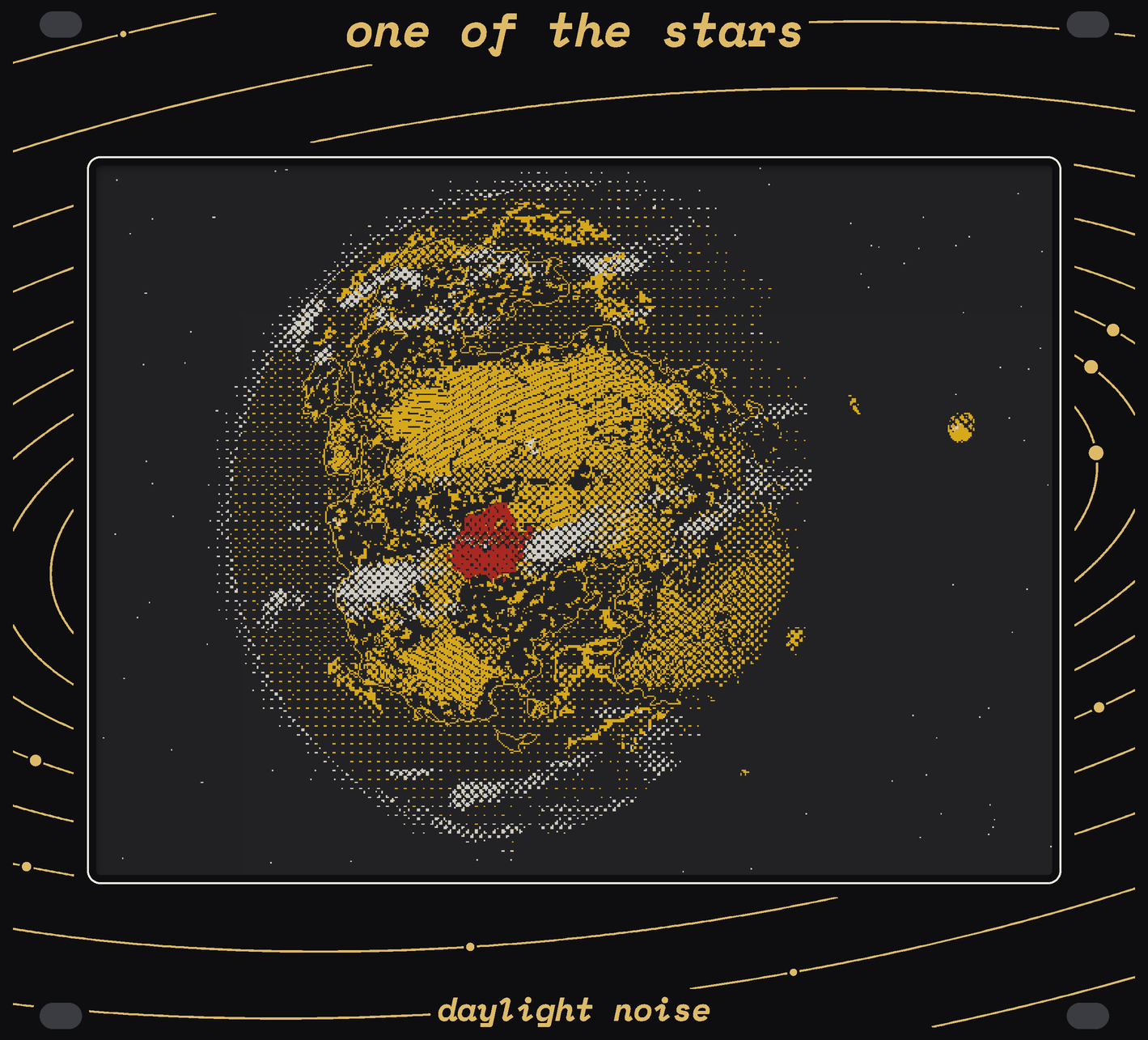
A blank panel with an e-paper window onto a world of its own, from the Big Bang to green land. Each time the rack comes on, time moves on there, drawn in black and yellow and kept with the power off.

The ONE OF THE STARS panel: black, with a wide window in the middle edged by a thin white line, and fine gold ellipses round it, a moon's orbits nested one inside the next, a gold dot on each for the moon, one of the stars in gold over it and daylight noise in gold under it. No jacks, no knobs, no lights.

Switch on and time moves on there, drawn over about twenty seconds. Switch off and the picture stays.

The rack's power. On, ONE OF THE STARS wakes and draws; off, it leaves the picture where it is.

This browser's own ONE OF THE STARS, its world grown and drawn by the module's own code, dot for dot what the module shows, at the screen's own pace. The page's starts somewhere in its story; a module starts at the Big Bang. The module also wants the rack off for three minutes before it moves on again; the page doesn't.

Waking

Switched on, ONE OF THE STARS wakes, moves its world on and draws it. For about twenty seconds the screen flashes its inks over the last picture, then the new one comes up, and it goes back to sleep until the rack is next switched on.

Keeping

E-paper needs no power to hold a picture. Switched off, ONE OF THE STARS keeps the last one it drew, for days, so the rack always shows the picture from the last time it was played. Its world is kept with it, and grows on from there.

The world

It begins with the Big Bang: the window white hot, cooling to gold, then red, then dark. The first stars light up, small galaxies fall together into a spiral, and the picture closes in on one of its arms, then on a cloud where stars are born, where a big star dies and its shock sets the cloud collapsing. A sun is born with a disk round it. In the disk, dust sticks into pebbles and pebbles into rocks, and the rocks crash into each other until only a few planets are left.

Then one last crash. The planet melts, and a ring of its debris gathers into a moon. The planet crusts over, steam closes round it and rains out into seas, and from there, five million years a switch-on, the continents drift, collide and break apart, gathering every few hundred million years into one and splitting again. Ice comes and goes, and twice the whole planet freezes over.

Life starts in a shallow sea, in a single switch-on, as a swirl of colour in the water. It spreads through the shallows, the air fills with oxygen and the seas rust. And at last plants come ashore: the coasts and river mouths darken, and the green climbs the rivers inland until the land is forest, desert and ice.

And it never settles. Every switch-on the continents creep a little further across the planet's face, and over a few dozen they part, cross the oceans and crash together again, their forests turning to desert and back as they drift from one latitude to the next. Ice sheets spread from the poles and pull back, the seas fall and flood the lowlands again, and now and then something big hits: the forests die back and the green climbs back after them. It goes on like that, a living planet, for as long as the module is switched on.

Every ONE OF THE STARS grows its own from the moment it's first switched on: its own galaxy, its own sun, its own planet with its own continents and moon. None of it is our world, and no two are the same. The page's is this browser's own.

The name is from the same book as daylight noise's. In Watership Down, the rabbits' story of how the world began says that Frith made all the stars, “and the world is one of the stars.”
Inside

The ONE OF THE STARS panel with its planet on the screen, in black and yellow.

Drag it or use the arrow keys to turn it; click it to take it apart.

Specs

Format

Width
28 HP
Behind the panel
15.2 mm, to the top of the power header
Power
+12 V only; 10-pin header
Controls
none: nothing to patch

The screen

Screen
5.83" e-paper, four inks: black, white, yellow, red
Pixels
648 × 480, on its side
Picture
about 119 × 88 mm
A new picture
about 20 s
No power
keeps its picture

The rest

The world
grown on the module, from the Big Bang on
A thousand power-ups
from the first light to about now; it never ends
Brain
RP2350
USB-C
for updates