noctiluca

keep it alive

20 HP

A glass vial of living sea cells, the kind that lights a breaking wave at night. Knock on the glass and each cell it reaches flashes blue, and that real flash is your envelope. They tire, they rest, they only do it in their own night, and if you neglect them they die.

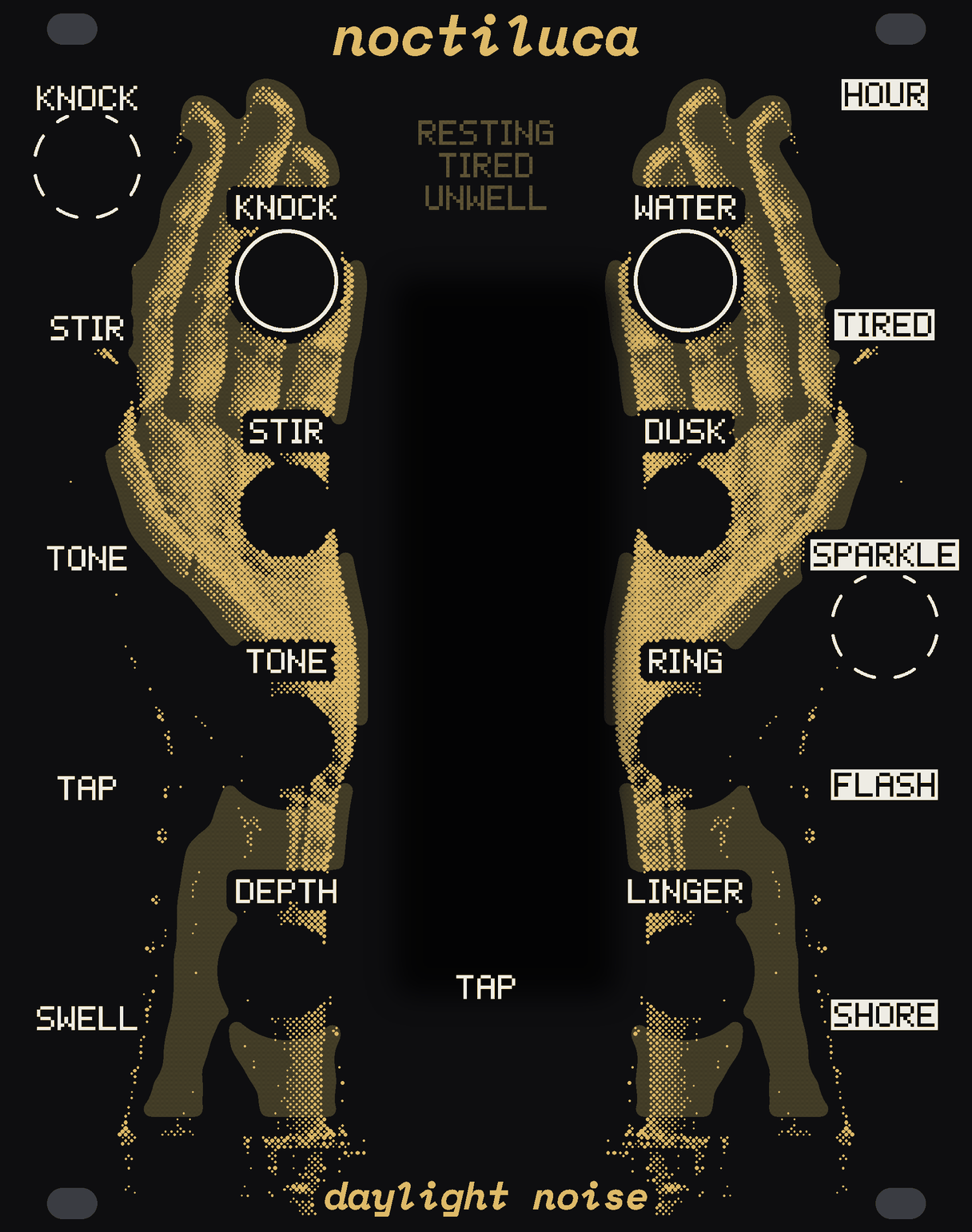
The NOCTILUCA panel: black, with a pair of cupped gold hands rising out of dark water, and between them a tall black pod with a slot in it and a glass vial behind the slot. Across its top KNOCK and WATER buttons; knobs for STIR, TONE, DEPTH, DUSK, RING and LINGER beside the pod and a big TAP knob under it; jacks down both sides: in on the left, KNOCK, STIR, TONE, TAP and SWELL, out on the right, HOUR, TIRED, SPARKLE, FLASH and SHORE.

The glass: tap it and they flash; drag on it to shake it. The ring at the top of the pod turns the sleeve. KNOCK strikes the glass as hard as TAP says. WATER: hold it for a fresh dose. Turn a knob: drag it or tap either side of it, roll the wheel over it or use the arrow keys; a double click puts a knob back. The patches step on by themselves until you touch something.

A slow bass, opened by their flashes, and a bell for each sparkle. Listen plays the patch from its top, and they stay as you left them.

example patches

The real one has living cells in it and a sensor reading their light. A browser hasn't, so a small model of 1,800 cells stands in for them, in a room that's always dark. On this page an hour is a minute, starting an hour after dusk whatever the time is where you are; while you're away they keep real time. It keeps how you left them in this browser, and nothing leaves it.

The flash

The cells are dinoflagellates. Disturb one and it flashes: about a sixtieth of a second after it's touched the light comes up in ten milliseconds, and it's gone in about a fifth of a second. A sensor behind the vial reads that light, and it's what opens the filter. There's no envelope generator in it. Each flash is a real one, and no two are the same. A tired cell's flash is dimmer, and slower both ways.

Keeping them

Nothing else in a rack asks anything of you. A night's light is a budget, and they spend it on what you ask. Flog them today and they're dim tomorrow. Leave them be and they come back. They want cool water, proper dark and a proper day, so the vial stands off the panel in its own pod, out of the case's warmth, with a lamp in it. The vial's only where they work. They live in a flask of seawater on a shelf, and every fortnight or so the vial gets a fresh dose. A culture has moods over weeks, so no two months sound the same.

What their light does

What comes out

Specs

Format

Width
20 HP
Controls
7 knobs, 2 buttons, a sleeve on a ring
Senses
the cells' own light, and how warm they are

Inputs

SWELL
audio, ±5 V
KNOCK
trigger, rising past 1 V
TAP, STIR
CV, ±5 V
TONE
CV, ±5 V

Outputs

SHORE
audio, ±5 V
FLASH, TIRED
CV, 0 to 8 V
HOUR
CV, 0 to 8 V
SPARKLE
trigger, 5 V