muster

the lullaby falls in line

20 HP

A music box plays a little tune it wrote itself. Turn MARCH and a machine joins it, playing the same tune: an iron drum on the beat, a grinding bass, chains and clanking metal, then the tune doubled two octaves down by something huge, until the nursery is an army marching. The tune never changes. What plays it does.

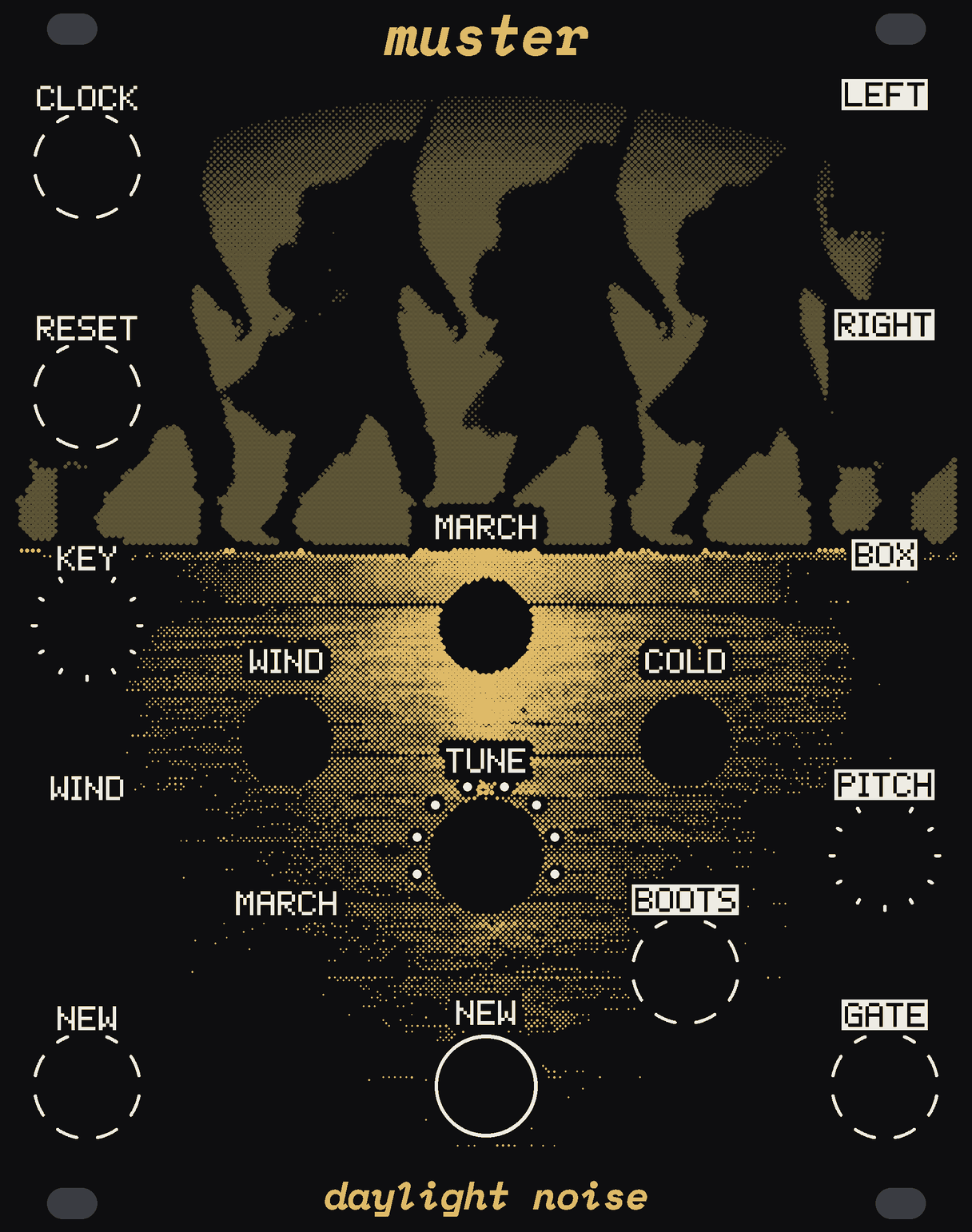
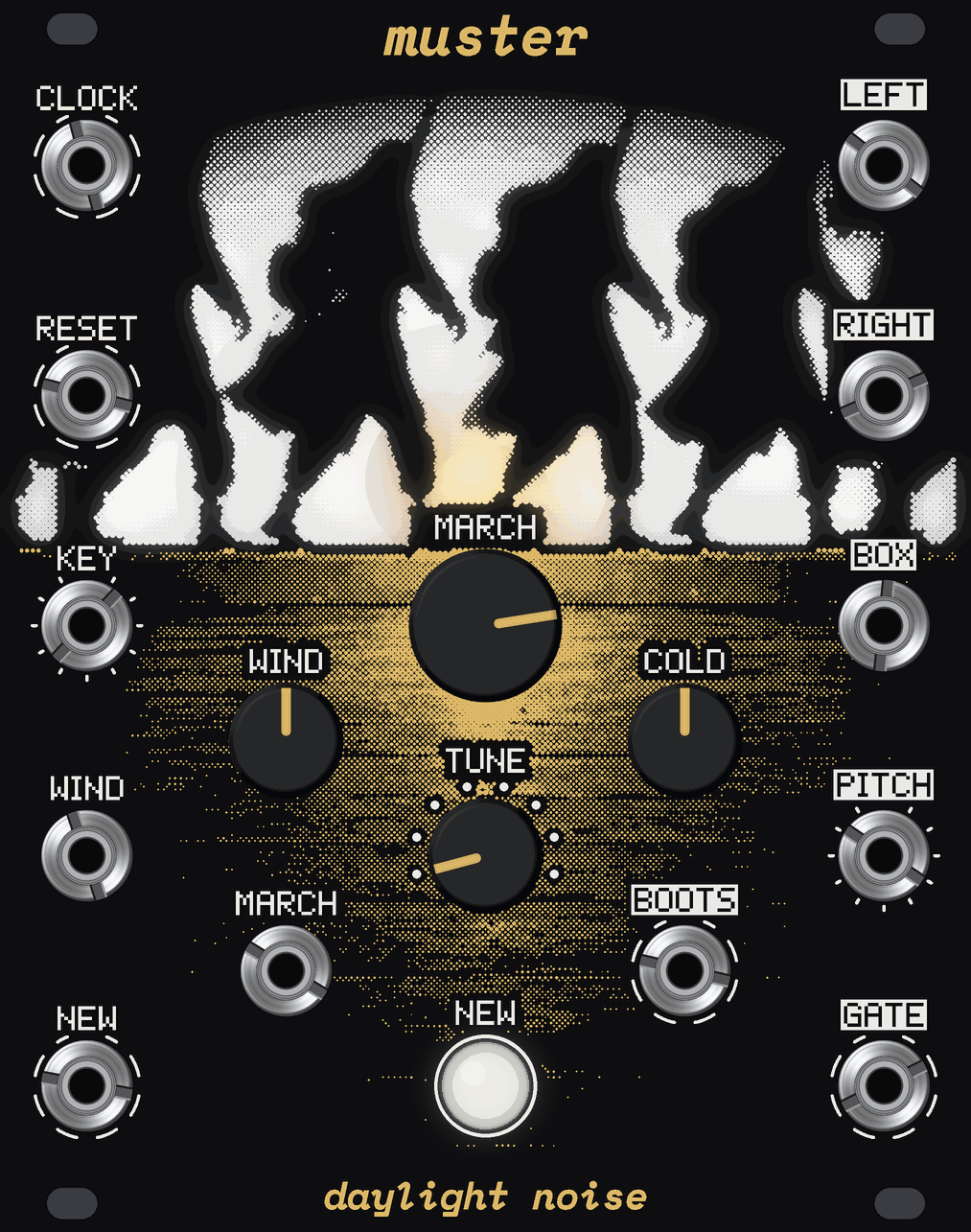
The MUSTER panel: black, and across its top a child's bedroom wall lit low from its foot, as if by a night light just out of sight, the huge black shadows of soldiers marching across it in greatcoats and packs, the light thinning out in a dome above their heads, their boots striding along the skirting; the floorboards below in gold. Jacks down both sides, a big knob under the wall, two knobs, a switch and a button.

Turn a knob: drag it or tap either side of it, roll the wheel over it or use the arrow keys; a double click puts it back. TUNE clicks from stop to stop the same ways. NEW is a button: press it (or Enter) for another tune. The patches step on by themselves until you touch anything.

A lullaby at 88 BPM, or a beginner's loop at 120, and the box.

example patches

Everything MUSTER does here is its engine as designed, running in your browser: the tunes it writes, the box and its spring, the machine, the room. The lullaby round it (a bass, brushed toms, a triangle, a celesta, an organ) and the beginner's loop are a stand-in rack.
A sweet tune in the wrong place

One of the oldest tricks in a horror film is a child's tune over something terrible: a music box, a few notes, played while the worst thing happens. On its own the tune is just sweet. What chills is the gap between it and what's around it: the tune is small and can't protect anyone, and the thing beneath it doesn't care. Turn that gap into a knob and you have this module.

MUSTER starts as a music box playing a tune of its own. Fully left on MARCH, that's all you hear, in a small room. Turn MARCH up and a machine joins in, a part at a time, every part playing the same tune or keeping its time, until the little box is leading an army. Every place on the way is somewhere to leave it, and turning it slowly from left to full is a whole build on its own.

The tune

The box

The machine

What comes out

Inside

The MUSTER panel lit: a child's bedroom wall at night, warm at its foot as if from a night light just out of sight, the huge shadows of soldiers marching across it in their boots, the light cold and climbing almost to the ceiling; its knobs, its switch, its lit button and its jacks.

Drag it or use the arrow keys to turn it; click it to take it apart.

Specs

Format

Width
20 HP
Depth
20.8 mm behind the panel, the power header's shroud included
+12 V
about 70 mA with the wall dark, about 290 mA with it at its cap (on paper, not yet measured)
−12 V
about 6 mA
+5 V
not used; 10-pin header
Controls
a big knob, two knobs, an eight-stop switch, a lit button
Light
the wall: 70 RGB LEDs behind bare FR4, 100 frames a second, held to 450 mA
Build
348 SMD parts, all on the board's front; 19 fitted by hand (the jacks, the pots, the switch, the button and two headers)

Inputs

CLOCK, RESET
gates, rising past about 0.9 V: a pulse a sixteenth; the tune's top. Nothing in CLOCK: the box is its own clock, 100 BPM
KEY
1 V an octave, 0 V on C, ±6 V, calibrated over USB
MARCH, WIND
CVs, added to their knobs, 5 V the whole turn, ±6 V
NEW
gate: a new tune, as its button

Outputs

LEFT, RIGHT
audio, under an 8 V ceiling
BOX
audio, the box alone, dry
PITCH
1 V an octave, 0 V on C3 at home, calibrated over USB
GATE, BOOTS
gate, 5 V; trigger, 5 V

Engine

Brain
RP2350 at 153.6 MHz, both cores
Converters
two PCM5102As out, 48 kHz; a DAC8563 for PITCH; an ADS131M04 for KEY and the CVs
Timing
every jack on one sample clock: a clock in to a note out in 2 ms, to the sample
Firmware
the same engine as this page's, to the bit; over USB-C