muscle memory

it remembers your hands

20 HP

Hold LEARN and turn its knobs the way you'd ride a filter or an echo. Let go, and it keeps doing what your hands did, round and round, in time, on four jacks. Four more hands that never get tired.

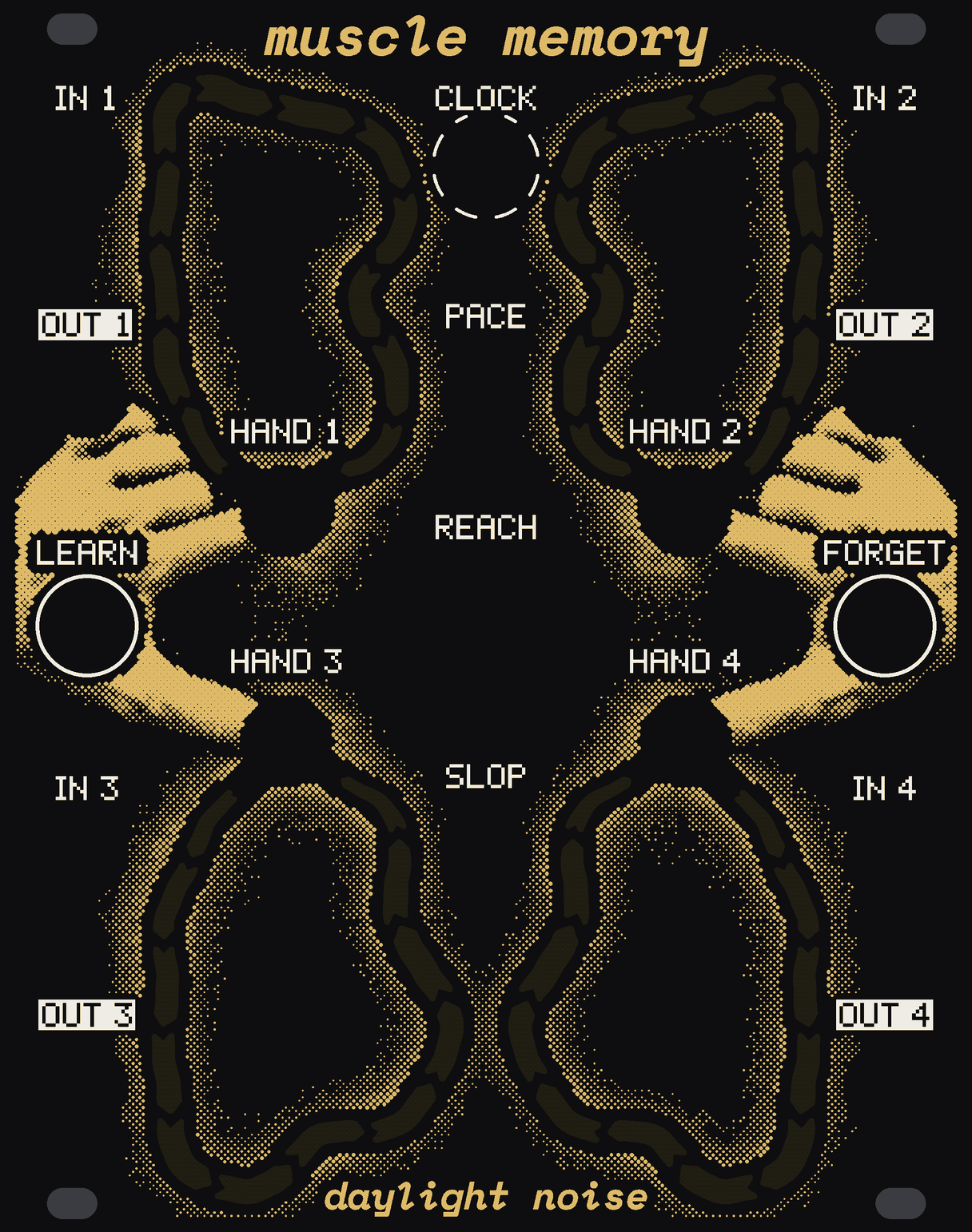
The MUSCLE MEMORY panel, black and gold: a long-exposure photograph of two real hands on a dark workbench. One comes in from each side edge, palm down and spread, the forefinger reaching to an upper knob and the thumb to a lower one, the other fingers curled. From each of those four fingertips a thin, wavering trail of light loops out and back: two above the hands, two below, mirrored left and right, each a chain of twelve glass dashes pointed the way the fingertip went. The trails are bare glass for light; the hands are gold, and so is the wood's grain where each trail lights it, a soft gold glow along both sides of every trail fading to black, the middle of each loop dark. REACH, the big knob, is in the middle with the four HAND knobs at its corners under the fingertips; PACE and SLOP sit above and below it; CLOCK is at the top; LEARN and FORGET, two lit buttons, sit on the backs of the hands at the two edges; each hand's IN and OUT jacks are beside its trails.

Turn a knob: drag it or tap either side of it, roll the wheel over it or use the arrow keys; a double click puts it back. Tap LEARN, turn a HAND knob, tap LEARN again: that hand keeps going. Tap FORGET and turn a HAND knob to wipe it. The patches step on by themselves until you touch anything.

Synthesised here. MUSCLE MEMORY makes no sound: you're hearing a stand-in rack with the module's four OUTs turning its knobs.

example patches

Everything MUSCLE MEMORY does here is its engine as designed, in your browser: the takes, the timing, the four voltages. The acid line, the drums, the pad, the echo and the beeps are a stand-in rack.

One cable, one more hand

Every patch needs something to move: a filter opening, an echo thrown, a level riding up. Your hands can do it, but you only have two, and an LFO sounds like an LFO.

Patch OUT 1 to anything with a voltage in. Hold LEARN and turn HAND 1 the way you'd turn that thing's own knob. Let go. The knob stops and the movement doesn't: it goes round and round, exactly as you did it, for as long as you held LEARN. There are four of them.

What it keeps

In time

Reach, leaning and slop

Four attenuverters

Forget

In a rack

Specs

Format

Width
20 HP
Controls
a big knob (REACH), six knobs (HAND 1, HAND 2, HAND 3, HAND 4, PACE, SLOP), two lit buttons (LEARN, FORGET)
Lights
48 cells: four loops of twelve
Replaces
four LFOs, a voltage recorder and four attenuverters
Parts
a demo for now: the line's knobs, jacks and buttons, no board yet

Inputs

CLOCK
clock, a pulse every sixteenth: takes are whole beats and stay on them
IN 1
a voltage or a sound for hand 1 to scale, up to ±10 V
IN 2
the same for hand 2
IN 3
the same for hand 3
IN 4
the same for hand 4

Outputs

OUT 1
hand 1: -5 to +5 V, or IN 1 times the hand
OUT 2
hand 2
OUT 3
hand 3
OUT 4
hand 4