moth

it does its sums out loud

20 HP

Eight real relays do your logic with little metal arms, so every gate clicks in your case, and a piezo hands you the clatter as a drum machine playing whatever the logic is doing. There's a real moth on a wire over them. Drag it along and each relay throws as it passes; leave it and that one's stuck.

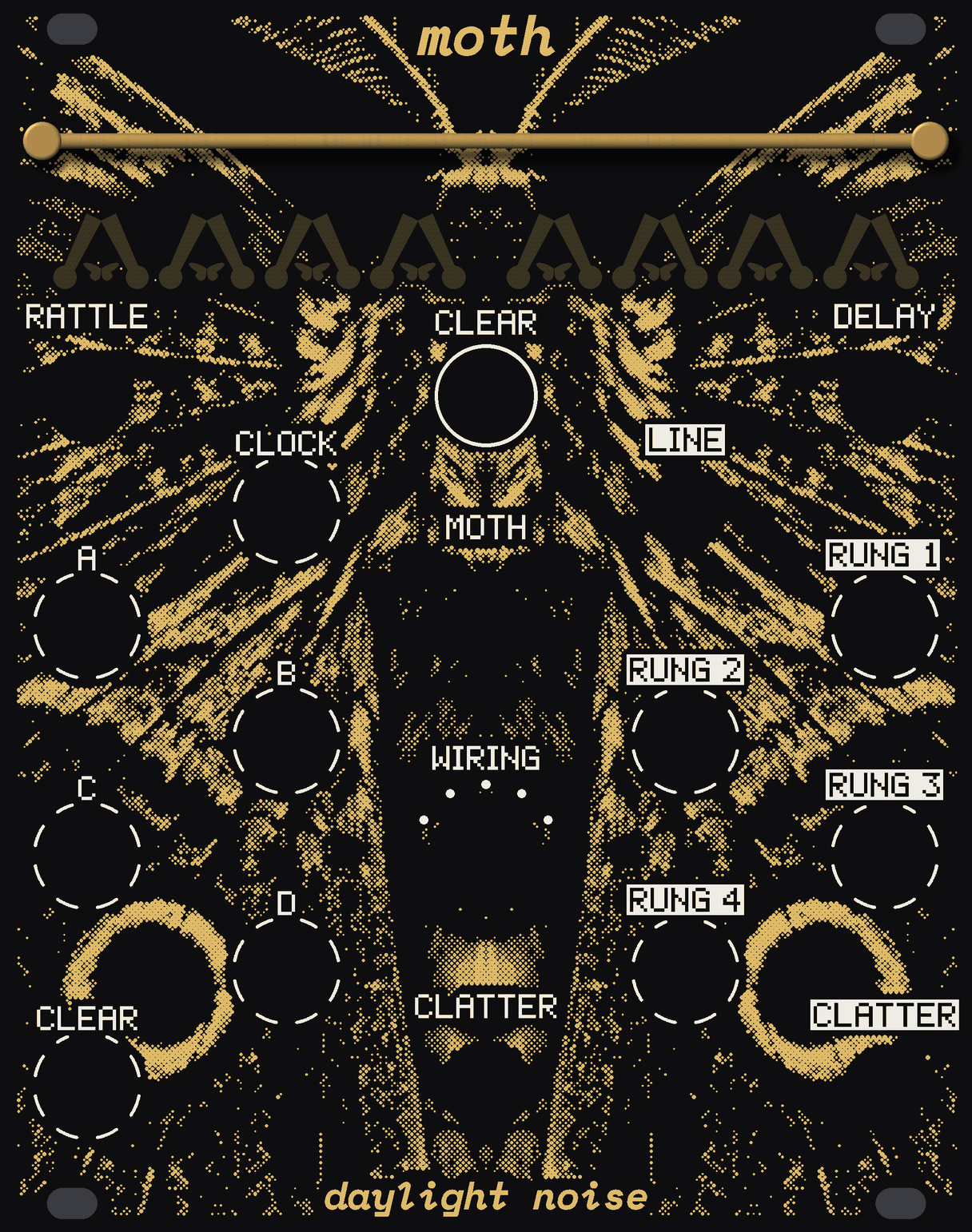
The MOTH panel: black, with a huge gold moth from above, its wings off the panel's edges. At the top a brass wire over a row of eight contacts. Four knobs, MOTH, RATTLE, DELAY and CLATTER, a switch, WIRING, a button, CLEAR, and twelve jacks.

Drag the moth along its wire, or tap either side of it, or use the arrow keys. Turn a knob: drag it or tap either side of it, roll the wheel over it or use the arrow keys; a double click puts a knob back. The patches step on by themselves until you touch something.

A kick, a snare, a hat and a bass on the rungs at 112 BPM, the clatter straight to the speakers. Listen plays the patch from its top.

example patches

Everything MOTH does here is its engine as designed, running in your browser, the relays, the case and the moth included. The drums and the bass are a stand-in rack.

Eight relays

The left four listen and the right four answer. Each of the eight is a real contact that really moves and really carries the signal, so the gates that come out have real bounce on them, and they arrive a few milliseconds late. Under each relay a pair of lit legs shows you which way its arm is thrown.

The module reads its own contacts, not what it told them to do, so a relay that doesn't move is wrong for everything after it. An empty input takes the relay to its left. With A empty the row comes round into a ring, and whatever's in it keeps going.

The clatter

A piezo on the board hears every landing. Each relay sounds a little different, the near ones low and the far ones dry, so the row is a small kit, and it plays whatever your logic is doing.

The moth

The one on the wire is real: there's a magnet in it. Each relay it passes throws, with no signal at all, and you feel it tug at each one. Let go and it settles. At home on the spine it's over nothing; anywhere else that relay can't let go, and it stays that way until you move it. A quick dab writes a bit into the ring.

Four ways

WIRING's last stop is an honest sequential switch. A to D take anything, audio or CV, and one at a time goes through a real contact to LINE, galvanically clean, with the small tick of a relay on each step. LINE is a wire, so it works backwards too: send one signal into it and A to D take turns. With a moth on one of them, two share the line.

What comes out

Specs

Format

Width
20 HP
Controls
a moth on a wire, 4 knobs, a 5-stop switch, a button

Inputs

A to D
A, B, C, D: gates, rising past 1 V; on the last stop, anything
CLOCK
gate, rising past 1 V
CLEAR
gate, rising past 1 V

Outputs

RUNG 1 to 4
RUNG 1, RUNG 2, RUNG 3, RUNG 4: gates, 5 V, through real contacts
LINE
a wire, through real contacts
CLATTER
audio, ±5 V