maw

gives your synth a mouth

20 HP

A filter with a throat: whatever you patch in becomes its voice. Open its jaw and it says ah. Turn TALK and it mouths in time by itself. Patch a voice into SAY and your synth says the words.

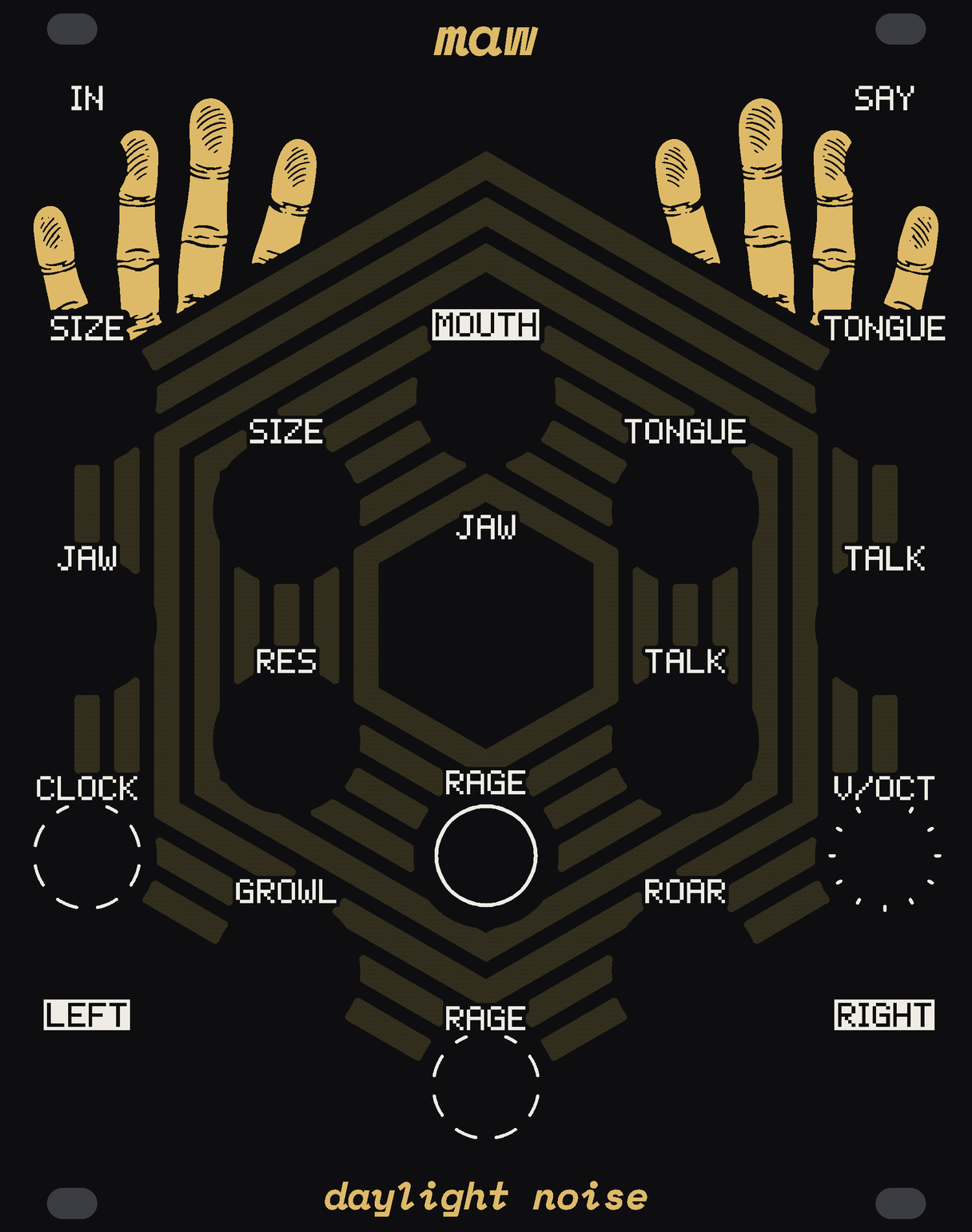
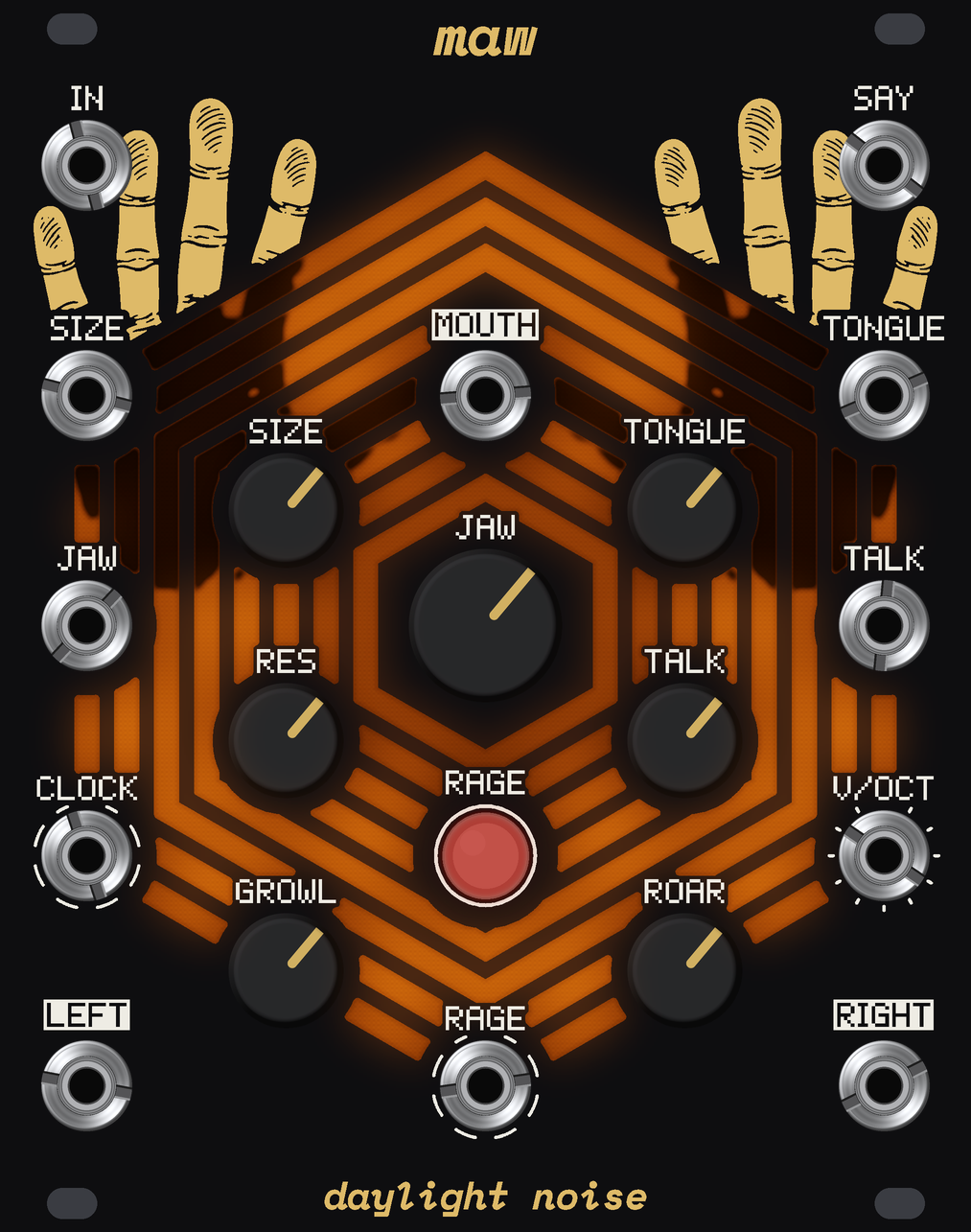
The MAW panel: black, eight nested hexagonal rings of bare glass round the big JAW knob, lit amber; the innermost runs whole round JAW, the outer ones broken round the knobs and jacks. Above the rings, the fingers of two hands pressed flat against the glass from behind, inked on solid gold, whorls on their tips, their palms a dark shadow in the light. White labels: IN and SAY in the top corners, SIZE and TONGUE twice (a jack, then its knob), MOUTH over JAW, JAW and TALK jacks either side of it, RES and TALK knobs under them, CLOCK and V/OCT down the sides, the lit RAGE button under JAW with its jack below, GROWL and ROAR, and LEFT and RIGHT in the bottom corners. maw at the top, daylight noise at the bottom.

Turn a knob: drag it or tap either side of it, roll the wheel over it or use the arrow keys; a double click puts it back. Hold RAGE and it gets out.

Your file goes

Pick a sound file, or drop one here. Its first minute plays through the module with every knob yours. It's opened in your browser and never leaves your computer. Talk to it puts your microphone into SAY, here only: wear headphones, or it hears itself.

example patches

The module's own engine, running in your browser: the throat, its talking, the growl and the rings' light, written as the firmware would be. The band around it is a stand-in rack, and the spoken lines are the module's own.
A filter first

Everything you patch into IN comes out through a throat: a voice box, a tongue, a jaw and lips. With TALK at zero it does what your hands say, and it's a good plain filter. Shut, it's dark and muffled, a closed-mouth mm. Open the jaw and the sound gets brighter and says ah. In between it says the vowels in between.

It talks

Turn TALK up and it starts mouthing by itself, in time. A bass line says wow, yoi, yeah and rawr; a pad starts talking; drums talk. It makes up a little riff of mouth moves, plays it a few times so it sounds like a part, and then makes up another. It never says a word: there's no speech in it, only a mouth opening and closing.

Say it

Patch a voice into SAY: a microphone through a preamp, a sampler, a spoken loop. The throat takes that voice's mouth, moment by moment, and whatever is in IN says the words. It's the old talkbox, with no tube in your mouth. TALK sets how much of the voice's mouth it takes, so at noon it's half yours and half the voice's.

It follows the voice's shape, not its loudness: a quiet voice and a loud one say the same thing. A bright, buzzy sound in IN (a saw, a full pad) says the words clearly; a soft sine can only mumble.

Cat to giant

Growl, roar, rage

Its own voice

With nothing in IN, it isn't silent: it has a voice box of its own, a buzzing like a throat's, tuned by V/OCT (a volt an octave). One cable out is a monster that talks: play it a slow sequence, turn SIZE to a giant and GROWL past noon, and the floor growls along. With nothing in SAY either, TALK makes it babble by itself.

What comes out

What it can't do

Inside

The MAW panel talking: two gold hands pressed against the glass, its rings lit amber round the big JAW knob.

Drag it or use the arrow keys to turn it; click it to take it apart.

Specs

Format

Width
20 HP
Depth
20.6 mm behind the panel
+12 V
about 110 mA dark, 185 to 235 mA playing, 300 mA at the most, the lights held to their cap (estimated)
−12 V
about 5 mA (estimated)
+5 V
not used
Controls
seven knobs (JAW the big one, SIZE, TONGUE, RES, TALK, GROWL, ROAR), one lit button (RAGE, its light red)
Light
90 RGB LEDs under the throat's eight rings of glass
Replaces
a vowel filter, a talkbox or vocoder, the LFOs or sequencer you'd need to make a filter talk, and a distortion

Inputs

IN
audio to ±10 V: the sound it gives a voice to (nothing in it: its own voice box)
SAY
audio to ±10 V: a voice whose mouth it takes (nothing in it: its own babble)
JAW, TONGUE, SIZE, TALK
CV, −5 to +5 V, added to the knob: 1 V a fifth of its turn
CLOCK
gate, high past about 1 V: the beat its talking lands on (nothing in it: IN's own notes)
V/OCT
−2 to +8 V, 1 V an octave: its own voice's pitch
RAGE
gate: while it's high, it gets out

Outputs

LEFT
audio to 10 V: with nothing in RIGHT, the whole voice
RIGHT
audio to 10 V
MOUTH
CV, 0 to 8 V: how open its mouth is right now

Engine

Brain
RP2350 at 240 MHz on both cores, 46.875 kHz: this page's engine, the same to the last bit
Memory
146 KB of the chip's own for the engine; nothing kept through power-off
Updates
over USB, the panel left on