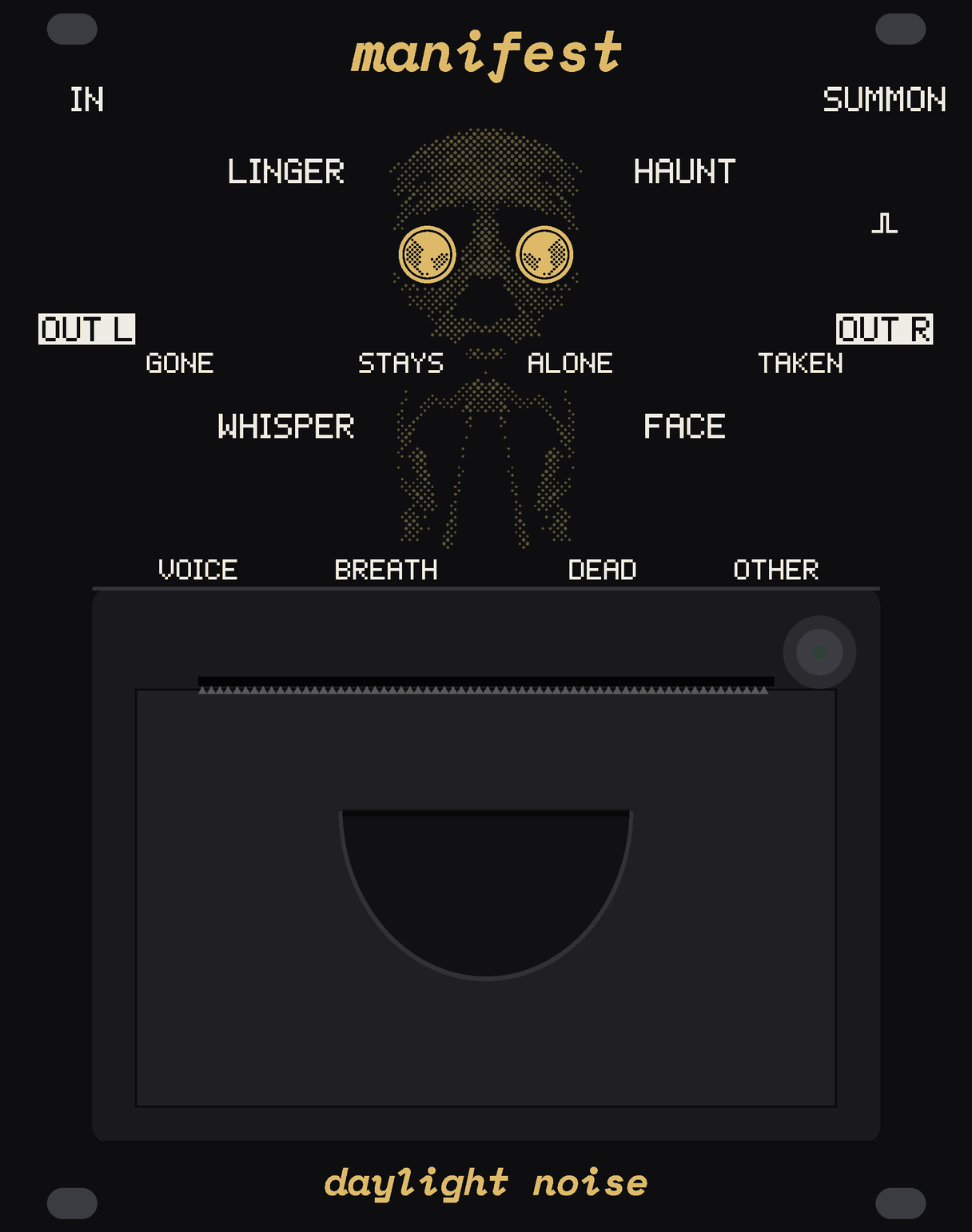
20 HP · the ghost of what left, printed
A spirit photograph of the sound.
Turn a knob: drag it, roll the wheel over it or use the arrow keys; a double click puts it back. Hold SUMMON down to call her, press FEED on the printer for blank paper, and pull the paper down (or click it) to tear it off.
example patches
The sound, the paper and the light here are MANIFEST's own firmware running in your browser, bit for bit: what it hears, when she comes, the ghost it sends back, every dot it prints and every LED behind her face. The drums, the bass, the pad, the lead and the voices are stand-ins for the rest of a rack.
MANIFEST listens to IN and keeps track of what's been playing, in twelve bands from 60 Hz to 11 kHz. A part counts once it's played for three seconds. When it stops (the drums drop out for a breakdown, a voice finishes its line, a cable's pulled), she comes, about a second after its last sound. A part that's always left gaps of its own (a pluck every few seconds) has to be gone longer than its gaps.
She's made of what's missing and nothing else. MANIFEST keeps the last five seconds of IN, and she plays back the two seconds before the part left, slowed down, through only the bands that went quiet: if a voice stops and the pad under it plays on, the pad stays out of her. If the part returns while she's there, she goes.
A loop that keeps going never brings her. Neither does a chord change, a filter closing or a slow fade: she only comes when something stops.
OUT L and OUT R send her back, wide across the stereo, with none of the dry sound in them, and they're silent until she comes. The rest of your case carries the dry sound.
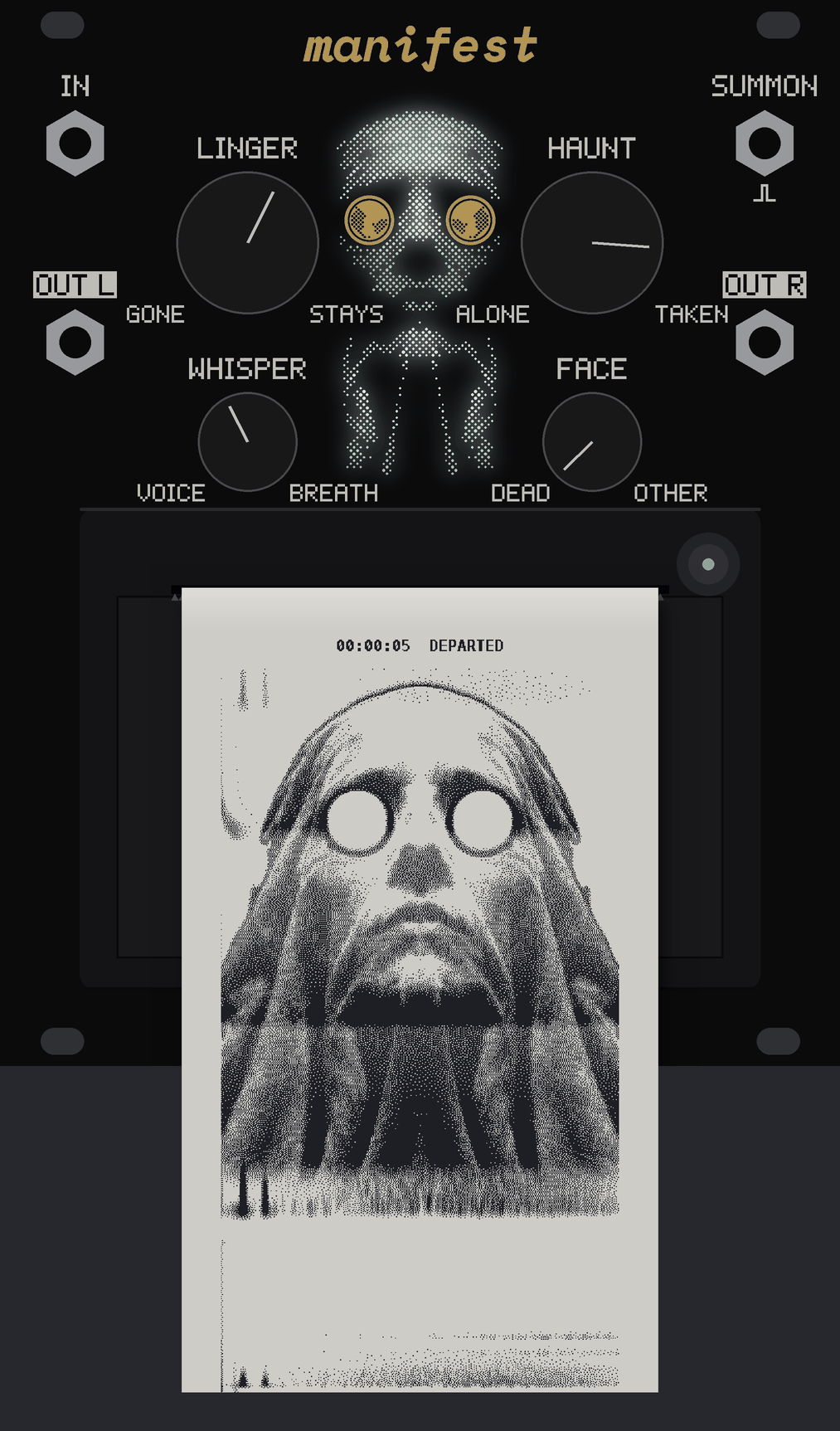
HAUNT sings a face into the ghost's spectrum, one line of the picture for each line of paper, across the same bands the printer prints. So she's in the sound, a hiss with a shape, and the printer draws her back out.
Her face rises a quarter of a second after the ghost, chin first, 64 mm tall, once each time she comes. On the panel, her face lights while she's here, rising out of the printer.
A 58 mm thermal receipt printer fills the bottom half of the panel, and it only runs when she comes. Then it prints one plate: the spectrogram of IN and the ghost together, a line of 384 dots about every 11 ms, the lowest sounds on the left from 60 Hz and the highest on the right up to 11 kHz. Loud is black. It starts from just before the part left, catches up, and prints on while she sings until her face is out. Then it captions the plate with the time and DEPARTED, and feeds it out past the teeth.
It prints upside down, so the plate hangs the right way up: the caption, her face, and under her chin the moment it left. A plate is about 11 cm, and a song brings a few. The printer's own FEED key feeds blank paper, and the paper tears off at the teeth.
SUMMON is a gate in. When it rises she comes at once, made of everything she's heard in the last two seconds, whether anything has left or not, and the plate is captioned SUMMONED. While the gate's high she doesn't leave: she waits on one moment, breathing, as the sound moves on underneath. When it falls she fades and is gone. Held while she's there for something that left, it holds her too.
Twenty HP, every part on the line's staggered grid and mirrored about the middle. Down the spine is a face under a burial sheet, with a gold coin on the sheet over each eye. The coins are gold. Her face is a screen of bare board dots, faint until she comes; then it lights a pale green-white from behind, rising out of the printer, and the coins go dark in the glow.
The printer clips into the panel and comes off with it. Behind the panel the main board sits over the printer's body, and on the board a black light box surrounds her face, fifteen LEDs at its foot. One RP2350 does it all: one core listens and plays, the other works out the ghost, her face and every line of paper.
Drag to look around.