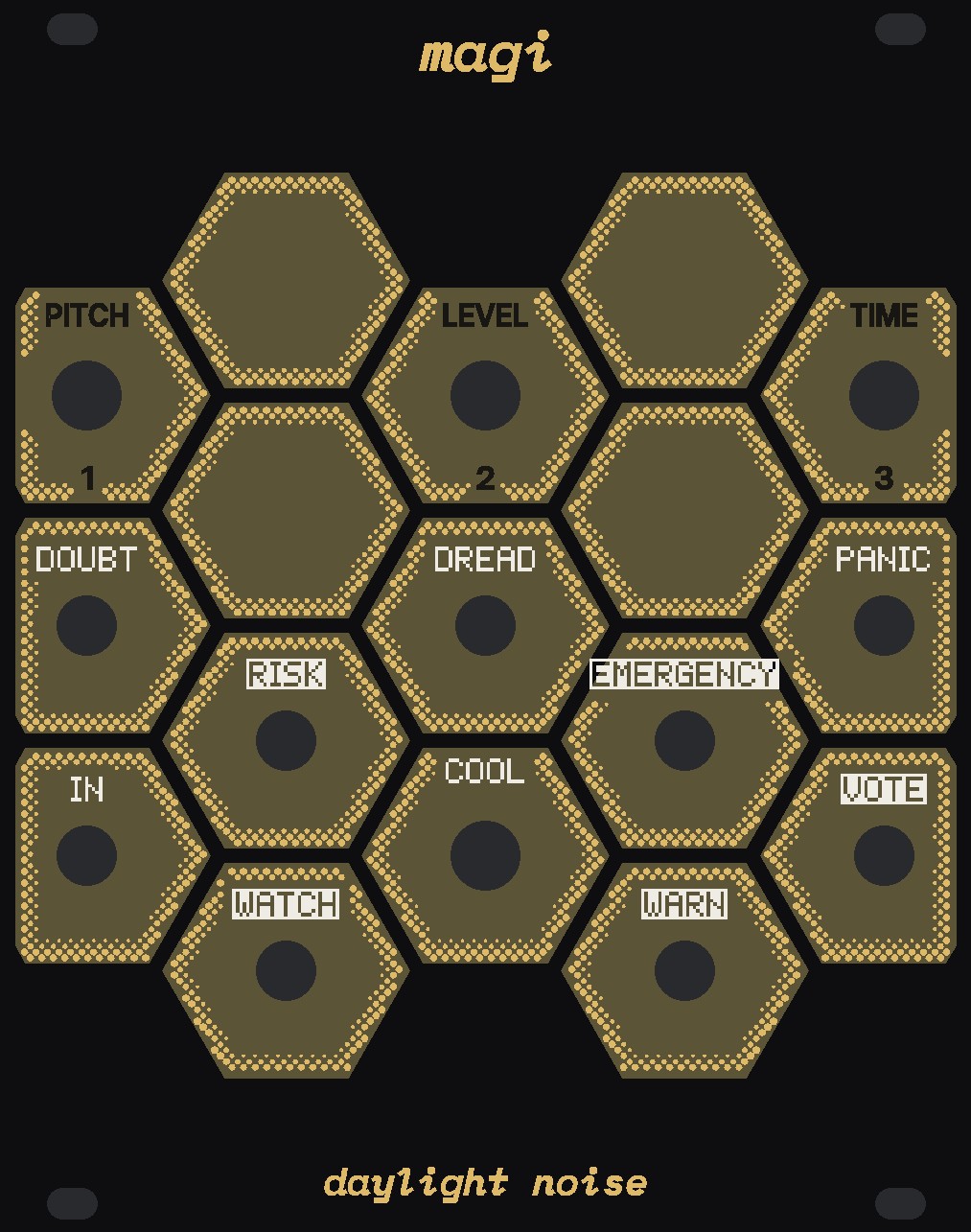
20 HP · three judges that vote
Three brains listen to one input, each for its own kind of surprise: a note that doesn't belong, a sudden jump in loudness, a beat out of place. On every note they vote. When two of them agree, the alarm climbs: WATCH, WARN, EMERGENCY. The panel is the screen: every tile is a window of bare circuit board, lit from behind.
Turn a knob: drag it, roll the wheel over it or use the arrow keys; a double click puts it back. PITCH, LEVEL and TIME make each brain easier to surprise; COOL sets how fast the alarm calms down (20 s from the top).
each brain's surprise at the last note; the tick is its threshold
the last sixteen notes, by how many brains agreed
example patches
The module's own engine, running in your browser: the firmware's three brains, the vote and the alarm, ported from its C and checked against it bit for bit, judging an input synthesised in the page.
Every event in IN is a note: an onset in audio, or a CV settling on a new value. Each brain keeps its own idea of what's normal, learnt from what it has heard, and scores how surprising the new note is. It votes when the surprise beats its threshold: its knob, plus its CV.
A note that doesn't belong. It learns which notes the line keeps to and the register it stays in; a note it has hardly heard, or a leap far out of the range, surprises it. Drums and noise get no opinion.
DOUBT → PITCH
A sudden jump in loudness. It knows how loud the notes usually are and how much they vary; a note that jumps well past that, by 12 dB and more, surprises it fully. For a CV, it's the size of the step.
DREAD → LEVEL
A beat out of place. It follows the beat from the gaps between notes and learns where in the beat notes land; a note somewhere they never do surprises it, however loud or in tune it is.
PANIC → TIME
A brain on its own only glows. When two agree, VOTE fires a trigger and the alarm jumps; when all three do, it jumps further. It climbs through three stages, each with its own gate out: WATCH, WARN and EMERGENCY, each high while the alarm is at or above it, and each slower to let go than to catch, so it doesn't chatter at the edge. RISK is the alarm itself, 0 to 8 V. COOL sets how fast it calms down when nothing surprises it, from a minute to a second.
Turned fully anticlockwise, a brain never votes, so two brains can run the alarm on their own. Turned right up, it votes on almost anything. Patch a sequencer into IN and an LFO into PANIC, and the module grows nervous about timing as the LFO rises.
There's no display. The panel is a circuit board, and every tile of its honeycomb is a window: no copper and no solder mask on either side, just the glass-cloth board, which glows when the LEDs behind it light. Between the tiles the copper stays on both faces under black mask, so a lit tile can't leak into its neighbour through the board. The screen's EMERGENCY is printed on the back of the board, black: unlit, it's black on black behind the glass and you can't see it; lit, it stands in the light's way. The brains' names are black on the front.
Each part sits at the centre of its own tile, and its tile shows its signal: the brains' knobs glow with their suspicion and flash when they vote, the inputs with their level, the gates when they're high. The screen's own tiles light one after another as RISK rises.
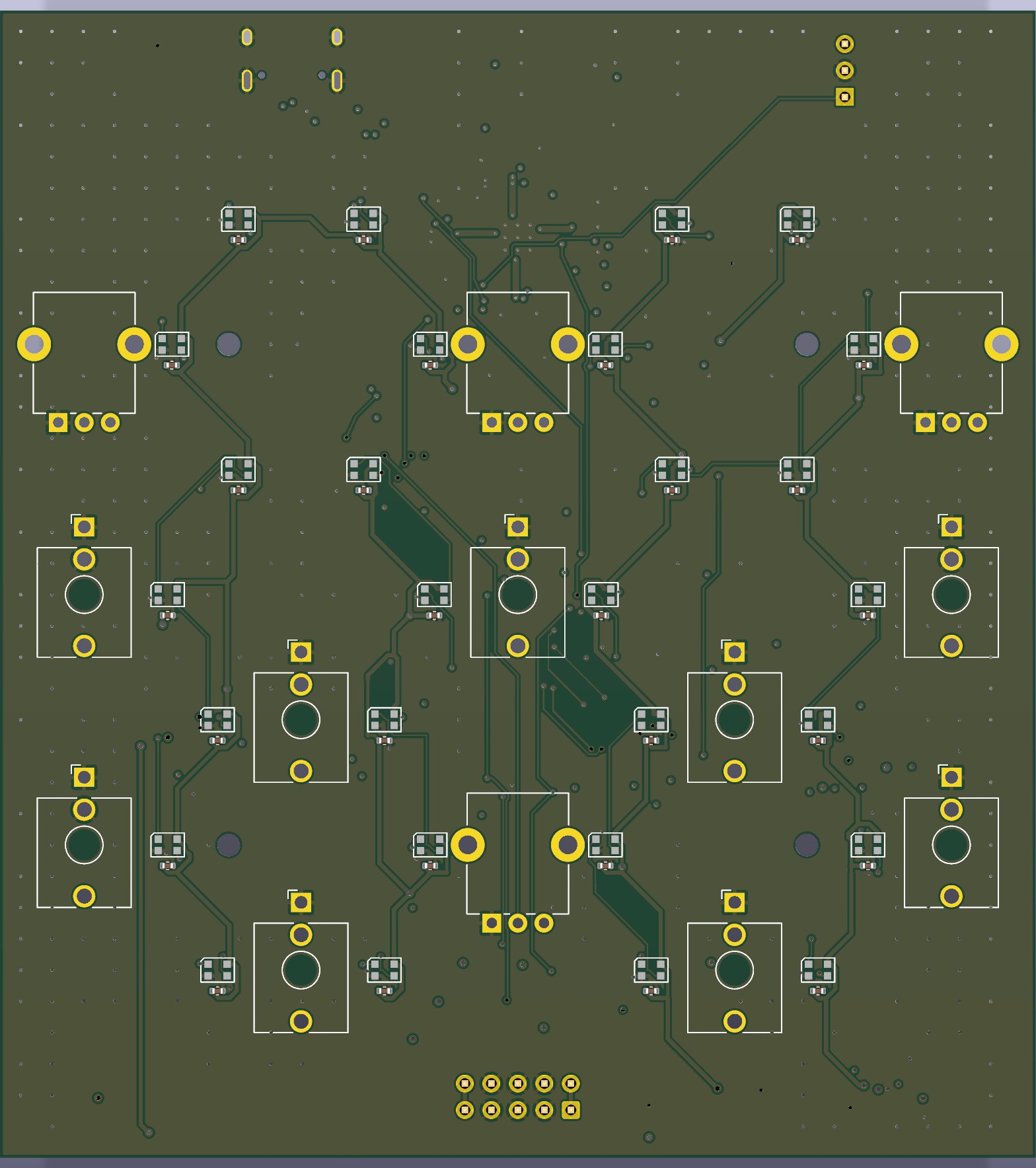
Behind the panel a black 3D-printed baffle fills the 10 mm to the main board: a cell for each tile, walls along the webs and round every jack and pot, with the RGB LEDs at the bottom of each cell. Their own buck converter feeds them, and the firmware caps their current so the whole module stays within its power budget. How the light looks through the board is the one thing a drawing can't settle, so a small test panel comes first.
One board sits right behind the panel: the jacks, pots and LEDs on its front, an RP2350 and everything else on its back. IN goes straight into the microcontroller's own converter, 48 thousand times a second, and the same engine that runs on this page runs there, the page's copy checked against it bit for bit.
Drag to look around. Lift the panel to see the baffle and the board behind it.
MAGI is designed and routed, and its engine runs here. Nothing's built yet, and there's no date.