logogram

it writes in circles

20 HP

An oscillator you can hit. A ring of masses ripples at the speed of your hand while a head reads it at the note you ask for, so the ring's shape is the wave, and the stroke of light round PITCH is the ring. Strike it, rub it, hold it still.

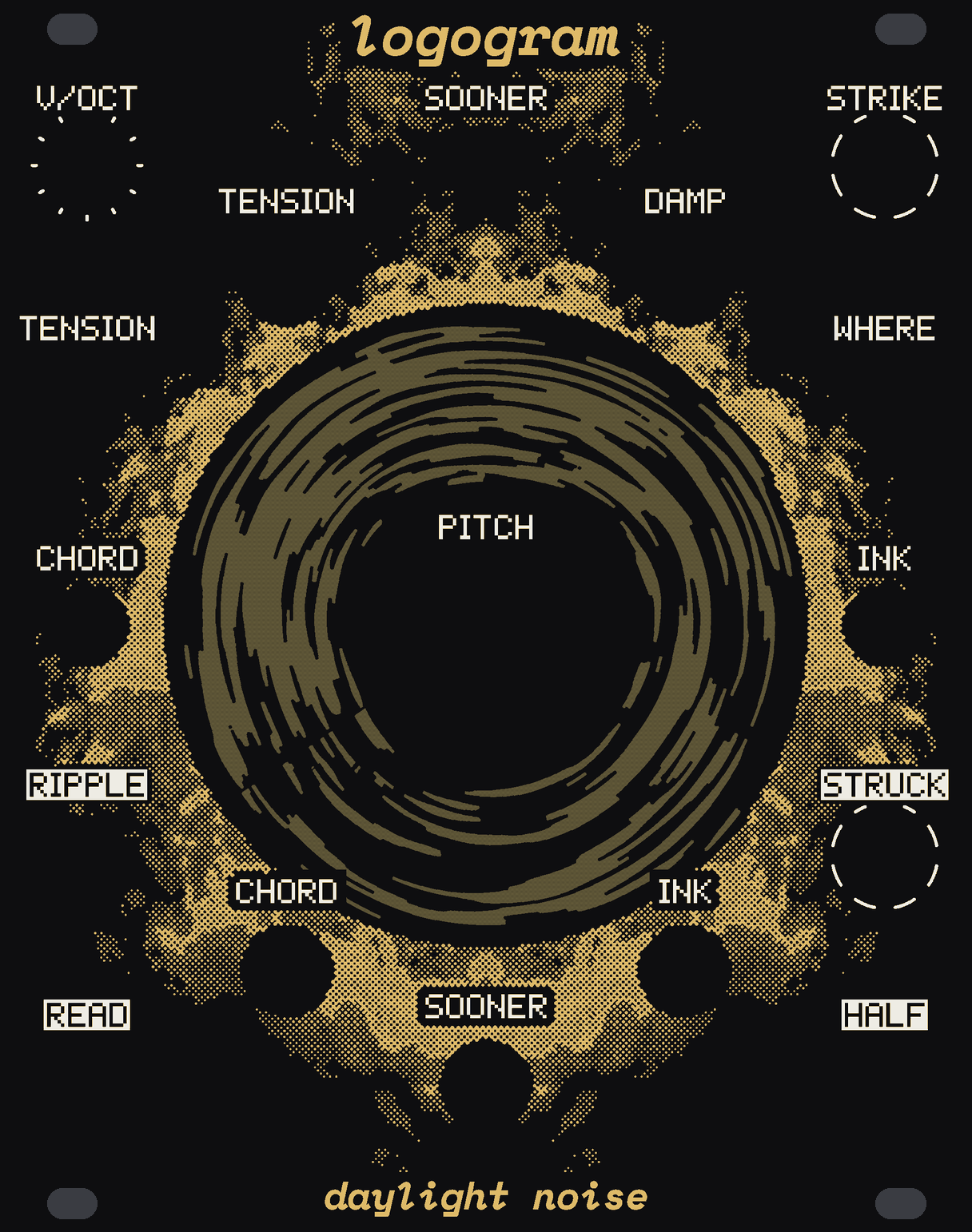
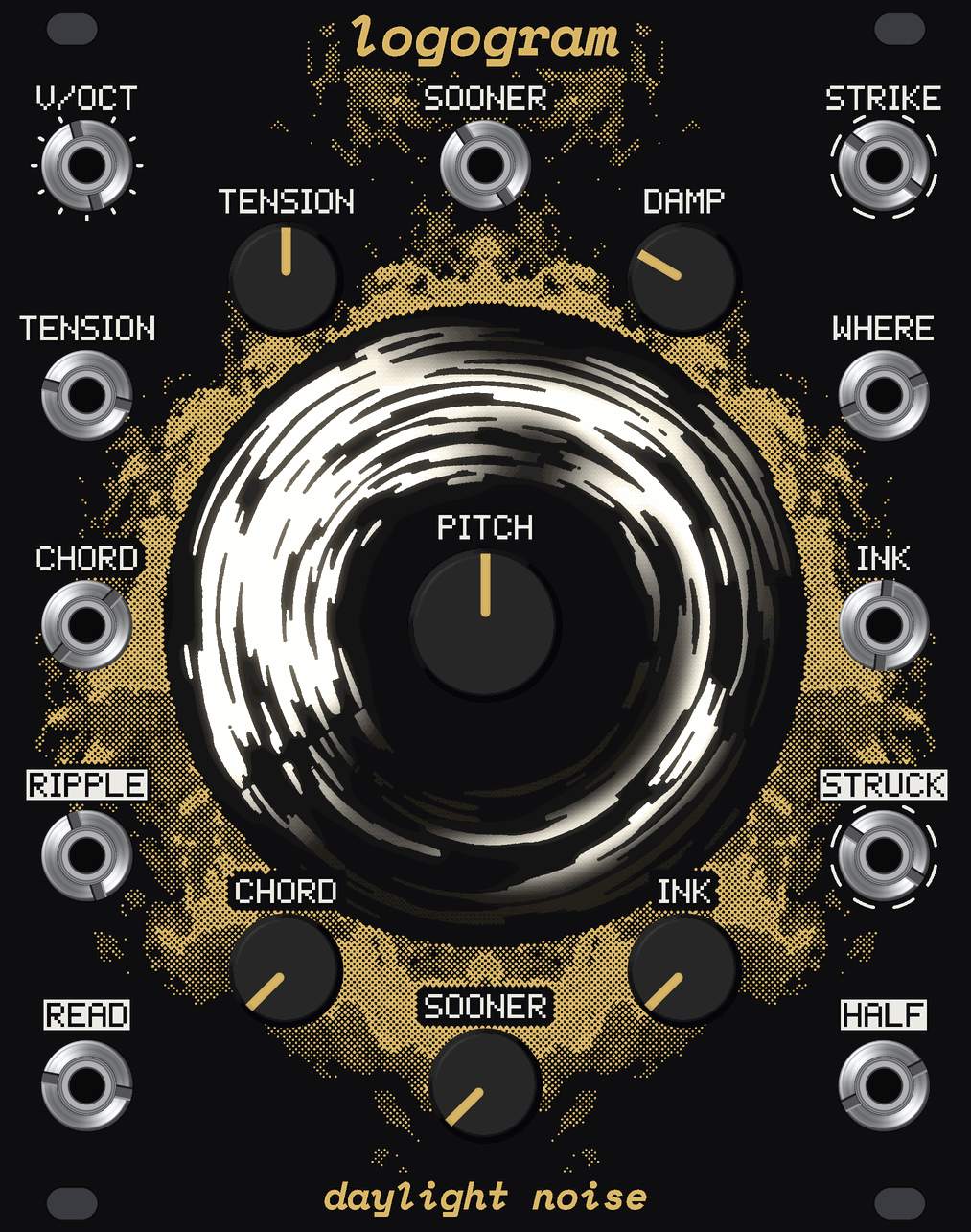
The LOGOGRAM panel: black, a pale cloud of gold dots, and round the big PITCH knob one huge dry stroke of a brush in bare glass, wet and full where it starts and breaking into streaks where it ends. TENSION and DAMP knobs above it, CHORD and INK below, SOONER at the foot. V/OCT, TENSION, CHORD, RIPPLE and READ down the left, STRIKE, WHERE, INK, STRUCK and HALF down the right. logogram at the top, daylight noise at the bottom.

Turn a knob: drag it or tap either side of it, roll the wheel over it or use the arrow keys; a double click puts it back. Touch the ring: tap it to strike it there; press and stay to hold it still; drag round it and it pushes, and at the ripple's own speed it builds. Or tab to it, move along it with the arrow keys and hold Enter or Space. The patches step on by themselves until you touch anything.

What you hear is LOGOGRAM with a rack round it: a sequencer at V/OCT, drums at STRIKE, a loop at INK, a VCA on READ. All made in the page.

example patches

The ring, the head and everything they do are LOGOGRAM's engine as designed, running in your browser, on a model of a ring of masses. What plays into it stands in for a rack.
The ring

How it moves

How it's read

Ink

What goes in

What comes out

Inside

One board 10 mm behind the panel, every part on its front. Round PITCH, 108 white LEDs, one in each cell of a printed white frame; its row walls have black cores, so the hairline stays one. The panel is a circuit board too: the ring's 24 touch sectors are copper just under its face, read by two chips on its back.

The LOGOGRAM panel: black, a pale cloud of gold dots, and round the big PITCH knob one dry stroke of a brush lit from behind, thick where it starts and breaking into streaks where it ends, five more knobs and twelve jacks round it.

Drag it or use the arrow keys to turn it; click it to take it apart.

Specs

Format

Width
20 HP
Depth
about 20.6 mm behind the panel
+12 V
about 170 mA at rest, 185 busy, 200 at the light's cap, 260 uncapped (on paper, not yet measured)
−12 V
about 5 mA (on paper)
Controls
a ring you touch, a big knob, 5 knobs
Board
99.3 × 110 mm, 4 layers, every part on the front
Panel
a 4-layer board: the touch is copper inside it
The back
the panel turns round to a second face; it's art: the ring feels only from the front, and the touch header comes off first

I/O

V/OCT
1 V an octave, ±6 V; calibrated, under 0.1 cent off straight over ten octaves, and about a cent if the room moves a degree or two (on paper)
STRIKE
gate, rising past 1 V; as hard as it is high, full at 5 V
INK
audio, ±9.4 V full scale
CVs
WHERE, TENSION, CHORD, SOONER, 5 V the whole way; ±12 V does no harm
READ, HALF
audio, about ±4 V, ±8.1 V full scale
RIPPLE
CV, ±5 V
STRUCK
gate, 0/5 V, 5 ms

Engine

The ring
128 masses, 4,000 times a second; read at the note, 46.875 kHz
SOONER
up to 2 s ahead of your ears
Touch
24 sectors round the stroke, read 244 times a second; a finger placed to about 2° (on paper)
Light
108 white LEDs behind the stroke, 36 round it and three across (its brightness on paper)
Power cycle
nothing kept: it wakes to a still ring at rest