lo and behold

20 HP · endless rise

Your sound as a wheel of octaves that rises forever and never arrives. Turn it the other way and it falls forever; stop it and it's a chord. Light it and it spins up, faster and faster, and on the one it breaks: your sound comes back dry and whole, right on the downbeat.

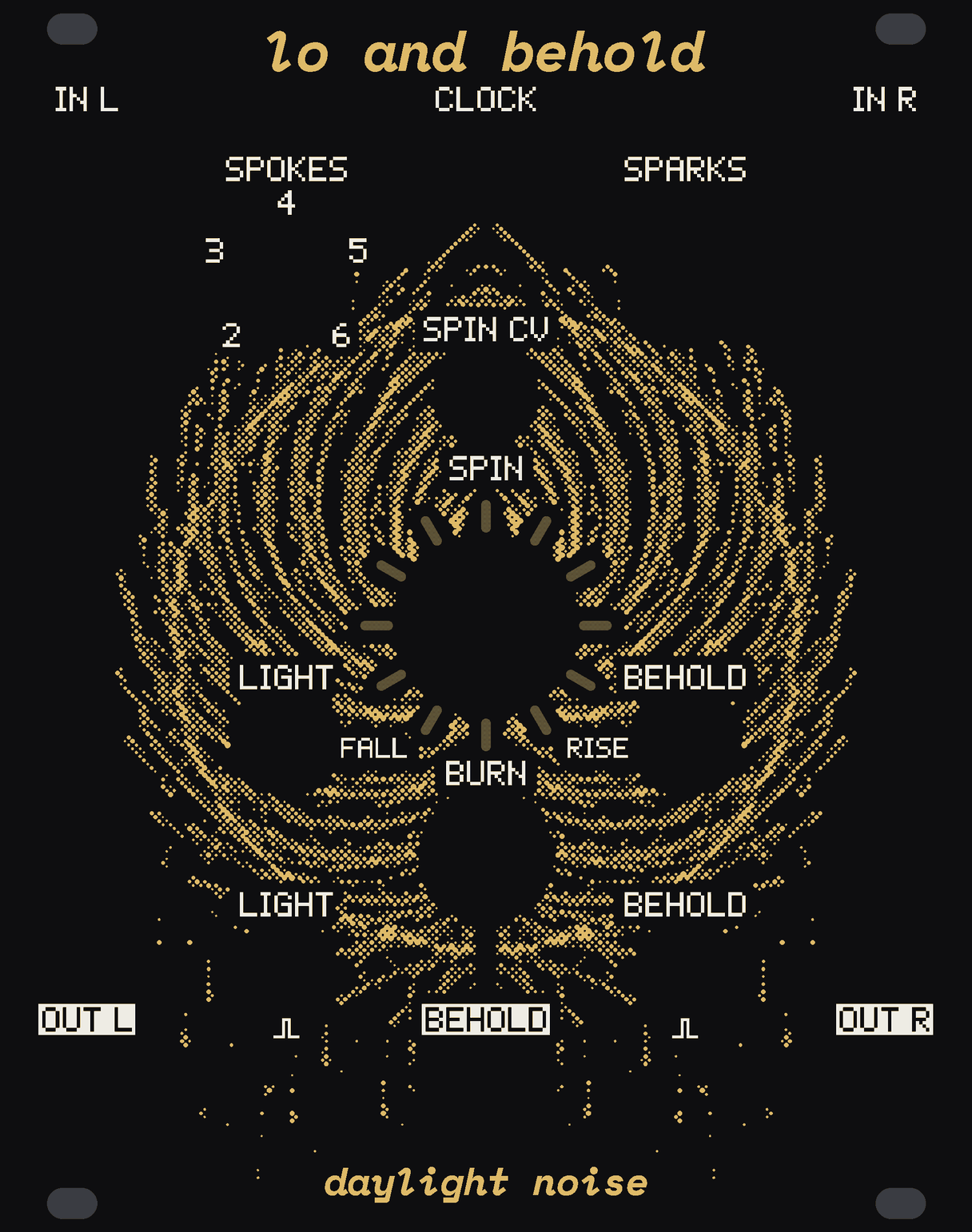
The LO AND BEHOLD panel: a firework wheel spinning at night in a long exposure, in gold dots on black, its hub on the big SPIN knob in the middle and its sparks drawn into trails that curl up both ways from it and fall away below. Twelve small windows of pale bare circuit board ring SPIN, with FALL and RISE either side under it. White labels for the knobs SPOKES (printed 2 to 6), SPARKS, SPIN and BURN, the buttons LIGHT and BEHOLD, and the jacks IN L, IN R, CLOCK, SPIN CV, LIGHT, BEHOLD, OUT L, OUT R and BEHOLD out.

Turn a knob: drag it, roll the wheel over it or use the arrow keys; a double click puts it back.

Everything but the four spoken lines is made in the page as you listen. Headphones help.

example patches

The sound and the lights here are LO AND BEHOLD's own engine: the module's firmware, ported to the page and checked against it sample for sample. The drums, the bass, the organ, the swells and the voices are stand-ins for the rest of a rack.
The wheel

Whatever comes into IN L and IN R becomes a wheel: your sound in several octaves at once, each one a spoke. Every spoke climbs, and as one fades out at the top a new one fades in at the bottom, an octave under the rest, so the whole thing rises forever and never gets anywhere. It's the barber's pole of sound, made of your own: a pad, a voice, a whole mix.

Each spoke is a pitch shifter with its read head sliding smoothly, so its pitch glides rather than steps. A bell of loudness lies over them: a spoke is loudest in the middle of the wheel and silent at its top and bottom, where it wraps round, so nothing ever jumps and the total level holds steady as the wheel turns.

Spin

SPIN is the big knob in the middle, the wheel's speed and its way round. Clockwise it rises, anticlockwise it falls, faster the further you turn it, from a slow drift to four octaves a second. At noon it stands still: the wheel settles on whole octaves and your sound comes out as a chord of itself, in tune.

SPIN CV adds to the knob, 5 V for its whole travel either side of noon, so an LFO through zero turns a rise into a fall and back, stopping for a moment on the way.

Sparks

SPARKS throws the top spoke off as grains: short pieces of whatever it just played, flung across the stereo, each one falling in pitch as it fades. They come faster the faster the wheel spins, so a slow wheel sheds a few and a burning one throws them everywhere. At zero there are none.

Light and burn

LIGHT is a lit button and a gate in. Light it and the wheel catches: it spins up the way a firework does, slowly at first, then faster and faster, until at the end of BURN it's turning six octaves a second faster than SPIN alone. LIGHT stays lit while it burns.

Behold

BEHOLD, a lit button and a gate in, breaks the wheel on the next downbeat; the end of a burn breaks it the same way. On the one the wheel shatters: a short burst of sparks flies off it, and your sound comes back dry and whole, exactly what came in. BEHOLD out goes high for a beat, on the one: patch it to whatever should come back with the drop.

Once broken, it stays beheld, your sound dry, until LIGHT relights it. Until the first break, it simply turns at SPIN's speed.

The panel

Twenty HP, every part on the line's staggered grid and mirrored about the middle. The art is a firework wheel spinning at night in a long exposure, in gold dots: its white-hot hub on SPIN, its sparks drawn into trails that curl up both ways from the middle and fall away past the outputs.

Round SPIN are twelve small windows of bare glass, lit from behind, hot white going orange like sparks. The lit one is where the wheel is, a turn for every octave climbed, chasing round as it spins with a trail behind it that grows the faster it goes. On the break all twelve flash, then go dark.

Inside

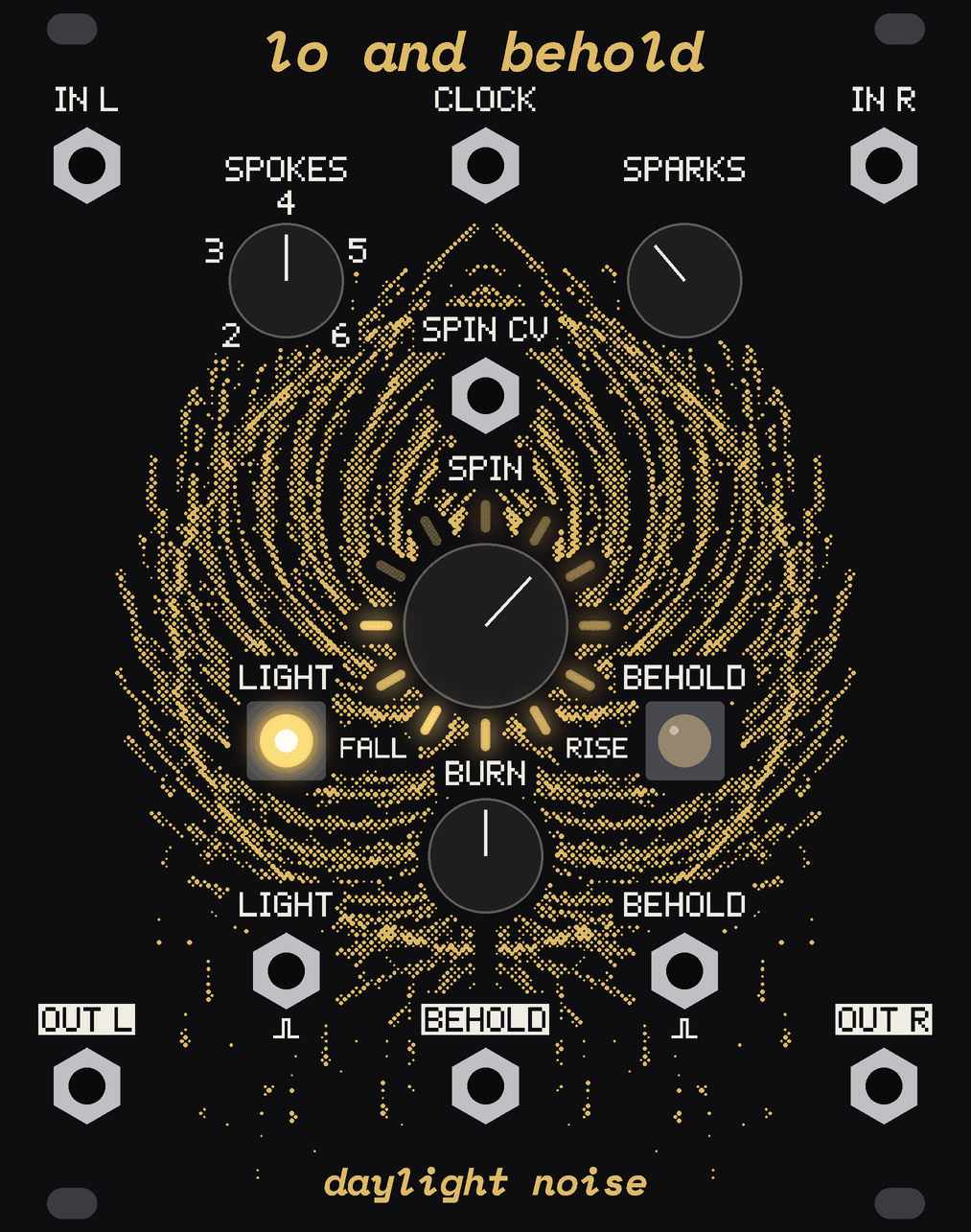
The LO AND BEHOLD panel burning: LIGHT's cap lit, the spoke windows round SPIN lit white going orange most of the way round, its knobs on.

Drag to look around. Lift the panel: the black baffle stays on the board, a ring round SPIN's shaft with a cell under each window, an LED at the foot of each. One RP2350 does it all, both its cores, the wheel in its own memory.

Specs

Format

Width
20 HP
Depth
about 21 mm behind the panel, its power header included; allow 25 mm for the cable's plug
+12 V
about 120 mA with the windows dark, 185 mA at the most (both caps lit, the windows at their cap)
−12 V
about 10 mA
+5 V
not used; 10-pin header
Panel
1.6 mm FR4: ENIG gold through black mask, white labels, twelve windows of bare glass
Controls
4 knobs (SPIN's big, SPOKES in five detents, SPARKS, BURN in six zones), 2 lit buttons

I/O

IN L, IN R
audio, ±5 V with room to ±9; 100 k. IN R normalled to IN L
SPIN CV
±5 V, 5 V for SPIN's whole travel either side of noon; 100 k
CLOCK
a gate, rising past about 1.1 V; 100 k. It knows when it's unpatched
LIGHT, BEHOLD
gates, the same; LIGHT acts at once, BEHOLD on the next one
OUT L, OUT R
±5 V with a soft knee to ±8; 1 k; each its own side
BEHOLD out
0 to 5 V, high for a beat from the one; 1 k

Engine

Brain
RP2350, both cores at 192 MHz, 46.875 kHz, 32-bit float
Converters
PCM1808 in, PCM5102A out, on one I2S clock
Wheel
up to six spokes, each a read head gliding between 3 and 62 ms behind the input, spliced where the sound matches
Sparks
up to 40 grains at once, cut from what the top spoke just played
Gates
timed to the sample, about 1 ms behind the jack
Light
12 RGB LEDs behind the windows, their current capped; the caps' own orange LEDs
Firmware
over USB-C, on the board's left edge

Nothing's for sale yet.

LO AND BEHOLD is designed, its board is routed and its firmware builds. The numbers here are the design's and the engine's, not measurements, and there's no date.