little green men

a rhythm is a slow chord

20 HP

Three spinning stars. Slow, they tick: three clocks in one pattern, three against two, five against four. Turn SPIN up and the same ticks run together into a buzz, and then a chord. A clock, a voice, and the one knob that turns either into the other.

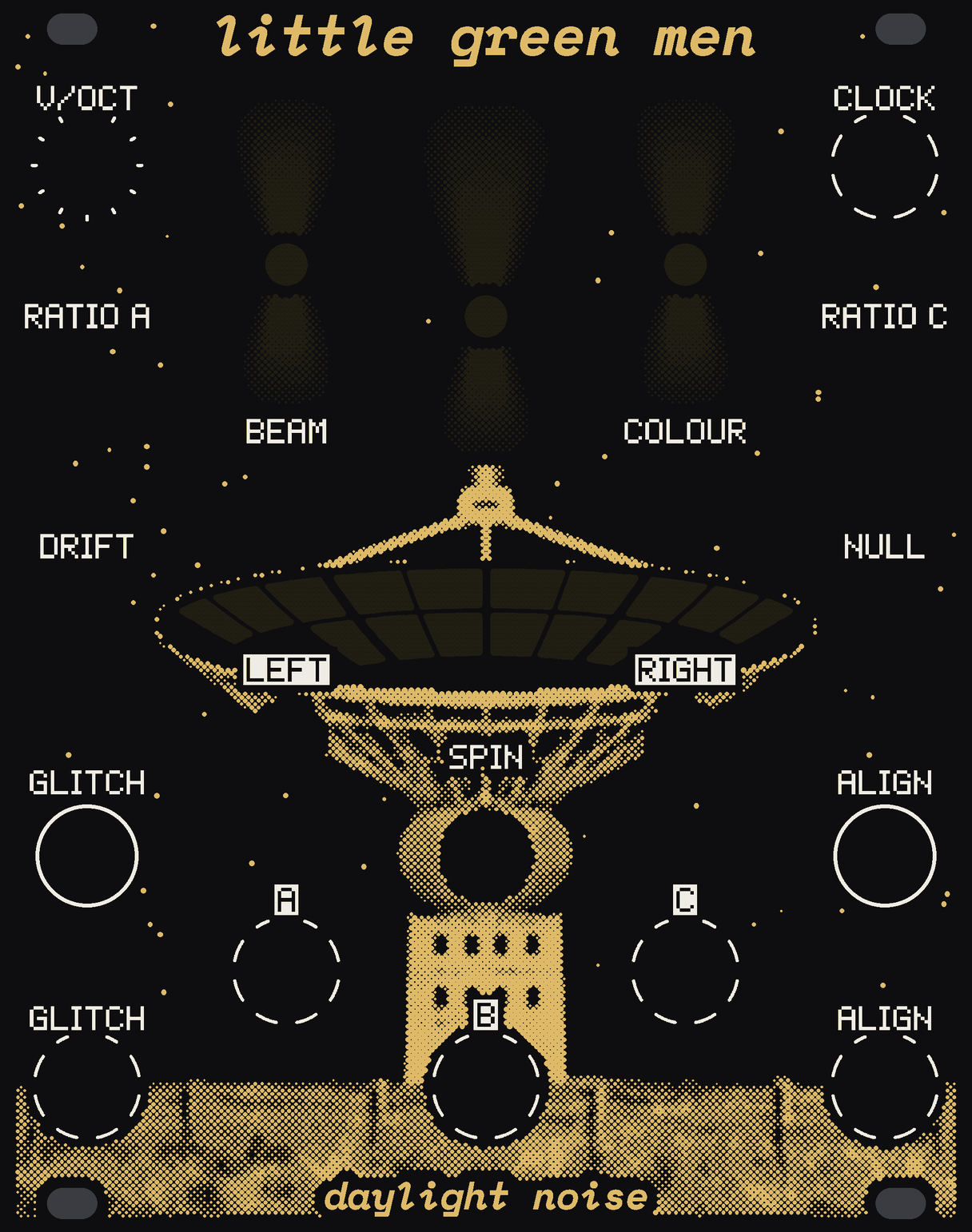
The LITTLE GREEN MEN panel, black and gold: a photograph of a radio telescope in a paddock at night. Its dish is tipped straight up on a two-storey tower, the truss of its back fanning down to the hub, four slim legs holding a small cabin over the bowl; dry grass and a post-and-wire fence at its foot, a few stars in the black sky as gold specks. The inside of the dish is glass for light, its panels' seams in black. Over the dish hang three stars, the middle one lower: each a round point of glass with a cone of light above it and another below, drawn as dots of bare glass, solid at the star and thinning out to nothing. SPIN, the big knob, is the dish's hub; BEAM and COLOUR sit under the two outer stars; the other knobs, the two buttons and the jacks stand down both edges, with the three pulse jacks A, B and C at the tower's foot.

Turn a knob: drag it or tap either side of it, roll the wheel over it or use the arrow keys; a double click puts it back. Press GLITCH for a star-quake, or ALIGN to bring all three stars together. The patches step on by themselves until you touch anything.

Synthesised here, as the module would make it: the three stars' pulses, with a stand-in rack round them.

example patches

Everything LITTLE GREEN MEN does here is its engine as designed, in your browser: the three stars and their pulses. The drums, the bass, the clock, the tune and the beeps round it are a stand-in rack.

One knob, a beat or a chord

Tap a table three times for every two taps of your other hand and you have a rhythm. Speed both hands up a few hundred times and you'd hear two notes, a fifth apart. They're the same thing at different speeds, and this module lets you hear one turn into the other.

Patch LEFT and RIGHT to your mixer. Three stars tick, each at its own speed. Turn SPIN up: the ticks crowd into a patter, a purr, a buzz, and then they're a chord. Nothing switches on the way. Turn it back down and the chord comes apart into the beat it always was.

Three stars

The pulse

What stars do

On a clock

In a rack

Specs

Format

Width
20 HP
Controls
a big knob (SPIN), six knobs (RATIO A, RATIO C, BEAM, COLOUR, DRIFT, NULL), two lit buttons (GLITCH, ALIGN)
Lights
30 cells: each star's two beams in four cells out from the star, the three stars' points, the dish's bowl in three parts
Replaces
a clock divider and pattern maker, an oscillator, and a riser
Parts
a demo for now: the line's knobs, jacks and buttons, no board yet

Inputs

V/OCT
1 V an octave: a volt doubles the speed, as a note or as a beat
CLOCK
clock, a pulse every two seconds to 500 a second: SPIN's slow half locks to it
GLITCH
gate: a rising edge is a star-quake
ALIGN
gate: a rising edge pulses all three stars together

Outputs

A
trigger, 8 V: the left star's pulses (a square wave above 33 a second)
B
trigger: the middle star's
C
trigger: the right star's
LEFT
audio: the middle and left stars (alone, all three)
RIGHT
audio: the middle and right stars