listen

12 HP · repetition detector

It notices when your patch has stopped changing. On every clock it samples a gate or a CV, and it counts the loops that come round the same, a light under its name growing brighter all the while. After PATIENCE of them, HEY fires, and again every loop until something changes. The moment it does, LISTEN fires and the count drops to nothing.

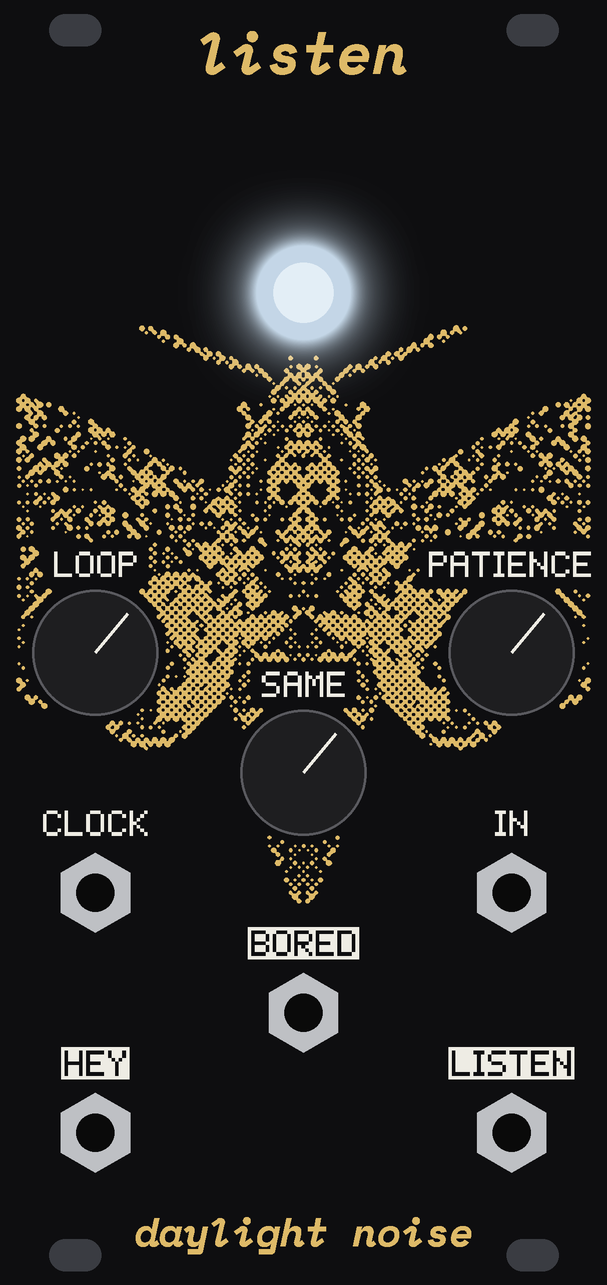
The panel: black, with a death's-head hawkmoth in gold halftone dots, the skull on its back, its wings running off both sides and its antennae reaching up either side of a round light under the name. White labels: LOOP and PATIENCE either side, SAME between them, then CLOCK and IN, and the outputs BORED, HEY and LISTEN in white blocks. listen at the top and daylight noise at the bottom.

Turn a knob: drag it, roll the wheel over it or use the arrow keys; a double click puts it back. The knobs are stepped: an arrow key moves one a setting.

Every sound is made in the page: the sequence, what HEY changes, what LISTEN strikes and BORED swells.

example patches

The module's own engine, running in the page: the firmware's, ported from its C and checked against it, tick by tick.

How it counts

Every rising edge at CLOCK is a step, and IN is sampled at each one. Each step is compared with the step one loop earlier. Two samples are the same when they're on the same semitone, so a gate's 0 and 5 V work, and so do a sequencer's notes.

The panel

Three knobs, two inputs and three outputs, every part on the line's lattice and mirrored about the middle. The outputs are knocked out of white.

LOOP

How many steps make a loop: 1, 2, 3, 4, 6, 8, 12, 16, 24, 32, 48 or 64. All the way down is AUTO: it finds the loop itself, the shortest that the recent steps repeat at, up to 64 steps. Until it has one, the input counts as changing.

AUTO · 1 to 64 steps

SAME

How many steps of a loop may differ and the loop still count as the same: none, all the way down, up to a quarter of the loop. For a loop that drifts a little and should still bore it.

none to a quarter

PATIENCE

How many unchanged loops before HEY: 1, 2, 3, 4, 5, 6, 8, 10, 12, 16, 20, 24 or 32. BORED climbs a step for each of them, to 10 V.

1 to 32 loops

The light

Under the name, between the moth's antennae: one frosted cool-white light. Brighter the longer the patch sits still, two quick flashes on HEY, a slow fade on LISTEN.

follows BORED
Patching it

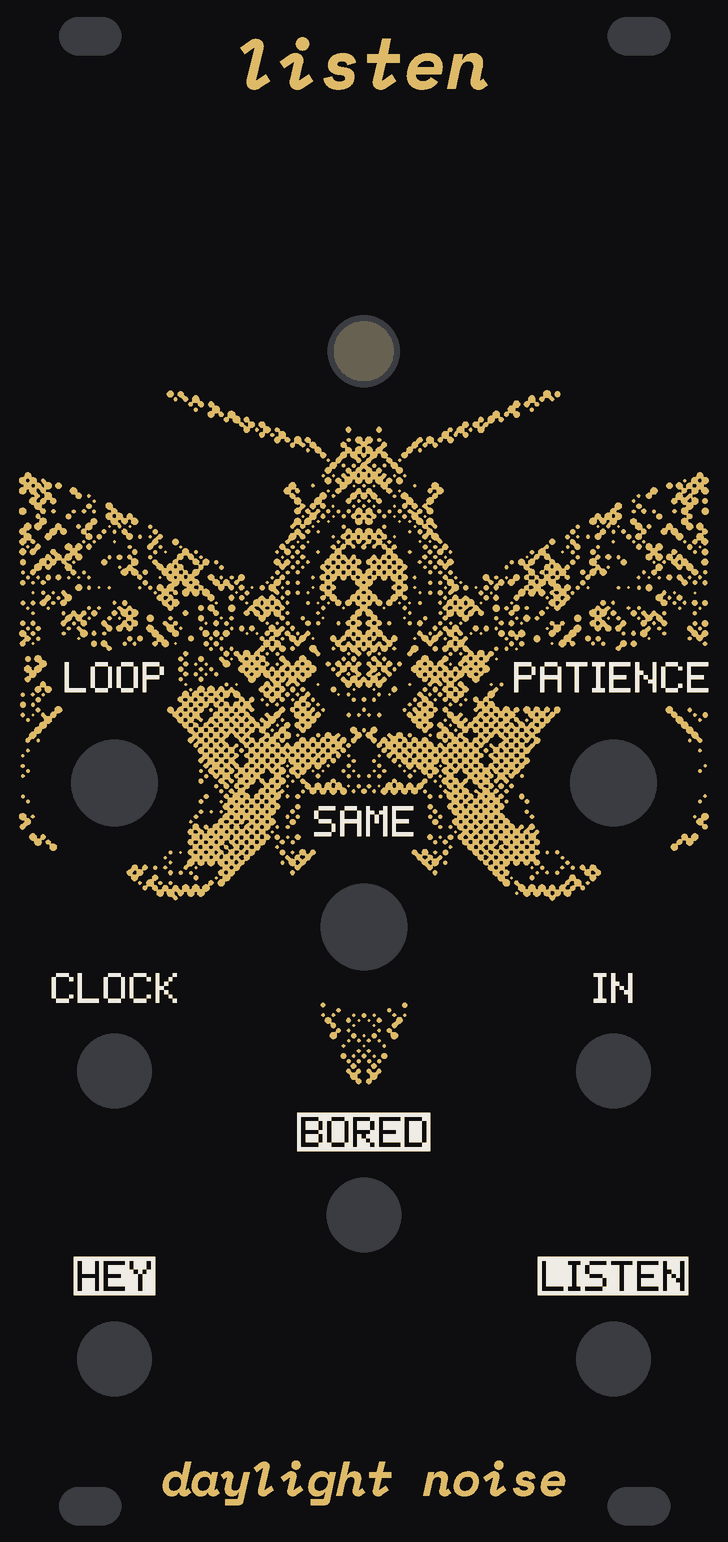
The art is a death's-head hawkmoth drawn to the light, in a halftone of exposed gold: the skull on its back under SAME, its wings running off both sides past LOOP and PATIENCE, its antennae reaching up either side of the light.

Inside

One board right behind the panel, every knob and jack straight behind its hole. An RP2350 runs the engine; it reads IN and the three knobs against a 3.000 V reference, sets BORED through an MCP4822 and an op-amp, and drives HEY and LISTEN to 5 V. The light is a 5 mm frosted LED standing off the board, its dome flush in the panel's 6 mm hole, dimmed by PWM.

All of it is generated from code. One table places every knob and jack and drives the panel, the board and this page, and the model below is drawn from the same files.

The panel with its knobs on and the light lit.

Drag to look around. Lift the panel and the light stays on the board.

Specs

Format

Standard
Eurorack, 3U
Width
12 HP (60.66 × 128.5 mm)
Panel
FR4, black mask, gold (ENIG) art
Controls
LOOP, PATIENCE, SAME
Light
One 5 mm frosted cool-white LED
Power
+12 V about 65 mA, −12 V about 6 mA (the design's estimates); 10-pin header

I/O

CLOCK
Rising edges, high above about 1.4 V, 100 k
IN
Gate or CV, −10 to +10 V, 100 k
BORED
0 to 10 V, 1 k out
HEY, LISTEN
5 V triggers, 10 ms, 1 k out
Unpatched
IN reads 0 V

Engine

Brain
RP2350
The same
Within half a semitone
LOOP
AUTO, or 1 to 64 steps
PATIENCE
1 to 32 loops
SAME
None to a quarter of the loop
IN read
0.5 ms after each clock

Nothing's for sale yet.

It's designed, and its engine passes its tests. Nothing's built yet, and there's no date.