likeness

they become each other

20 HP

Two sounds come in, left and right, strangers. Slowly each takes on the other's rhythm, tone and voice while the field between them closes, until they're one face in the middle, half of each. SPLIT tears them apart.

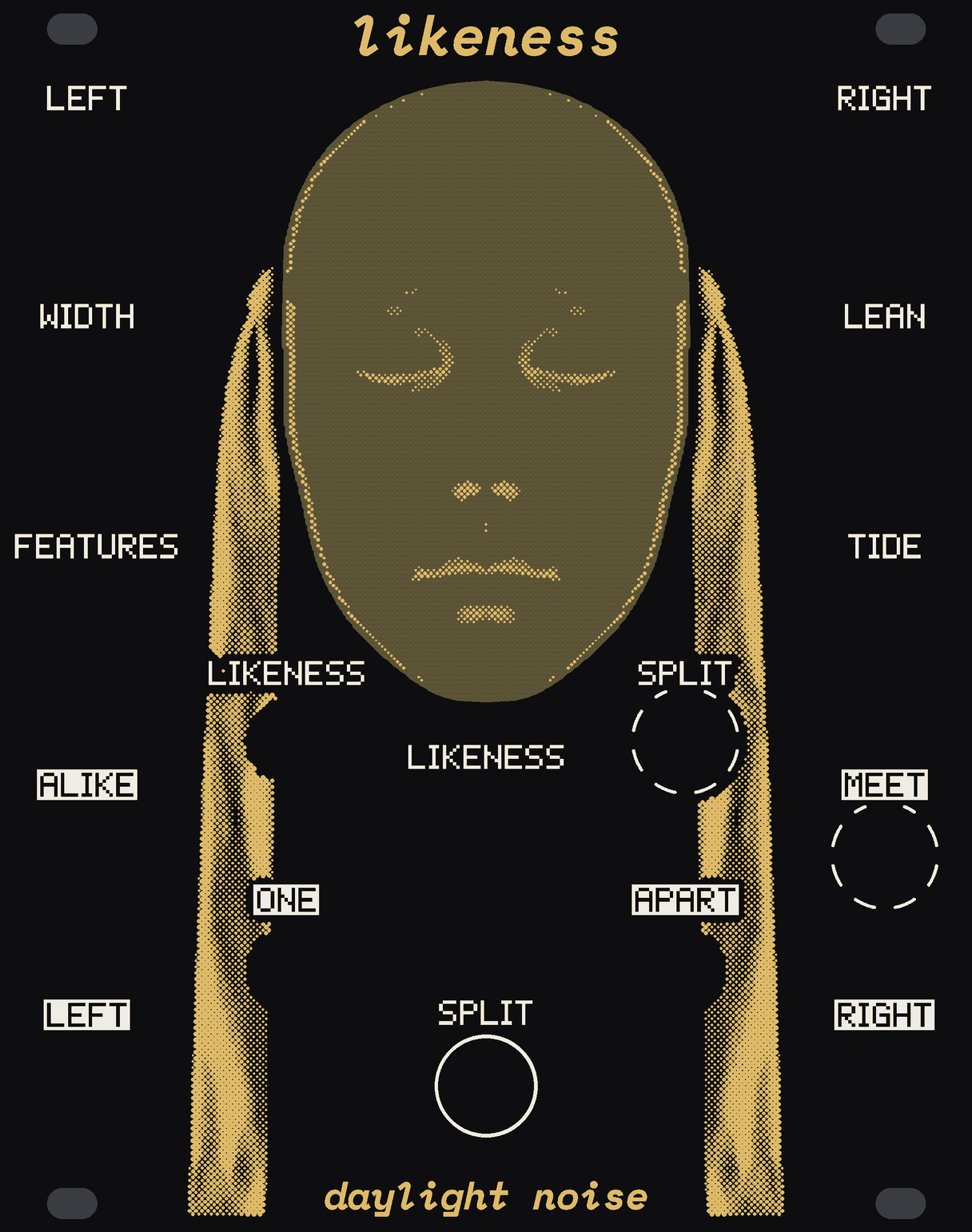
The LIKENESS panel: black, a pale mask in gold dots under the name, its eyes and lips closed, long ribbons from its temples hanging to the foot. The mask's face is a window of bare circuit board. LEFT and RIGHT in at the top corners, WIDTH and LEAN under them, FEATURES and TIDE under those, LIKENESS's jack and SPLIT's gate under the chin either side of the big LIKENESS knob, ALIKE and MEET out at the edges, ONE and APART out either side, LEFT and RIGHT out at the foot corners, the SPLIT button between them. likeness at the top, daylight noise at the bottom.

Turn a knob: drag it or tap either side of it, roll the wheel over it or use the arrow keys; a double click puts it back. SPLIT is a button: press it to tear them apart. The patches step on by themselves until you touch anything.

A dark loop in E minor, two of its parts through LIKENESS, one left, one right. Listen plays the patch from its top.

example patches

Everything LIKENESS does here is its engine as designed, running in your browser. The loop is a stand-in rack.

Becoming each other

LIKENESS hears each side as its rhythm, how its loudness rises and falls; its tone, the shape of its spectrum; and its voice, the fine detail, the partials and the notes. Each side shapes itself toward the other in those, both ways at once, while the field closes, so the two end as one sound in the middle. Two different sounds work best: a pad and a pluck, a voice and a beat.

What they borrow

The field

Split

What comes out

Every out is 21 ms late: that's how long it takes to hear a sound's shape.

Specs

Format

Width
20 HP
Controls
a big knob, 4 knobs, a lit button

Inputs

LEFT, RIGHT
audio, ±5 V; RIGHT takes LEFT when it's empty
LIKENESS
CV, added to the knob, 5 V the whole way
SPLIT
gate, rising past 1 V

Outputs

LEFT, RIGHT
audio, the two sides
ONE, APART
audio, their middle and their difference
ALIKE
CV, 0 to 8 V
MEET
gate, 5 V while they're one