lift hill

it climbs before it drops

20 HP

Your loop, made into a track. Four parts go through it, each in its own lane, and it brings them in and takes them out bar by bar: a quiet start, a climb, a drop where everything comes in at once, a break, another climb, a bigger drop, an end.

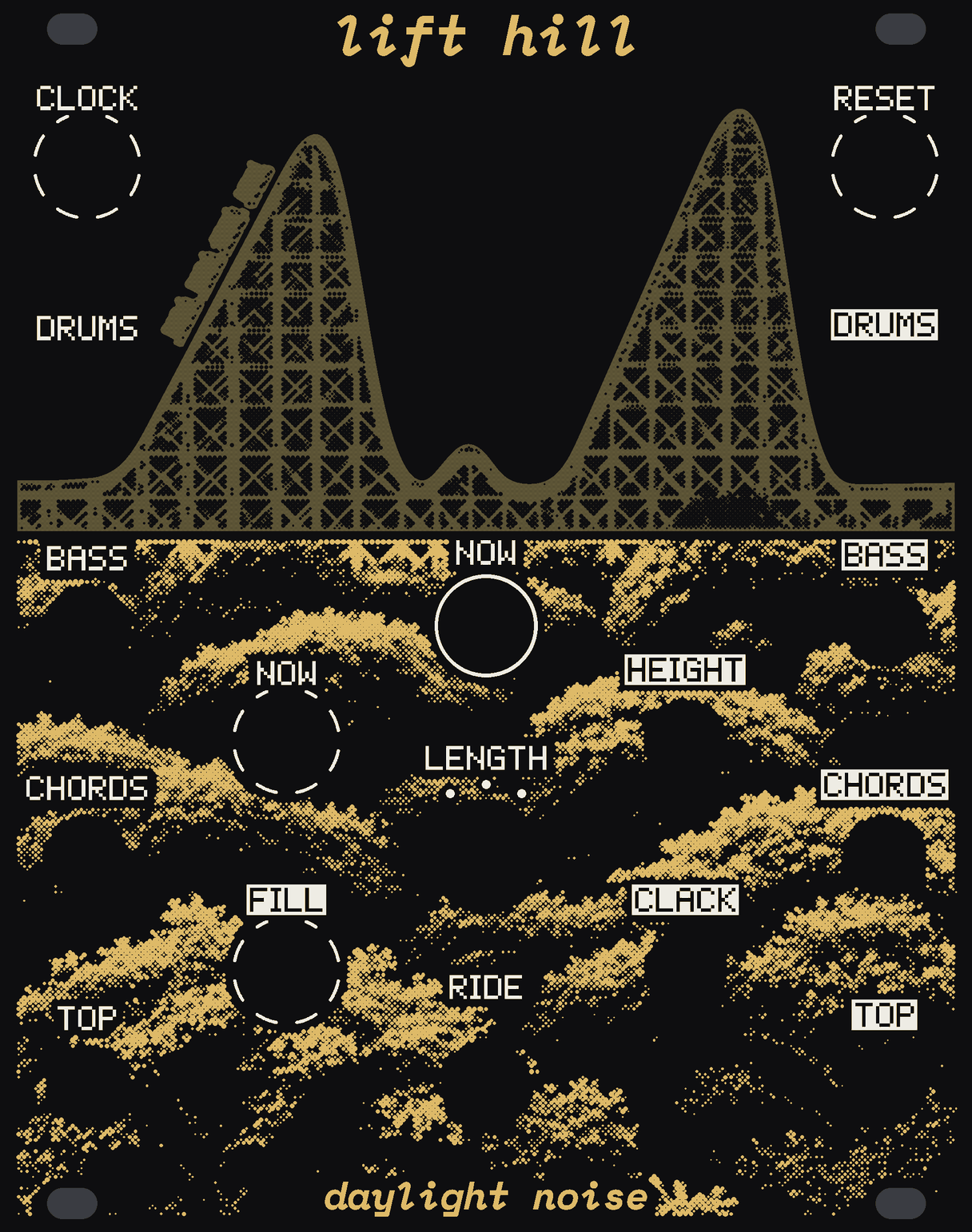
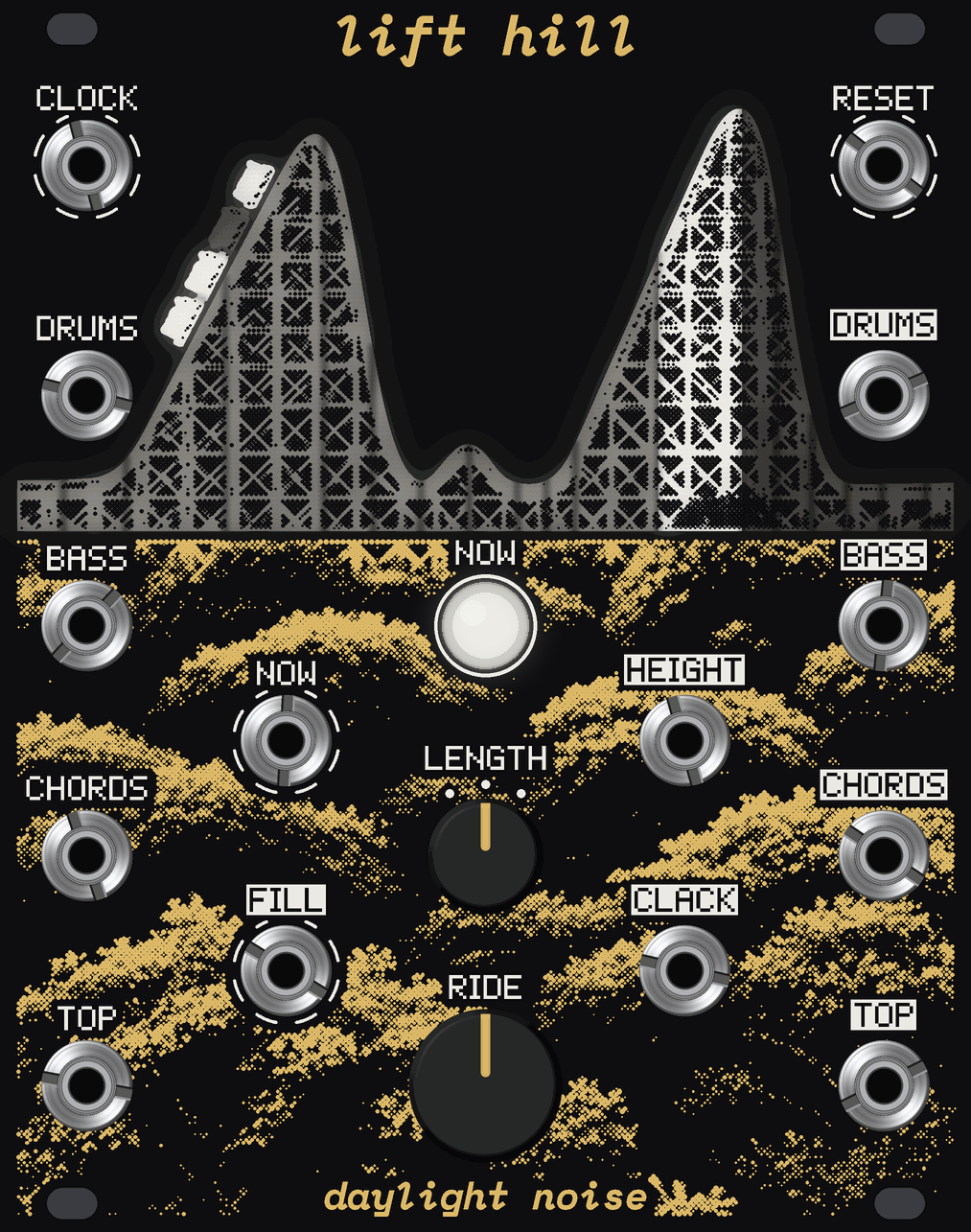
The LIFT HILL panel: black, and across its top a white wooden roller coaster in profile, two tall hills of timber lattice with a low run between them and a train of four cars climbing the first; gold treetops under it. Jacks down both sides, the knobs and a button between.

Turn a knob: drag it or tap either side of it, roll the wheel over it or use the arrow keys; a double click puts it back. LENGTH is a switch: it clicks from stop to stop the same ways. NOW is a button: tap it (or Enter) to move on at the next bar line, hold it to stay where you are. The patches step on by themselves until you touch anything.

A deep dubstep loop at 140 BPM, ridden through LIFT HILL from the top. The first patch rides it in a minute; press NOW to move it on.

example patches

Everything LIFT HILL does here is the module's own engine, running in your browser, the same to the bit as its firmware: the ride, the four lanes, HEIGHT, FILL and CLACK. The loop, the drums and the voices are a stand-in rack.
A loop isn't a track yet

A loop plays every part, all the time, at the same strength, until you switch it off. A track goes somewhere. It starts with a part or two, builds (adds parts and tension bar by bar), then lets go into the drop: the moment everything comes back in at once. Then a break, where the beat falls away and you hear what's under it, and another build to a bigger drop.

The trick is taking things away so that bringing them back hits hard. Doing that by hand means pulling cables out and putting them back, bar by bar, in time. LIFT HILL does it for you.

The ride

RIDE and NOW

What comes out

Inside

The LIFT HILL panel half way up the second lift hill: the first hill and the break behind lit low, the climb's cell blazing, the bass's car dark.

Drag it or use the arrow keys to turn it; click it to take it apart.

Specs

Format

Width
20 HP
Depth
20.6 mm behind the panel
+12 V
about 215 mA at the ride's busiest, 305 mA at most with the light at its 400 mA cap (estimated)
−12 V
about 17 mA (estimated)
+5 V
not used
Controls
a big knob, a three-stop switch, a lit button
Light
51 white LEDs in 22 rooms: the 18 cells of the track and the four cars

I/O

CLOCK, RESET
gates, high past about 0.9 V: a pulse a sixteenth; back to the start
NOW
gate: a short one moves on at the bar line, a long one holds
DRUMS, BASS, CHORDS, TOP in
audio, up to about ±10 V
DRUMS, BASS, CHORDS, TOP out
audio, up to ±10 V, each passed down to TOP with no cable in it
HEIGHT
CV, 0 to 8 V
FILL
gate, 5 V over the bar before a change
CLACK
audio, into TOP's out with no cable in it

Engine

Brain
RP2350 at 192 MHz: this page's engine, to the bit
Audio
46.875 kHz, 24-bit converters, four in and five out
Light
100 frames a second, held under 400 mA