lamp

12 HP · optical tremolo

A real lamp, pulsing in the panel. LAMP is the tremolo in old guitar amps made into a module: an analog LFO heats a filament behind a window, a photocell reads it, and the light opens the volume and the tone together. The filament heats faster than it cools, so it throbs rather than chops, and patching an envelope into LIGHT turns the bulb into a slow low-pass gate. A digital spring tank sits after it, and FLICKER sends the light out as a CV.

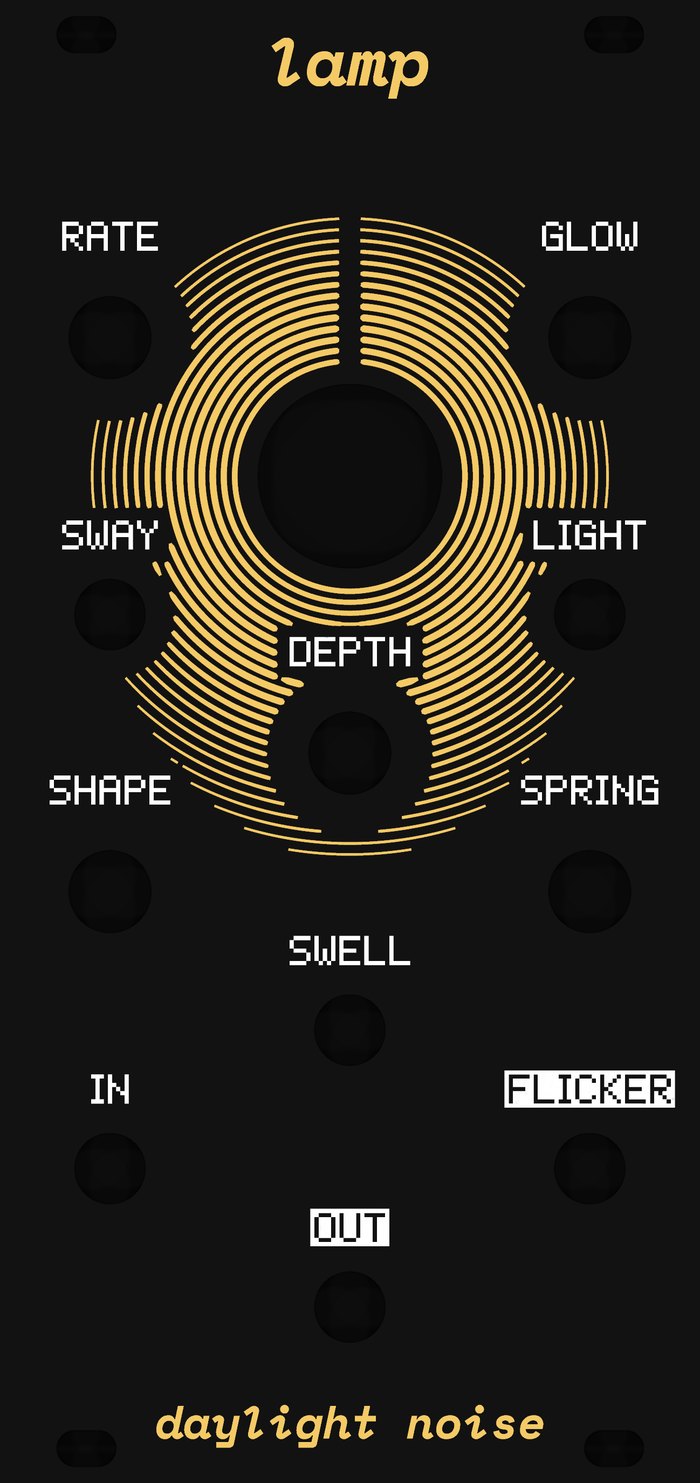
The LAMP panel: black, a round window near the top with a small bulb behind it, gold rings spreading round the window like the glow of a lamp, white labels, five knobs and six jacks. lamp at the top, daylight noise at the bottom.

Turn a knob: drag it, roll the wheel over it or use the arrow keys; a double click puts it back. The window shows the bulb as the engine heats it.

A chord, a sawtooth line, a drum loop or a lead into IN, all made in the page.

example patches

The module's engine running in your browser: the firmware's spring, ported from its C and checked against it bit for bit, and a model of the analog side, bulb and all. The window follows it.
The lamp

The LFO is analog: one OTA charges a capacitor between a Schmitt trigger's thresholds, and a second scales the wave. The bulb driver adds it to GLOW and LIGHT and holds the bulb at that voltage, with a current limit against a cold filament's inrush. The filament barely glows until it's warm, and the photocell holds the light a moment after it's gone, so the wave that reaches the sound has been rounded and delayed on the way.

The gate

The photocell's reading sets the gain of four matched cells on one chip, an SSI2164. The sound darkens as it dims.

The spring

The one digital part: after the gate, the signal goes through a converter, a model of a long two-spring tank on an RP2350, and back out, mixed in after the dry path, which stays analog.

A spring disperses sound: low notes run along it faster than high ones, so every echo arrives as a chirp, smeared further each trip. The model does the same with stretched allpass filters in each spring's loop, the first echoes at 32 and 38 ms. It reads the light too, so the tail wavers in time with the tremolo.

The tank's impulse response, computed by the firmware's spring in this page: time across, pitch up.

The panel

Three columns. Each CV jack sits under the knob it adds to.

The wave

RATE and SHAPE, down the left. IN, the audio input (100 k), at the foot.

SWAY → RATE · IN

The lamp

The window and the bulb behind it, DEPTH below, and OUT at the foot.

SWELL → DEPTH · OUT

The light

GLOW and SPRING, down the right, and FLICKER, the light as a CV, at the foot.

LIGHT → GLOW · FLICKER

The art is the bulb's light as a line screen: gold rings round the window, each as wide as the glow is bright there, cut above the window by a black stripe, the lamp's cord. The outputs, OUT and FLICKER, are knocked out of white blocks; everything else is an input.

Inside

The bulb lies on a gold pad that throws its light back up, run at most at 9.6 V on its 12 V rating. The photodiode faces it dome to dome in a black sleeve, so the room's light can't reach it. Both are soldered by hand, with the SSI2164, so a new bulb goes in the same way; the board house places the rest.

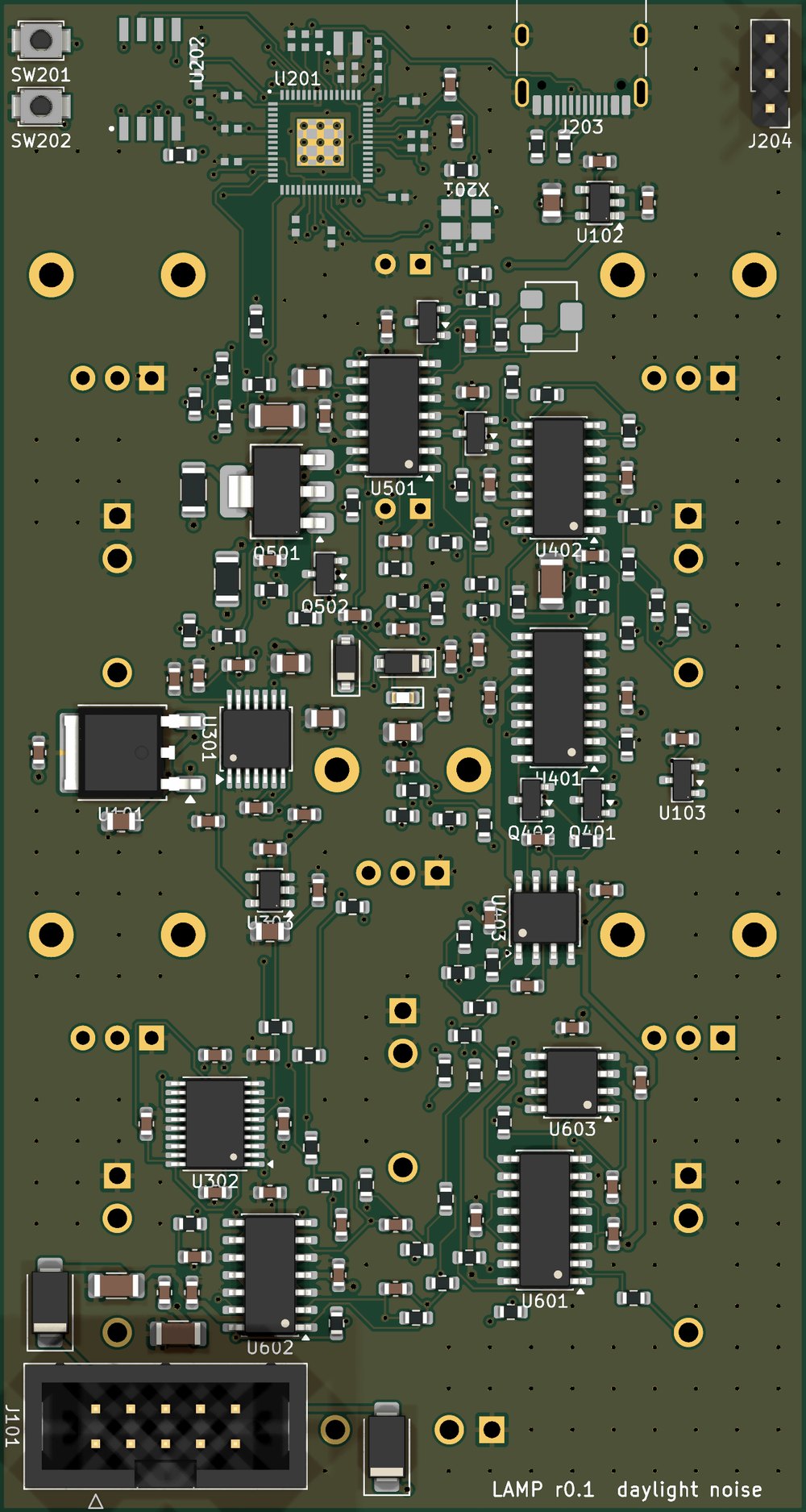
The back of LAMP's main board as KiCad renders it: black solder mask, the RP2350 and its flash and crystal at the top, the op-amps, the LM13700 and the SSI2164 down the board, the eurorack power header at the bottom right.

Drag to look around. Lift the panel for the bulb in its sleeve; turn it round for the back of the board.

Specs

Format

Standard
Eurorack, 3U
Width
12 HP
Depth
About 22 mm behind the panel to the top of the power header, plus the cable
Panel
FR4, black mask, gold (ENIG) art, a 16 mm window
Controls
RATE, SHAPE, DEPTH, GLOW, SPRING
Power
+12 V about 130 mA (the bulb up to 116 mA while it warms), −12 V about 35 mA, no +5 V

I/O

IN
Audio, 100 k, ±10 V
OUT
The gate plus the spring, unity through
FLICKER
The light, 0 to about 8 V at full GLOW
SWAY
Adds to RATE, linear; below zero stops it
SWELL
Adds to DEPTH, ±5 V across it
LIGHT
Adds to GLOW: about 1 V on the bulb per volt

Engine

LFO
Analog, LM13700: 0.07 to 20 Hz, triangle to square
Bulb
T-1, 12 V 60 mA (7219), fitted by hand
Cell
3 mm PIN photodiode, daylight filter
Gate
2-pole low-pass + VCA, SSI2164
Spring
Two springs on an RP2350, 46.875 kHz, 24-bit
Converters
PCM1808 in, PCM5102A out

Nothing's for sale yet.

LAMP is drawn, routed and checked, and its firmware builds, but nothing has been soldered: the numbers on this page are the design's, not measurements. There's no date.