kommissar

one man, then a crowd

20 HP

A deep German man's voice. Every gate he says one word, connected to the last. Press ROAR, or send it a gate, and he roars; ARMY brings a gang of him in with him; ANSWER has a crowd of him shout his words back. Hold JOIN and he fuses two words into one.

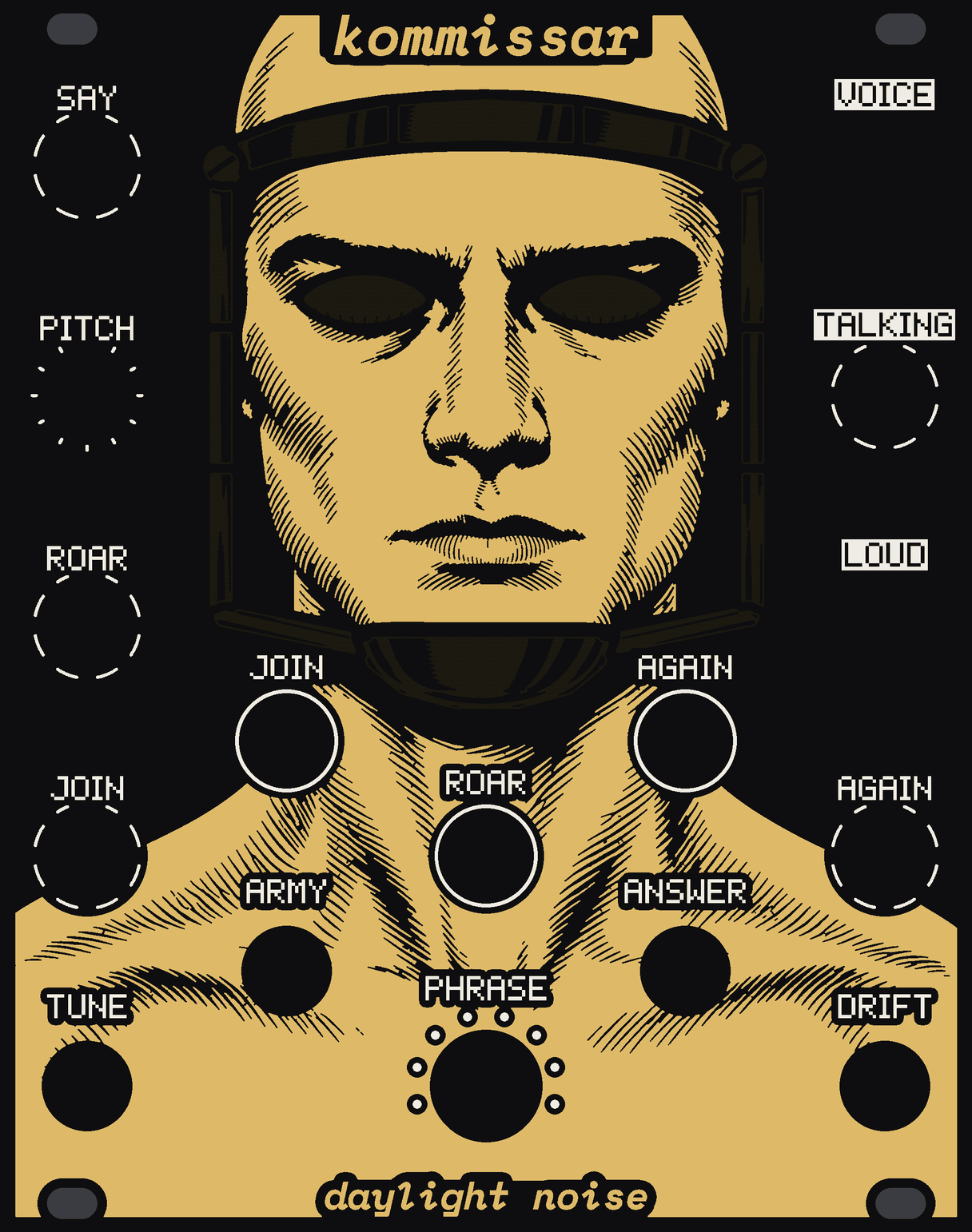
The KOMMISSAR panel: black and gold, a man's face drawn in black ink on solid gold, its shadows hatched, filling the top of the panel, his eyes shut, his head held in a polished steel brace: a band across his brow, a rod down each side of his face, a cup under his chin; his neck and bare shoulders run down behind the knobs. The steel, its shine inked in black stripes, and his eyes are bare windows for the light. Four jacks down each side, two buttons and two knobs (ARMY and ANSWER) either side of ROAR, a lit button in the middle; PHRASE, a knob with eight marks round it, under it; TUNE and DRIFT in the bottom corners.

Turn a knob: drag it or tap either side of it, roll the wheel over it or use the arrow keys; a double click puts it back. ROAR, the lit button in the middle, is how he says it: press it and he roars every word until you press it again. ARMY brings a gang of him in, ANSWER a crowd that shouts back. JOIN and AGAIN are buttons too: hold JOIN down (or a key) and every pair of words he can join, he joins; a tap joins the next pair. AGAIN stays on until you press it again; hold it a second to keep a chorus. The patches step on by themselves until you touch anything.

A stomp at 100 BPM, a march at 112, and his voice: synthetic, an ElevenLabs voice designed for the module, heard through the module's own 4-bit storage.

chorus: none kept, hold AGAIN

example patches

Everything KOMMISSAR does here is its engine as designed, running in your browser: the words he picks, when he says them and how, the gang, the crowd, the rhymes, the joins, talking in tune. His voice is synthetic, an ElevenLabs voice designed for the module, not a recording of any singer; the gang and the choir are more of him. What you hear is it through the module's own storage, 4 bits a sample at 24 kHz, as the real one keeps his words; the module runs this same engine, to the bit. The loop and the instruments round him are a stand-in rack.
Talking on the beat

Some of the heaviest records put a voice over the beat that doesn't sing a tune: a man saying one word at a time, low and deliberate, each word landing like a hammer on the kick, the whole line sitting on the track's note. Talk-singing. It turns a loop into a song without anyone having to write a melody, and it's hard to get from a sampler, because a sampled word only ever says itself one way and only the word you chose.

KOMMISSAR is that voice. He has 406 German words in fourteen topics and he picks them himself: every word follows from the last, by a rhyme or by meaning, so a run of them reads like a thought (Eisen, Hammer, Amboss, Funken: iron, hammer, anvil, sparks). You don't choose the words; you choose when, on what note, how hard and how far he wanders. The page shows each word's English under it.

Talking, or roaring

Every one of his words was recorded two ways: talked, stern, and shouted. ROAR picks which one you hear. It isn't an effect laid over one voice: a roared word is him roaring it, with the longer vowel and the higher, harder voice a shout has.

Call and response

A crowd shouting a line back at the stage is one of the oldest grooves there is: a call, a gap, the answer. ANSWER puts that crowd behind him.

What he says

Joining words

German builds new nouns by gluing words together: Hand and Schuh (hand and shoe) make Handschuh, a glove. JOIN makes him do it with his own words, so each gate can give a word nobody has said before: Eisen and Kind become Eisenkind (iron child), rot and Glut become Rotglut (red embers).

Talking in tune

What comes out

Inside

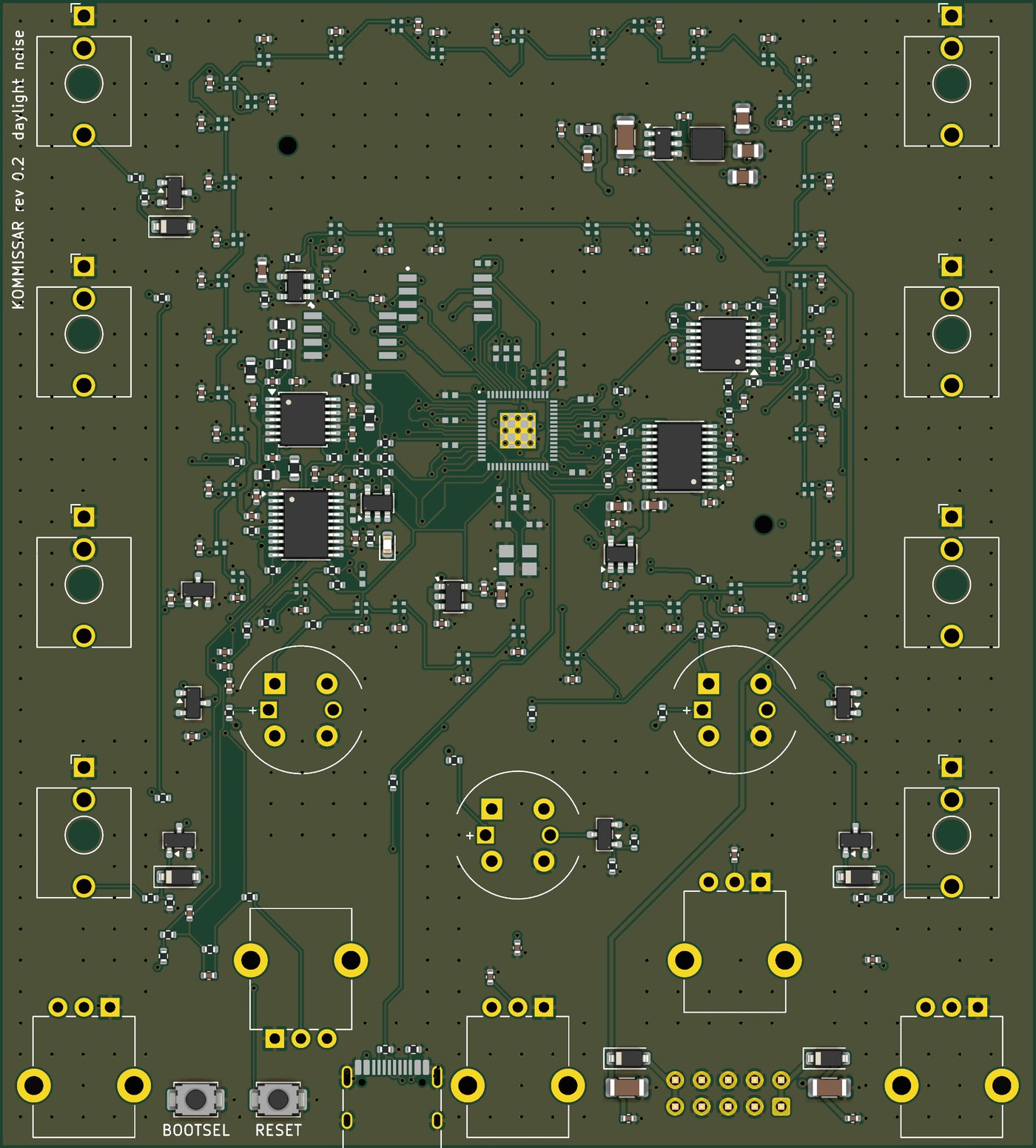
The routed main board's front as KiCad renders it: green, gold pads, four jacks down each side, the five knobs' pots and the three lit buttons in the lower half, the RP2350 in the middle with its two flash chips up and left of it and the converters and amplifiers either side, and 48 tiny LEDs in a ring round the top half, under the steel brace and his eyes; the USB-C and the power header at the foot.

Drag it or use the arrow keys to turn it; click it to take it apart.

Specs

Format

Width
20 HP
Depth
20.6 mm behind the panel, plus the power cable's plug
+12 V
about 130 mA quiet, 215 mA with the steel and his eyes at their brightest (estimated)
−12 V
about 4 mA (estimated)
+5 V
not used
Controls
four knobs (ARMY, ANSWER, TUNE, DRIFT), PHRASE a knob in eight steps, three lit buttons (ROAR, JOIN, AGAIN)
Lights
the steel brace in fourteen cells (ROAR), his eyes in two (the gang), a flash for the choir: 48 RGB LEDs held under 290 mA

I/O

SAY
gate, high past about 0.9 V, safe to ±12 V: a word each rise, up to four at once; unpatched, he talks by himself
PITCH
1 V an octave, 0 V on C3, read to ±6 V with 24 bits and calibrated; folded into each way's own octave
ROAR
gate: high past about 1.2 V, he roars (as when the button's on); a gate rising with SAY's roars that very word
JOIN
gate, as SAY: high, every pair that fits is joined; a rise joins the next pair; patched and low, no joins
AGAIN
gate, as SAY: high, the chorus, or his last sentence
VOICE
audio, a word's peaks to about 4.5 V, rounded off above 5 V, never past 8 V
TALKING
gate, 5 V while any word sounds
LOUD
CV, 0 to 8 V, DC

Engine

Brain
RP2350 at 192 MHz: this page's engine, line for line and to the bit, at 24 kHz, out at 48 kHz
His words
406 German words in fourteen topics of twenty-nine, each said two ways (stern, roared): 812 takes, 4 bits a sample at 24 kHz, 8.1 MB in flash
New words
loaded over USB, under a minute
Gate to sound
about 7.5 ms, a fixed lead the module keeps over its busiest moments
Power cycle
PITCH's calibration kept