janken

nobody ever wins

20 HP

A three-way mixer. Rock, paper and scissors each duck the one they beat, so one part takes the stage, then the one that beats it, round and round. Turn up FEED and the music fights back.

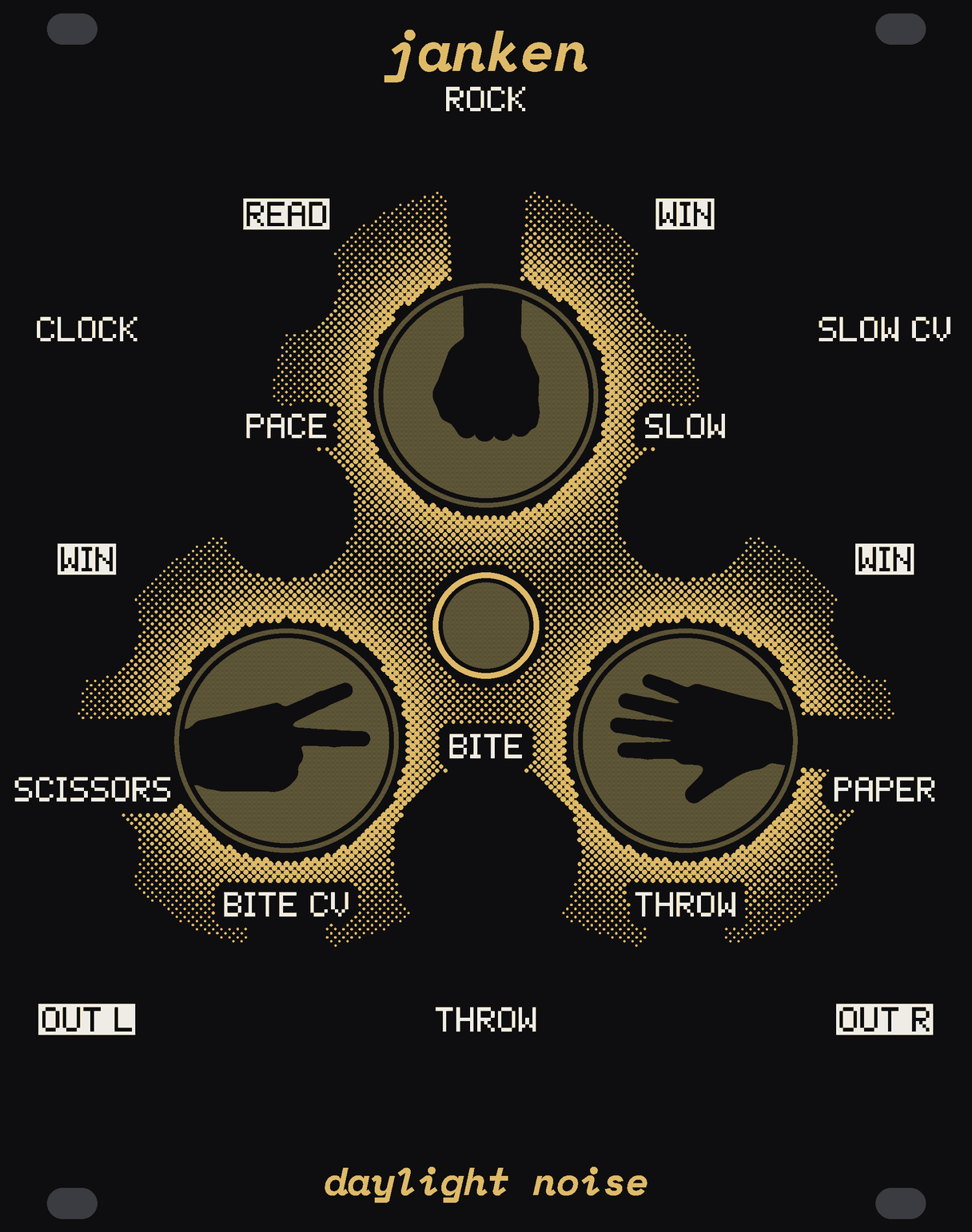
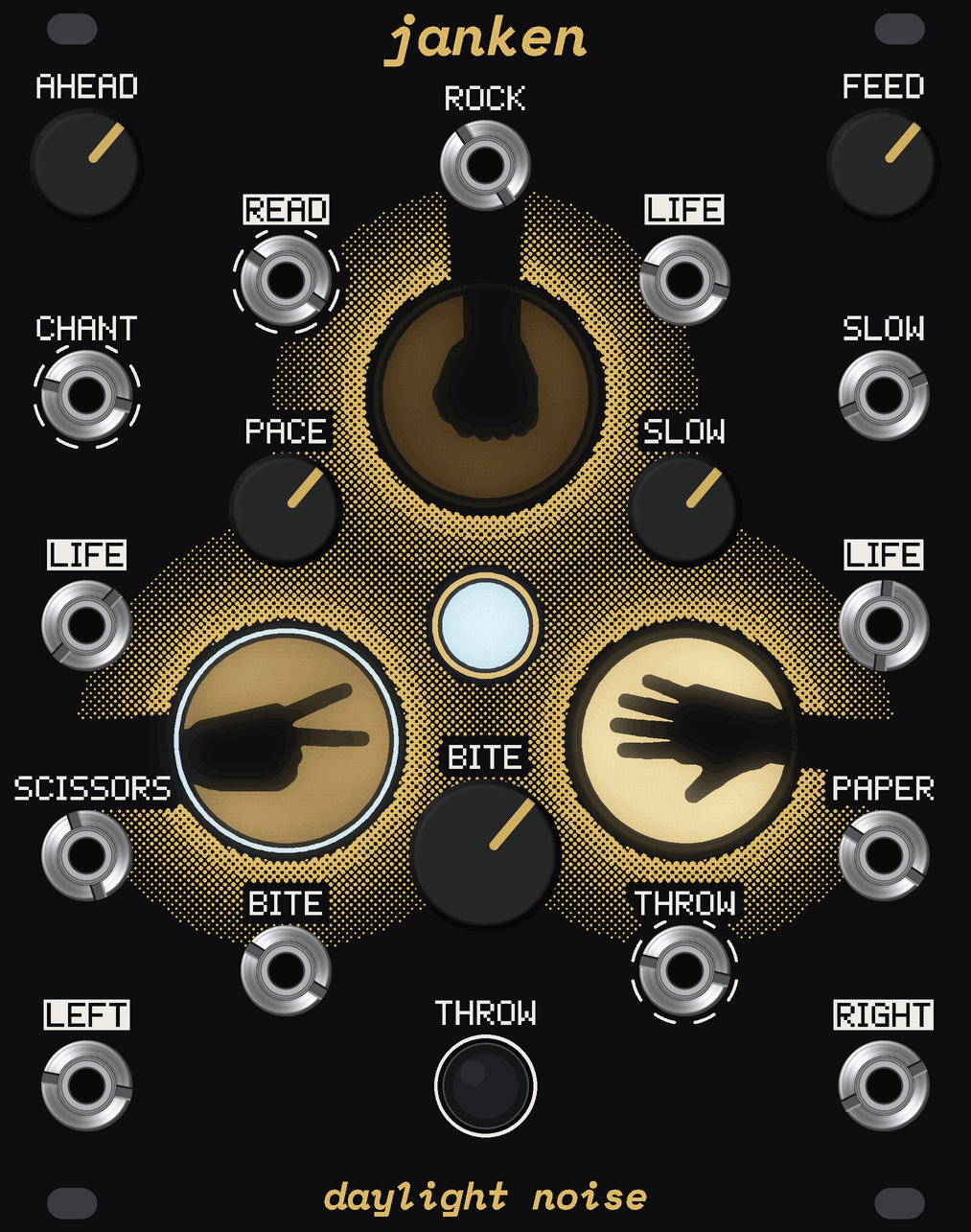
The JANKEN panel: black, with three round windows of bare circuit board at the corners of a triangle, a hand's shadow in each: a fist at the top, a hand making scissors lower left, an open hand lower right, each arm's shadow running out to its input. A small round window sits between them, and gold dots fall away from the three windows like pools of light. White labels: ROCK at the top, SCISSORS and PAPER down the sides; PACE, SLOW and the big BITE in the gaps between the hands, the THROW button at the foot; AHEAD and FEED in the top corners; CHANT, READ, BITE (its CV in) and LEFT down the left, SLOW (its CV in), THROW and RIGHT down the right, and a LIFE beside each hand; a dashed white ring round CHANT, READ and THROW's jack. janken at the top, daylight noise at the bottom.

Turn a knob: drag it or tap either side of it, roll the wheel over it or use the arrow keys; a double click puts it back. THROW is a button to press.

The mixing is JANKEN's own. The three parts of the song and the riser are made in the page as you listen. Each patch starts from a fresh deal.

example patches

The contest, the gains, the read and the lights here are JANKEN's engine as it's designed, running in your browser: who holds the stage, for how long, how hard it ducks the others. The song is a stand-in for the rest of a rack.
The contest

Patch three parts of one song into ROCK, PAPER and SCISSORS. Each ducks the one it beats: paper covers rock, scissors cut paper, rock blunts scissors. So none of them can stay on top. One part takes the stage, the one that beats it comes up and takes it over, then the one that beats that, round the triangle, clockwise on the panel. The mix never settles. Janken is rock, paper, scissors in Japanese.

The turns

A fresh deal starts with all three level and a flurry of quick turns. Then each part holds the stage a little longer than the one before, as long as SLOW lets it, until you throw again.

The read

JANKEN works out each turn before it comes, so it can tell you who's next. A little before every change, the ball in the middle comes up and a ring lights round the hand about to win, both in a cold light, before you hear it. With FEED down it's never wrong; with FEED up it reads the music as it is now, and the music can prove it wrong.

What comes out

Each hand's window is lit warm, as bright as its part's share of the mix.

Inside

The JANKEN panel in mid-turn: PAPER's hand lit warm, SCISSORS coming up with READ's cold ring round it, ROCK nearly out, the ball up, its knobs, jacks and the black button.

Drag it or use the arrow keys to turn it; click it to take it apart.

Specs

Format

Width
20 HP
Depth
20.8 mm behind the panel, plus the power cable's plug
+12 V
about 120 mA in use, 40 mA dark at boot, 180 mA with its lights at their cap (estimated)
−12 V
about 5 mA (estimated)
+5 V
not used
Controls
5 knobs (BITE's big), a button

I/O

ROCK, PAPER, SCISSORS
audio or CV, DC-coupled, ±10 V, read to ±12 V
CHANT
the clock in: up past 1.5 V, down under 0.8 V; unpatched, the turns run free
THROW
a trigger, up past 1.5 V
BITE, SLOW
CVs: ±5 V adds or takes away half the knob, read to ±12 V
LEFT, RIGHT
the mix, straight to 8 V, a soft knee that never passes 10 V
LIFE
three, one a hand: 0 to 8 V, adding up to 8 V
READ
a 5 V gate from the read to the turn

Engine

Brain
RP2350 at 62.5 kHz, 32-bit float
The mix
digital, DC-coupled: DC to 16 kHz, about 73 dB of signal to noise for a 10 V swing (estimated)
In to out
1.8 ms
The contest
a thousand times a second, on the samples' own count
Light
29 white LEDs, warm in the hands, cold in the rings and the ball, 200 frames a second
Power cycle
a fresh deal; only the calibration is kept