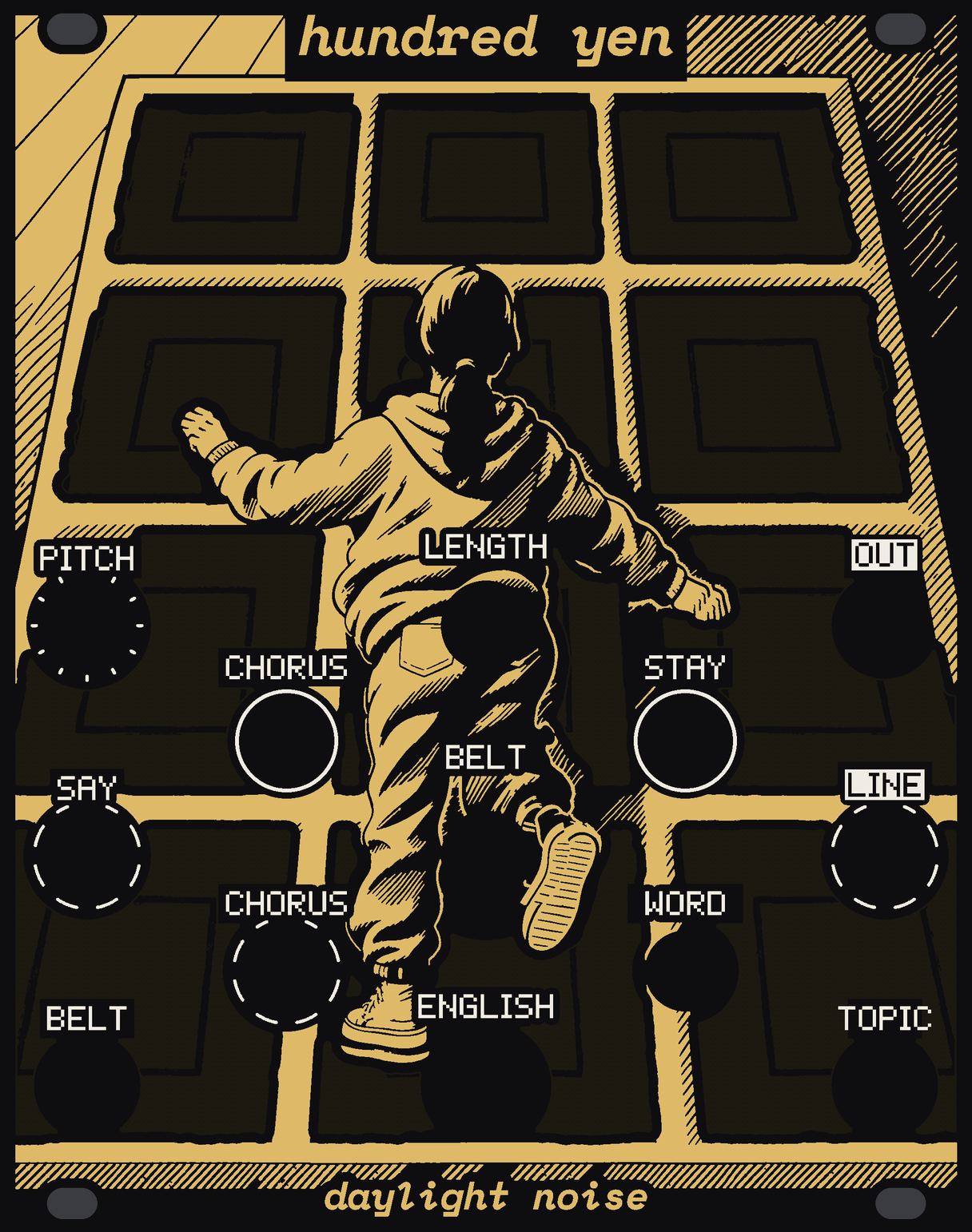
her chorus goes English
20 HP
A Japanese voice for your rack. Every gate is one whole word she picks herself, in her own voice; turn up ENGLISH and each line ends on an English word, the way J-pop choruses do. BELT takes her from a breathy ballad to the full chorus belt. TOPIC and WORD let a sequencer write her lyrics.
Turn a knob: drag it or tap either side of it, roll the wheel over it or use the arrow keys; a double click puts it back. BELT, the big one, is how hard she sings: a breathy ballad fully left, the full chorus belt at full. ENGLISH turns the end of each line into English. STAY keeps her on the word she's on, every note, until you press it again; CHORUS stays on until you press it again. The patches step on by themselves until you touch anything.
example patches
Everything HUNDRED YEN does here is its engine as designed, running in your browser: the words she picks, her English, when each word starts, the words you write. Her voice is a stand-in made with ElevenLabs, not a recording of any singer, heard through 4 bits a sample at 24 kHz the way a module would keep it. Nobody has listened to it yet: it's checked by measurement. The band round her is a stand-in rack.
Patch a gate into SAY and every rise is one whole word, the next one she picks, the way she said it: her own voice, her own pitch, her own pace. Play her a melody and she sings along with it, a word a note, the way a singer talks a line over a song. Your notes don't bend her voice; a low note leans her soft and a high one has her belt.
You don't write the words. She picks them herself, everyday Japanese words like sora (sky), kaze (wind) and hikari (light), and each one is connected to the last. Each word is one recording, start to end, about half a second, so give her room: a half note at a brisk tempo suits her. The page shows each word in Japanese, its romaji under it, and its English.
Japanese is built from short, even syllables, and nearly every one ends on an open vowel: a, i, u, e, o. A sung vowel can be held as long as you like, and each syllable usually gets its own note when Japanese is set to music. That's what makes it such a good language to sing: nothing piles up between the vowels.
Singers change how they use their voice as a song builds. A verse is often sung soft and close, the chorus pushed out full and bright: belting, the big chest voice pop singers use for the high notes. BELT is that, from fully left, a breathy ballad, to full, the whole chorus belted.
J-pop sings in Japanese and drops into English for the hook, usually on the last word of a line, where the long note is: a Japanese line that lands on forever, or baby. ENGLISH does that to her lines.
The other voices in this line pick their own words and won't be told. This one you can write for. Two CV inputs pick the exact word she sings on each gate, off a chart of all 336: TOPIC is which of her twelve topics, WORD which of its twenty-eight words. Two more tracks on your sequencer and a pattern becomes a lyric she sings back the same way every time round.
Pick a topic, then press any of its words: press Listen first and she sings it, in the voice she's in. The word she's singing lights up.