12 HP · drone voice
The hum of a power line, played. A switch picks 50 or 60 Hz, and that frequency runs everything: PITCH walks up its harmonics, the transformer's buzz ripples at twice its rate, and the arcs crackle on its half-cycles. Every arc fires FLICKER, a gate made to be patched to a light, a video module or an envelope.
Turn a knob: drag it, roll the wheel over it or use the arrow keys; a double click puts it back. Click MAINS to flip it between 50 and 60 Hz.
example patches
The module's own engine, ported from its firmware and checked against it sample by sample, running in your browser. The knobs and MAINS go to each patch's settings, and the engine plays them wherever you leave them.
HUM isn't a sample and isn't connected to the mains: it runs on your rack's ±12 V. The mains is a number in its engine, and the whole voice keeps time with it. Flip MAINS from 50 to 60 and the note, the buzz and the arcs' clock move together, by 6:5, a minor third.
PITCH covers four octaves and lands on every harmonic of a quarter of the mains, the 2nd to the 32nd: 12.5 Hz steps at 50, 15 Hz at 60. It holds still for a moment round each one, so the knob clicks from harmonic to harmonic, and moves freely between. Noon is twice the mains, a transformer's own hum: 100 Hz at 50, 120 Hz at 60. On a harmonic the buzz and the voice lock into one sound; off it, they beat, like two machines on the same line.
V/OCT transposes the grid, unsnapped. Calibrated at 1 V and 3 V, it tracks within half a cent from −1.9 to +7.9 V in the desktop tests, which model the input stage's part errors and noise.
An arc is a burst of filtered crackle with a snap at the front. Random arcs come in clusters, as real ones do, and only start on a peak of the mains, 100 or 120 times a second, so even a storm keeps the line's time. Each one sags the voice for a moment.
FLICKER fires on every arc, random or from STRIKE, on the same sample as its sound. Through a VCA or a light driver, a lamp flashes with the arcs. Into an envelope, they duck or swell another voice; into a video module, they drop the picture out for a frame.
GROWL, SPARK and BROWN add to their knobs: ±5 V sweeps the whole knob either way.
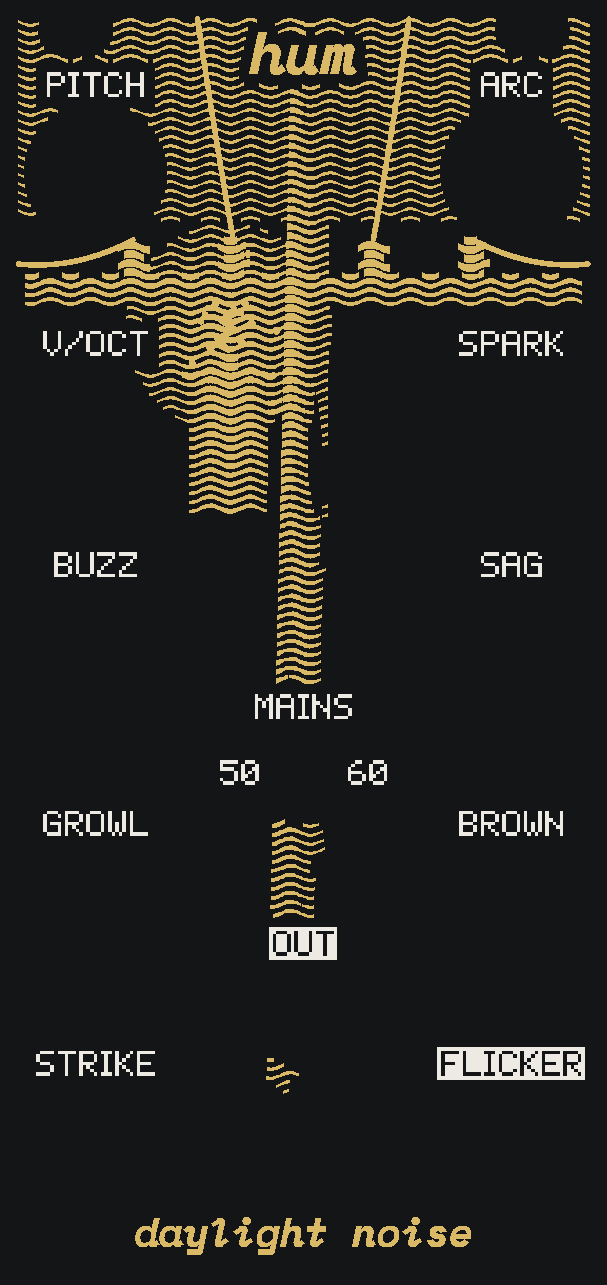
The art is a power pole at night, the transformer on it throwing a spark, drawn in wavy horizontal lines of gold-plated copper through the black mask; each line widens where the picture is brighter. The parts sit on the line's staggered grid, and the outputs are knocked out of white.
The voice is a small engine in portable C. It runs on the module's RP2350, in a desktop simulator with its own tests, and on this page, ported line by line to JavaScript. Each build is checked against the C on one script of knobs, CVs and gates: every arc and FLICKER edge on the same sample, the sound matching to rounding.
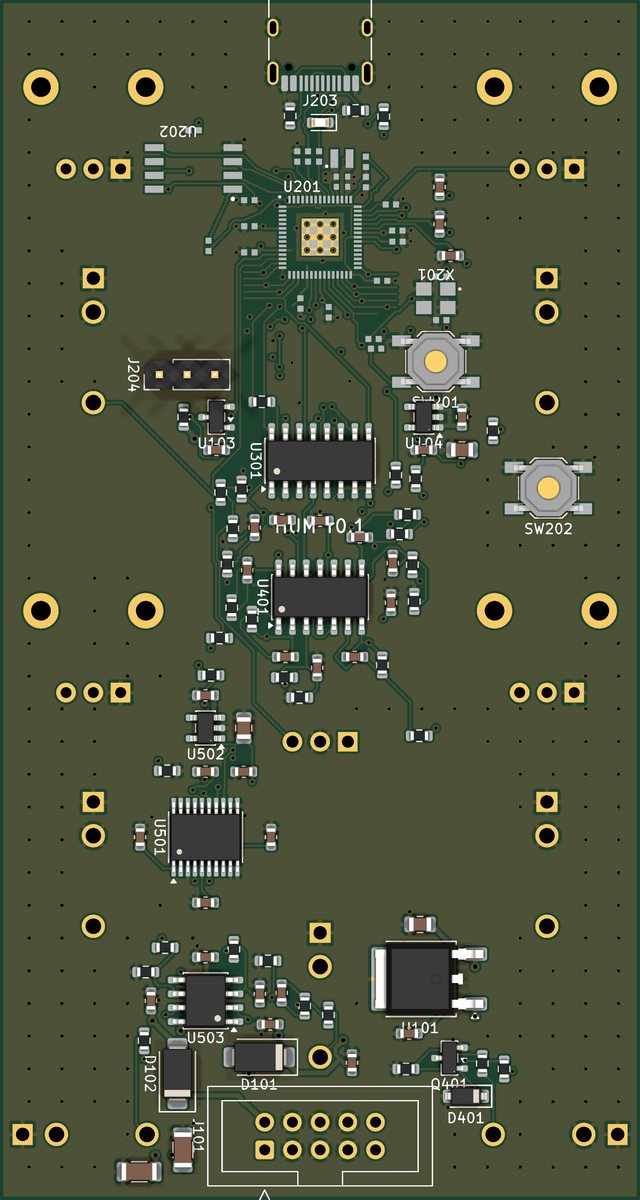
The board is four layers, the surface-mount parts all on the back: the RP2350 at 153.6 MHz (an exact multiple of 48 kHz), a 32-bit PCM5102A DAC, op-amp stages for the CVs and OUT, and a 3.000 V reference the ADC reads every knob against.
Drag to look around. Lift the panel off its jacks, or turn it round for the routed board's back.
HUM's board is routed and passes its checks, the panel is drawn, and the firmware passes its tests on the desktop. Nothing has been built or played on hardware yet, and there's no date.