house band

a band that plays along

20 HP

Plug in anything you play and a band plays along: a drummer, a bass player and a keys player. They find your key, change chord when you do, keep your time, and lay back when you play softly or build when you play hard.

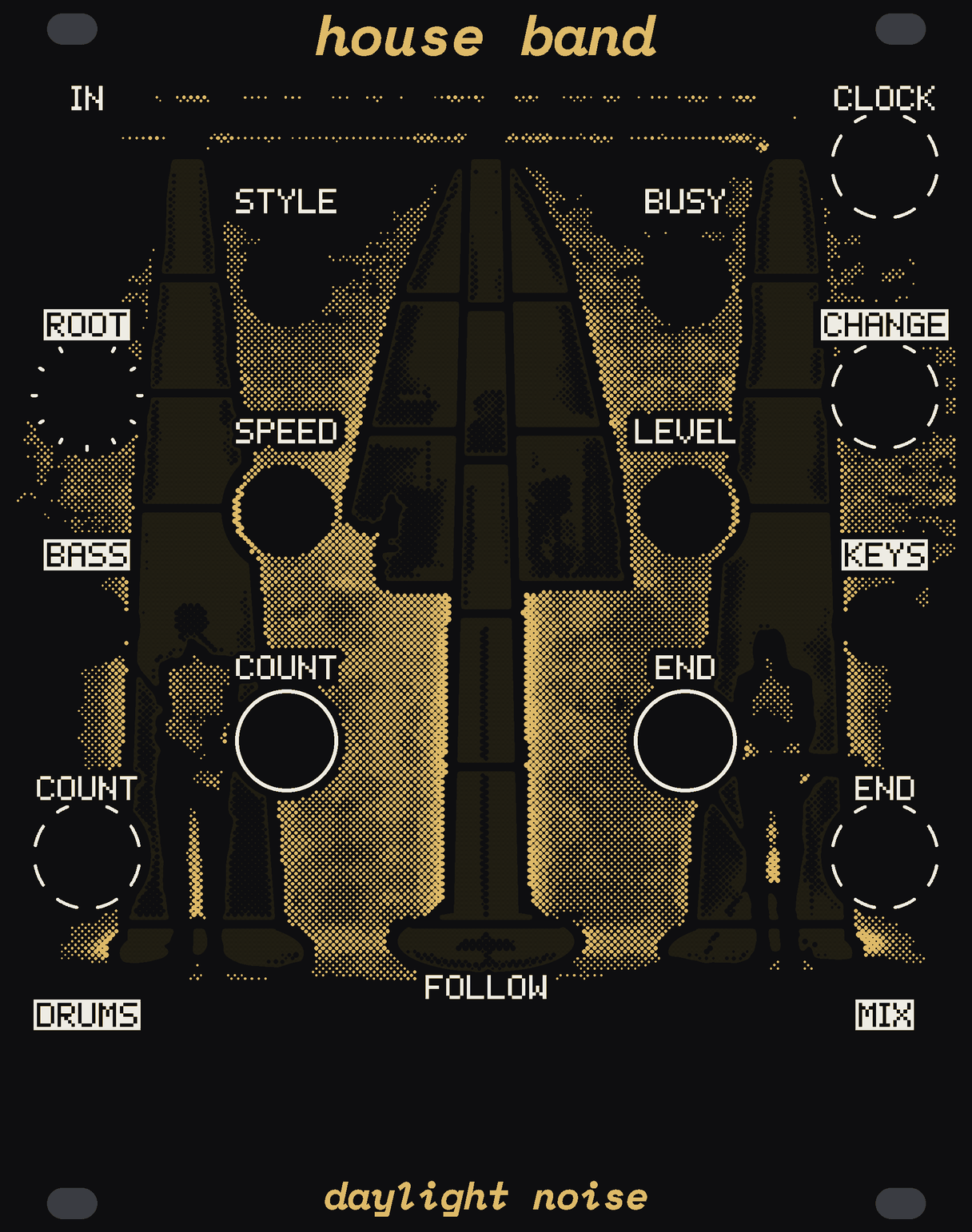
The HOUSE BAND panel, black and gold: a photograph of a small pub stage at night through haze, a bare brick wall behind. From a lighting truss across the top, four beams of light fall through the haze: a straight one down the left edge onto a bass player in silhouette, a straight one down the right onto a keys player behind a keyboard on an X stand, a wide cone down the middle onto a drummer behind a small kit on a riser, and a narrow beam in front of it onto an empty microphone on its stand at the front of the stage, nobody at it. Each beam ends in a pool of light on the floorboards. The beams are bare glass for light, cut across into cells, the haze and the players showing through as fine black dots. FOLLOW, the big knob, sits in the dark room below the stage; the other knobs and the two buttons sit between the beams, the jacks down both edges.

Turn a knob: drag it or tap either side of it, roll the wheel over it or use the arrow keys; a double click puts it back. Press COUNT and the drummer counts the band in; press END and they finish. The patches step on by themselves until you touch anything.

Synthesised here, as the module would make it: the drums, the bass and the keys, played along to a stand-in rack.

example patches

Everything HOUSE BAND does here is its engine as designed, in your browser: it hears only what comes into IN. The whistle, the synths, the pad and the beeps that play into it are a stand-in rack.

One cable, a band

You can make a sound. A band makes it a song: drums keeping time, a bass under it, chords filling it out. HOUSE BAND is those three players, sitting in with whatever you play.

Put anything into IN: a synth line, a sequence, chords, a guitar, a whistle. Take MIX to your mixer: you and the band together. Press COUNT, or just start playing. Every knob at noon is a good band.

It listens

It hears which notes you're playing, single notes or chords, and works out your key: the set of notes your tune lives in. On every beat it picks the chord your notes belong to, from that key's own chords. The bass plays that chord's bottom note, its root; the keys play the chord, moving as little as they can from one to the next.

Loud and quiet

Five bands

Count in, and end

How close it follows

In a rack

Specs

Format

Width
20 HP
Controls
five knobs (FOLLOW, STYLE, BUSY, SPEED, LEVEL), two lit buttons (COUNT, END)
Lights
four beams in 22 cells: the bass player's, the keys player's, the drummer's, the mic's

Inputs

IN
audio, what you play: the band hears this and nothing else
CLOCK
clock, a pulse every sixteenth; unpatched, the band keeps its own time
COUNT
gate: a rising edge counts the band in
END
gate: a rising edge ends the song

Outputs

MIX
audio, you and the band
DRUMS
audio, the drums
BASS
audio, the bass
KEYS
audio, the keys
ROOT
1 V an octave, the chord's root (0 V is C3)
CHANGE
trigger, 10 ms each time the chord changes