honeycomb

20 HP · sequencer

A sequencer you don't write. Workers walk a comb of thirty-seven lit cells, each a note. Every visit leaves honey, the cells they keep coming back to fill and play, and the tune settles into their paths.

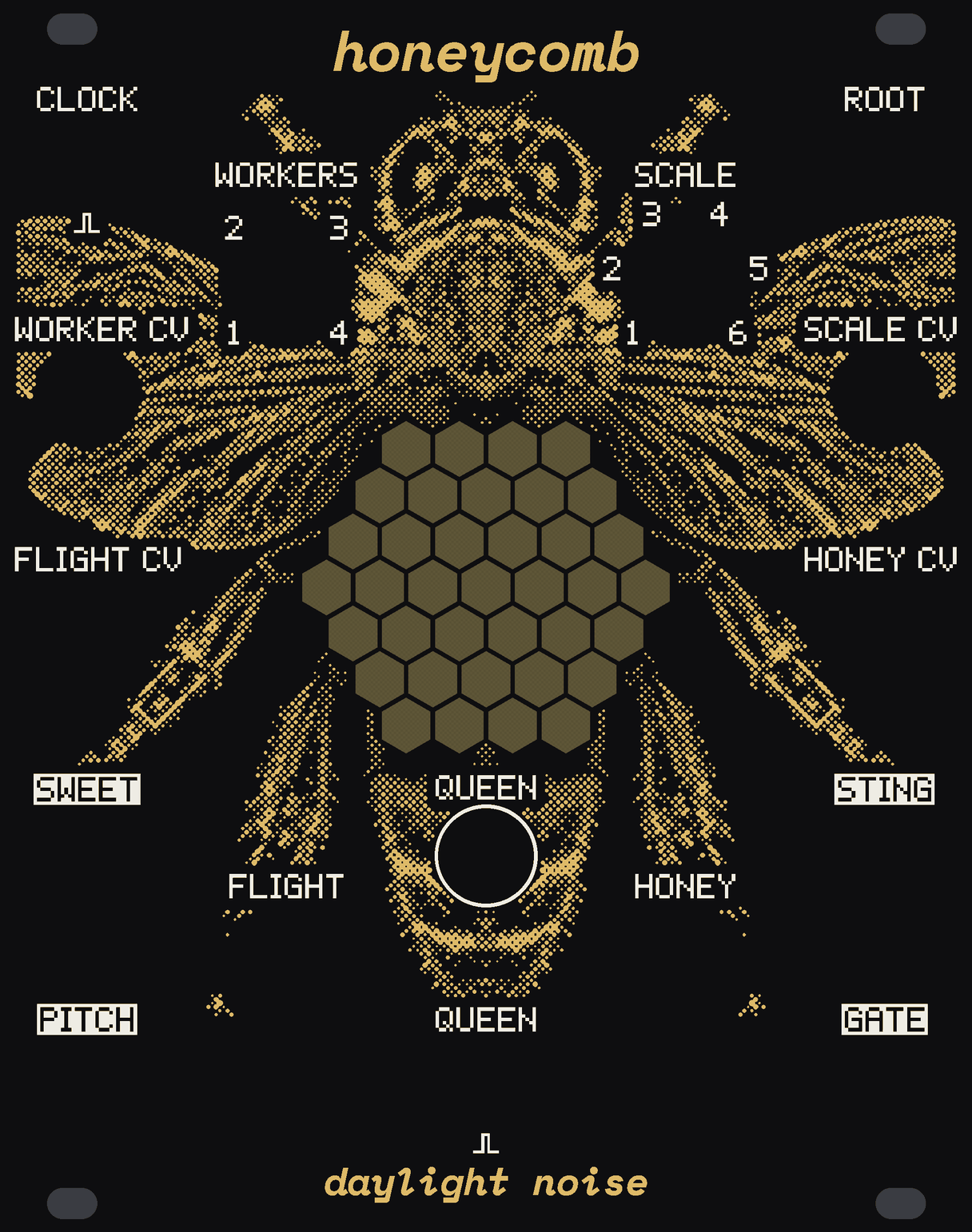
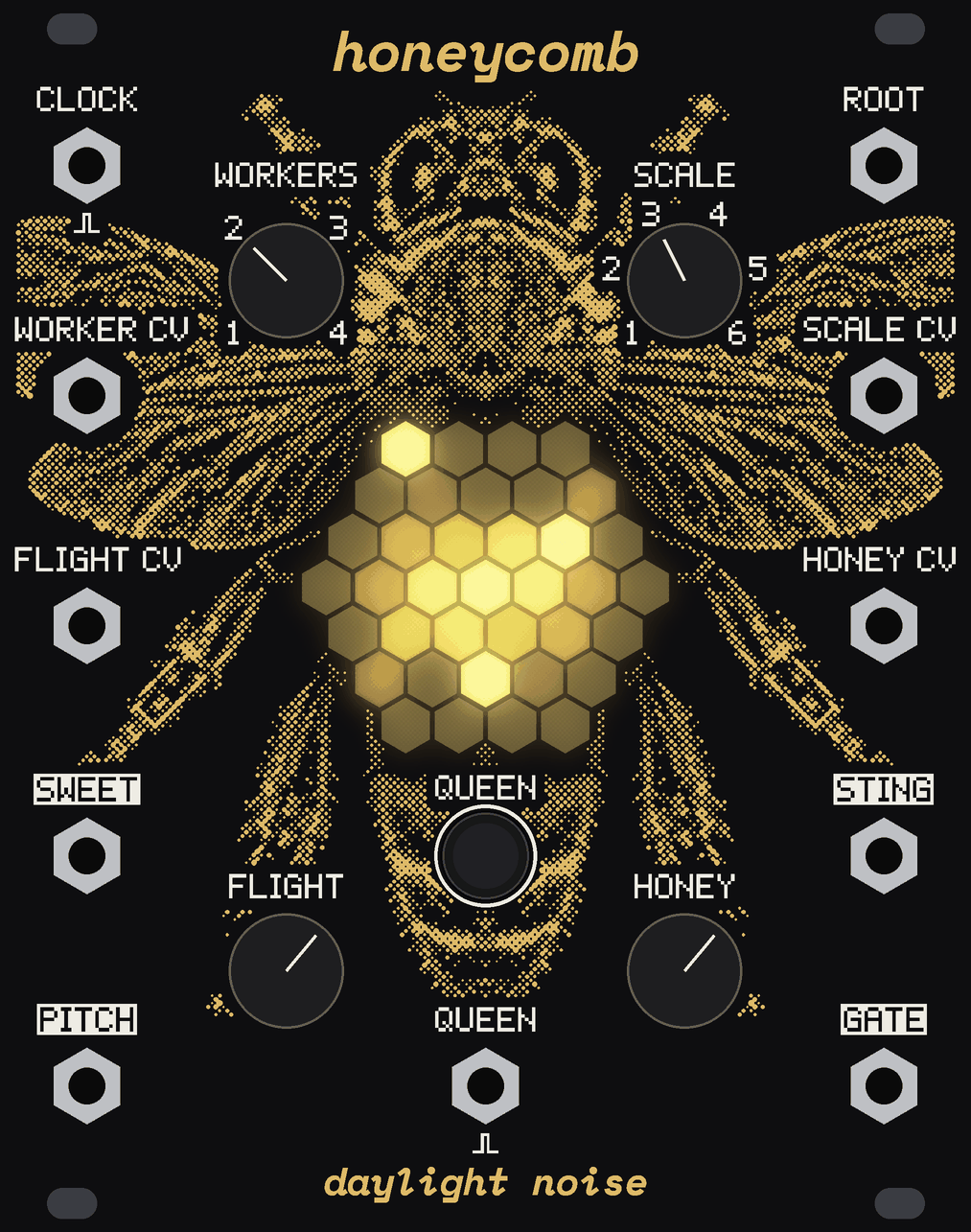
The HONEYCOMB panel: a honey bee in gold dots on black, seen from above and pinned out like a specimen, its head under the name, its wings spread wide and its body running down to the foot. Over its middle is a comb of thirty-seven hexagonal cells of bare circuit board. White labels: CLOCK and ROOT in the top corners, the numbered knobs WORKERS (1 to 4) and SCALE (1 to 6), the jacks WORKER CV, SCALE CV, FLIGHT CV and HONEY CV down the edges, the knobs FLIGHT and HONEY either side of the body, QUEEN's button in a white ring under the comb and its jack below it, and the outputs SWEET, STING, PITCH and GATE near the foot. honeycomb at the top, daylight noise at the bottom.

Turn a knob: drag it, roll the wheel over it or use the arrow keys; a double click puts it back. WORKERS and SCALE click from number to number. Press QUEEN to call the workers home and take the honey.

The clock, the drums, the bass and the voices are made in the page as you listen. Each patch starts from an empty comb, so the first notes take a few seconds.

example patches

The comb and the notes here are HONEYCOMB's own engine, its firmware's, running in your browser: where each worker steps, the honey it leaves, what plays, how the cells light. HONEYCOMB makes no sound of its own; the clock and everything you hear are stand-ins for the rest of a rack.
The comb and its notes

Thirty-seven hexagonal cells of bare circuit board, lit from behind, each a note. The middle cell is ROOT. The cell next door is always a third or a fifth away in the scale, so any three cells that touch make a chord: the middle of the comb is the chord on ROOT, with the sevenths and ninths further out. Across the comb the notes rise from left to right, up to about two octaves either side of ROOT.

The workers and their flight

On every clock one worker takes a step, the next in turn, so the notes keep the clock's pace however many are out. A worker plays the cell it lands on only if there's honey enough in it. No two workers share a cell.

Honey, and how the tune settles

Every visit leaves honey, and a cell plays once it holds a quarter. So a fresh comb is silent: the cells a worker comes back to start to sound, and glow brighter as they fill. Each worker follows the freshest honey it has laid, so it keeps coming back. The cells it walks fill, the full cells get walked, and within a few bars it's walking a short path, often three cells that touch: a chord picked out a note at a time.

Now and then a worker tries an empty cell, and the path drifts. Honey dries: a little of it in seconds, a full cell over a minute. A path that's still walked stays full; an old one fades.

The queen

QUEEN, the button or a trigger at its jack, calls every worker home to the middle and takes the honey. The comb drains in half a second and goes dark, and the tune grows again from silence. A clock divider into QUEEN gives a new tune every so many bars.

The outs

The panel

Twenty HP, every part on the line's staggered grid and mirrored about the middle. The art is a honey bee in gold dots, pinned out like a specimen with its wings spread round the comb. The comb is bare circuit board in the middle of the panel, lit amber from behind, a light of its own under every cell.

Inside

One four-layer board sits 10 mm behind the panel, with the jacks, the knobs, QUEEN's key switch and an RGB LED under each of the 37 cells on its front, and everything else on its back. A printed black block between them gives every cell a chamber of its own, so each window is lit by its own LED. An RP2350 runs the walk 4,000 times a second; a clock edge reaches it 1.5 ms after it arrives, so a ROOT that changes with the clock has settled first. PITCH and SWEET come from a 16-bit DAC, and each unit's ROOT and PITCH can be calibrated over USB with a meter.

The HONEYCOMB panel playing, its comb lit along the workers' paths, with its knobs on.

Drag to look around. Lift the panel to see the baffle's cells, lit from the LEDs on the board.

Specs

Format

Width
20 HP
Depth
about 21 mm behind the panel, to the top of the power header (estimated)
+12 V
about 85 mA with the comb dark, up to 185 mA lit (estimated)
−12 V
about 5 mA
+5 V
not used; 10-pin header
Panel
1.6 mm FR4: 37 bare glass cells, gold through black mask
Controls
4 knobs, 1 button

I/O

CLOCK, QUEEN
gates or triggers, high above about 1.2 V
ROOT
1 V an octave, −2 to +8 V, rounded to the semitone
CV ins
WORKER, SCALE, FLIGHT, HONEY: ±5 V across each knob
PITCH
1 V an octave, 16 bits; notes past −2.83 or +7 V fold by an octave
GATE
5 V for half the clock
SWEET
0 to 8 V
STING
5 V, 5 ms

Engine

Brain
RP2350, 4 kHz, 32-bit float
Timing
a clock edge to a note 1.5 to 1.75 ms, every time
Light
37 RGB LEDs, one behind each cell, their current capped
Firmware
over USB-C or the debug header, on the back