higher

push it at the top

20 HP

A playground swing as an LFO you drive. It swings at its own rate. Push it at the back and it goes higher; push it early and it loses height; leave it and it dies down. JUMP lets the rider go from the top, and they land.

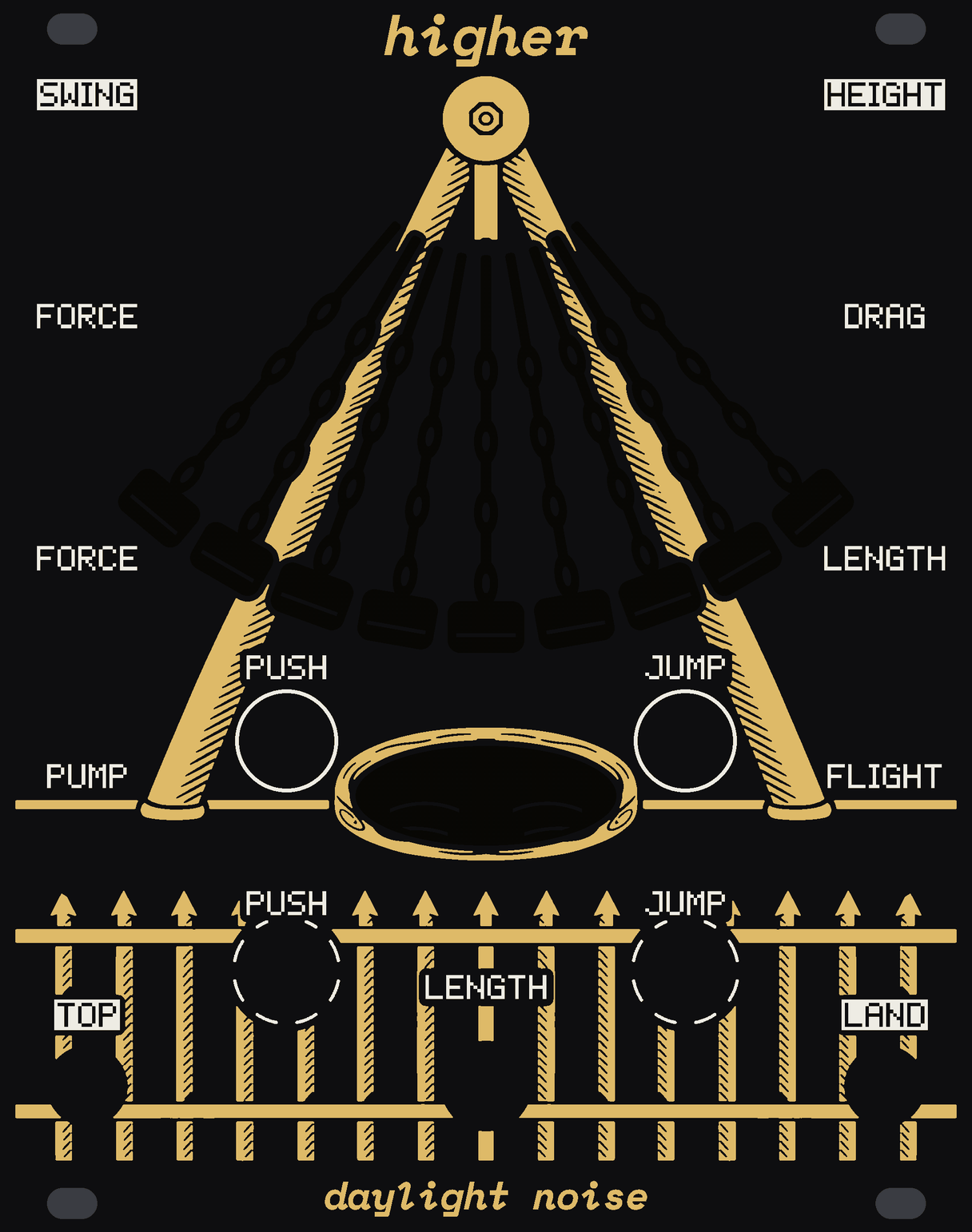
The HIGHER panel, black and gold: a playground swing seen end-on, drawn in bold ink, its A-frame's two steel legs splaying from the top beam's round end cap at the top of the panel down to the ground, a hollow of sand edged with timber under the swing, and iron railings with spear tips along the foot. From the pivot hang nine chains, each ending in a seat, a fan through the swing's arc from forty degrees back to forty forward: each chain and seat is bare glass for light. The jacks and knobs run up both edges; PUSH and JUMP, two lit buttons, sit either side of the sand over their jacks; LENGTH, the big knob, at the foot among the railings.

Turn a knob: drag it or tap either side of it, roll the wheel over it or use the arrow keys; a double click puts it back. Press PUSH to push the swing (try it as the seat turns at the back) and JUMP to let the rider go. The patches step on until you touch anything.

Synthesised here. HIGHER makes no sound of its own: its outs play a stand-in rack.

example patches

HIGHER here is its engine as designed, in your browser: it hears only what comes into its jacks. The pulse, the piano, the pad, the drums and the plate are a stand-in rack.

Push it at the top

HIGHER is a swing. Left alone it hangs still. A gate into PUSH, or a press of its button, pushes it, and it swings back and forth at its own rate: SWING is the seat, a smooth voltage there and back.

Like a real swing, it matters when you push. A push that comes just as the seat turns at the back sends it higher. One that comes early shoves against it while it's still coming at you, and it loses height. One that comes late barely touches it. Push it on time, swing after swing, and it climbs; stop and it dies down.

The swing

Pushing on a clock

Jump

A gate into JUMP gets the rider ready, and they let go at the next top. While they fly, HEIGHT follows them: up a little more, then down to nothing as they land. Then LAND thumps, as big and as long as the jump was high, and the sand lights where they came down. FLIGHT is how long they're in the air, a hop to four seconds. The empty seat jangles to a stop and the rider climbs back on.

Patched to a rack it's a build and a drop: HEIGHT a riser, the jump its peak, LAND the hit, all on your timing.

Pumping

PUMP is the rider leaning into it. Turned up past DRAG, the swing keeps itself going after one push, at the height where the two meet: a steady LFO whose depth you set. Below DRAG it just dies down more slowly. From still, pumping does nothing: it needs a push.

In a rack

Specs

Format

Width
20 HP
Controls
a big knob (LENGTH), four knobs (FORCE, DRAG, PUMP, FLIGHT), two lit buttons (PUSH, JUMP)
Lights
10 windows on 51 RGB LEDs: nine places of the swing, each a chain and a seat, and the sand
Replaces
an LFO, an envelope follower, a slow envelope and a triggered envelope, with the patching between them
Parts
a demo for now: the line's knobs, jacks and buttons, no board yet

Inputs

PUSH
gate: each rising edge pushes the swing
JUMP
gate: the rider lets go at the next top
FORCE
CV, added to FORCE, +5 V the whole turn
LENGTH
CV, +1 V swings twice as fast

Outputs

SWING
the seat, −5 to +5 V
HEIGHT
how high, 0 to 8 V; in a jump, the rider
TOP
trigger, 8 V, at each top
LAND
the landing, up to 8 V and falling