hearsay

nobody saw it the same

20 HP

Play it a phrase and four witnesses tell it back at once, each on its own pitch and gate, each by its nature: one tells it bigger, one slower and lower, one backwards from below, one exactly as it was but a note short. One melody becomes four parts that agree and disagree.

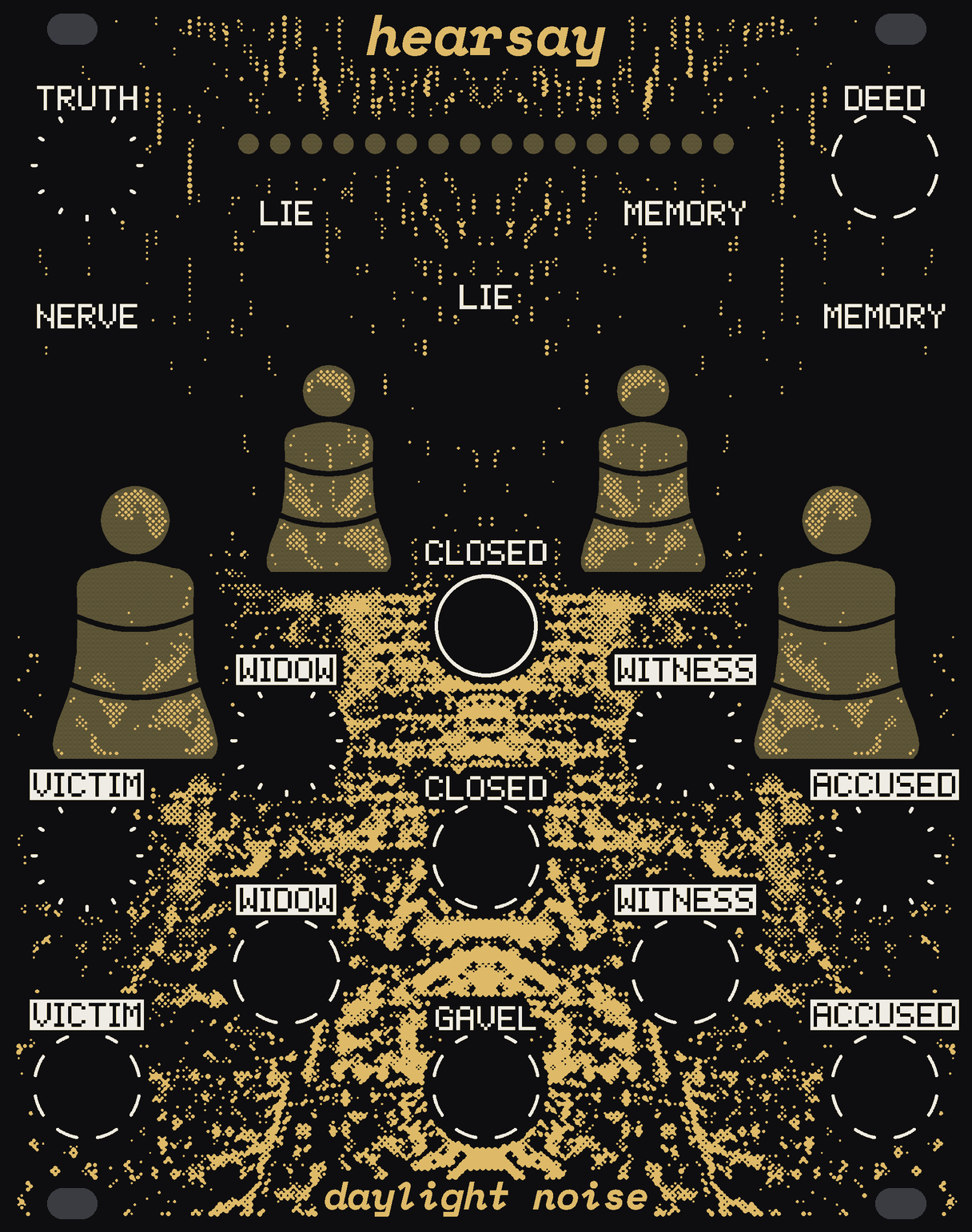
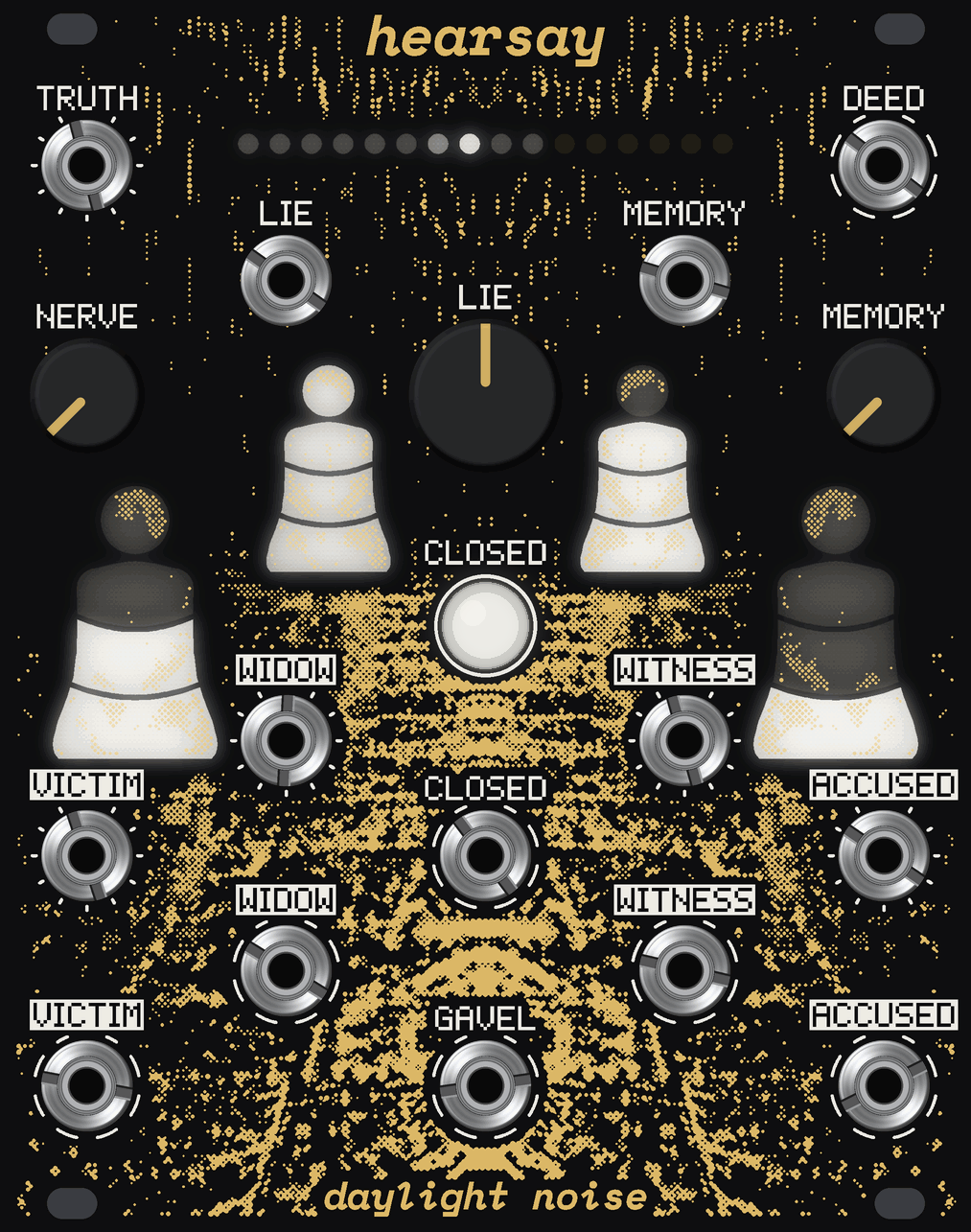
The HEARSAY panel: black, gold dots of four shrouded figures kneeling in the rain on wet stone. Each figure is a window of bare circuit board in four bands, the two inner ones higher. A row of sixteen small round windows runs under the name. TRUTH and DEED at the top corners, the CV jacks for LIE and MEMORY under them, NERVE, the big LIE and MEMORY across the brow, CLOSED's button and jack down the middle, each witness's two jacks in its column under its figure: VICTIM, WIDOW, WITNESS, ACCUSED, and GAVEL at the foot. hearsay at the top, daylight noise at the bottom.

Turn a knob: drag it or tap either side of it, roll the wheel over it or use the arrow keys; a double click puts it back. CLOSED is a button: press it to close the case, and again to open it. Play an event on the keys below (or A to K on your keyboard). The patches step on by themselves until you touch anything.

A rack round HEARSAY: a phrase on its own voice into TRUTH and DEED, each witness on a voice of its own, a low drone and a kick under it. Listen plays the patch from its top.

example patches

The event, the four tellings, the case and every out and light here are HEARSAY's engine, the module's own code, running in your browser. The phrases, the voices and the drums are a stand-in rack.
The event

A phrase played in after a silence is a new case: the four fall silent and listen, and a bar after it ends they tell it, all at once, round and round on the clock, until the next.

The four

How they tell it

Closing the case

What comes out

Inside

One board sits 10 mm behind the panel with everything on its front: the jacks, the knobs, CLOSED, the 58 LEDs and the whole circuit, the USB-C in a notch in its left edge. Each band of a figure and each of the event's windows has its own cell in a black printed baffle, lit by its own white LEDs, so a figure lights from the lap up and never into the next. An RP2350 hears the event and tells it four ways, four thousand times a second.

The HEARSAY panel with all four telling: the four kneeling figures lit white from the lap up, the event's row of small windows glowing under the name, its knobs, jacks and CLOSED's button on.

Drag it or use the arrow keys to turn it; click it to take it apart.

Specs

Format

Width
20 HP
Depth
20.8 mm behind the panel
+12 V
about 45 mA dark, 155 mA in use, 240 mA at the most (estimated)
−12 V
about 5 mA (estimated)
+5 V
not used
Controls
a big knob, 2 knobs, a lit button

I/O

TRUTH
1 V an octave, −6 to +6 V, read to the nearest semitone 2 ms after DEED rises; a 24-bit converter, calibrated; safe to ±12 V
DEED, GAVEL
gates, high past about 0.9 V, safe to ±12 V; GAVEL unpatched keeps the last clock's pace
CLOSED
gate, high past about 0.9 V: each rise opens or closes the case, as the button does
CVs
LIE, MEMORY: added to their knobs, 5 V the whole way, safe to ±12 V
Pitches
VICTIM, WIDOW, WITNESS, ACCUSED: 1 V an octave, −5 to +5 V (a note past that folds by octaves), 16-bit, calibrated
Gates
VICTIM, WIDOW, WITNESS, ACCUSED: 0/5 V, high for each note, held through a tie

Engine

Brain
RP2350, 4,000 steps a second, 32-bit float
Memory
one event: up to sixteen notes over sixty-four clocks
Light
58 white LEDs in 32 windows, 100 frames a second
Power cycle
it wakes with no case; only the calibration is kept