hang time

hold the good bit

20 HP

An action film's opening titles in one module: a bass that pulses on every sixteenth, slow minor chords under it and a blast of horns on every change, built up with one knob. Hold HANG and it all drops into slow motion. Let go and it slams back in, on the beat.

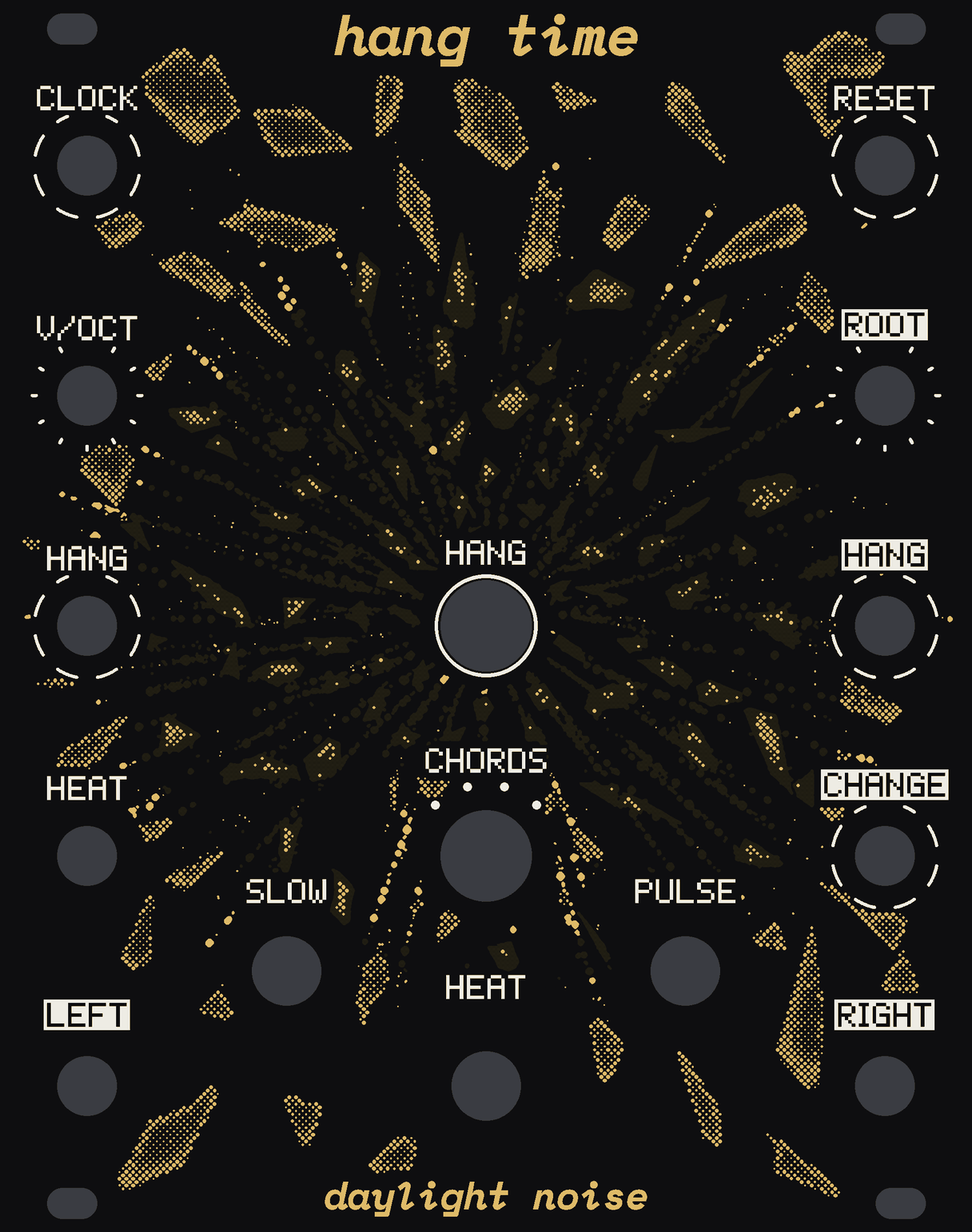
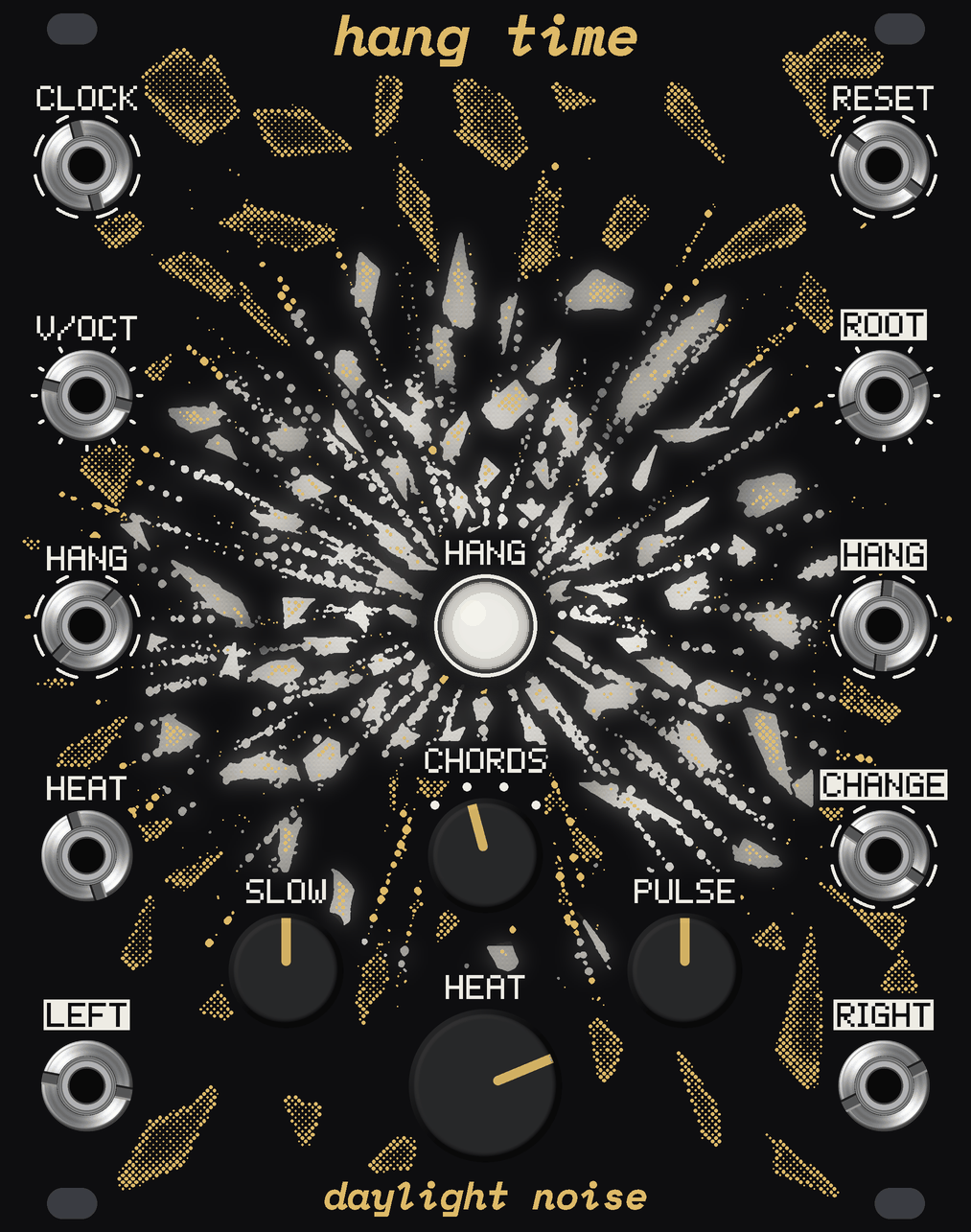
The HANG TIME panel: black, with a pane of glass bursting outward from a round button in its middle, the shards and glass dust near the button pale bare board, the shards flying out to every edge in gold dots. Jacks down both sides, a switch, two knobs and a big knob below the button.

Turn a knob: drag it or tap either side of it, roll the wheel over it or use the arrow keys; a double click puts it back. CHORDS is a switch: it clicks from stop to stop the same ways. HANG is a button: hold it (or hold Enter on it) for slow motion, and let go. The patches step on by themselves until you touch anything.

The opening titles at 124 BPM, from the top: HANG TIME with the rack's arpeggio and crash. Hold HANG whenever you like.

example patches

Everything HANG TIME does here is its engine as designed, running in your browser: the bass, the chords, the horns, the drums, the lead and slow motion. The loop, the arpeggio and the crash are a stand-in rack.
What makes an opening

The opening titles of an action film tend to be built the same way. A bass pulses on every sixteenth note (four to a beat) and never lets up: that's what drives it. Under it, slow chords (three or more notes that sound together) change every couple of bars, in a minor key, which is what makes it sound grand and dark rather than cheerful. And on every change of chord something big hits, usually brass, low and loud, so you feel each change in your chest.

A patch of beeps has the pulse but not the rest: nothing changes, so nothing lands. HANG TIME plays all three by itself. One cable from LEFT to your mixer and you have an opening; the rack's clock into CLOCK and it plays in time with everything else.

HEAT

HANG and SLOW

The bass and the chords

What comes out

Inside

The HANG TIME panel with its knobs on and its burst lit: HEAT at three o'clock, just after a chord change.

Drag it or use the arrow keys to turn it; click it to take it apart.

Specs

Format

Width
20 HP
Depth
20.8 mm
Power
+12 V about 89 mA with the glass dark, 219 mA as it plays, 281 mA at its brightest; −12 V about 15 mA
Board
one-sided; 17 parts fitted by hand
Lights
136 RGB LEDs behind the burst's 48 cells
Controls
a big knob, two knobs, a four-stop switch, a lit button
Tempo
its own 124 BPM, or the clock's, 20 to 400 BPM and past

Inputs

CLOCK, RESET
gates, high past about 0.9 V: a pulse a sixteenth; back to the start
V/OCT
the key, 1 V an octave, 0 V = C, −6 to +6 V, to the semitone
HANG
gate: slow motion while high
HEAT
CV, added to the knob: 5 V the whole turn

Outputs

LEFT, RIGHT
audio, held under 4.6 V
ROOT
1 V an octave, 0 V = C, −6 to +6 V
CHANGE
trigger, 5 V for 10 ms
HANG
gate, 5 V from the press to the slam