grubby

herself, eight times over

20 HP

One woman's high, breathy voice, made by the module and stacked on herself into a choir. Send a note and a clock and she sings; turn CHOIR and more of her join in, each a step higher; SPELL picks how they take turns. HAZE is the room, HELIUM makes her squeaky, HOLD freezes the chord.

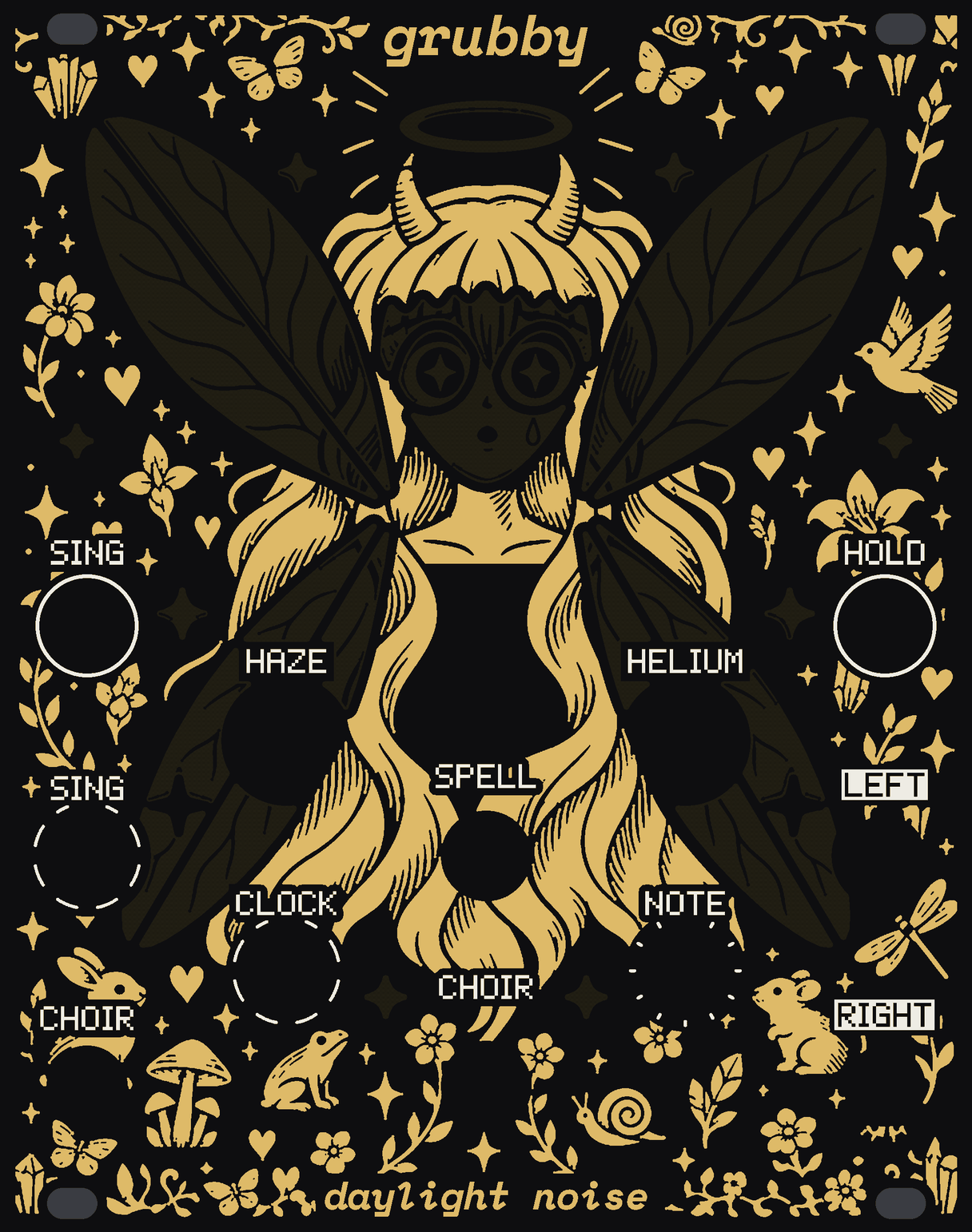
The GRUBBY panel: black and gold, a fairy hand-inked across the whole panel like a screen-printed poster: her hair, horns and neck and the doodles flat solid gold, shaded with bold black ink lines and hatching, the doodles running out to the edges round the name at the top and the maker's mark at the foot. Little horns with a white halo floating between them, a heavy fringe over a pale face, huge violet eyes with star sparkles in them, a single tear and a small round singing mouth; her long hair falls in big wavy gold locks all the way to the foot of the panel, either side of her plain black top. Four insect wings spread from behind her shoulders, a few bold veins in each, every wing split down its vein into two: the forewings lavender and pink, reaching up to the top corners, the hindwings ice blue and mint, running down both sides. Eight small four-pointed sparkles round her, and gold doodles all about: flowers, hearts, stars, vines, crystals, butterflies, a bird, rabbits, mushrooms, a frog, snails, a ladybird and a dragonfly. The knobs, buttons and jacks sit over the drawing: SING and HOLD buttons at the two sides halfway down, HAZE and HELIUM over the hindwings, SPELL in the middle and CHOIR the big knob at the foot, the SING, CLOCK, NOTE and CHOIR inputs on the left and middle, the LEFT and RIGHT outputs down the right.

Turn a knob: drag it or tap either side of it, roll the wheel over it or use the arrow keys; a double click puts it back. CHOIR, the big one at the foot, is how many of her sing: one alone fully left, all eight fully right. Hold SING down (or a key) for a note of her own; press HOLD to freeze the chord, and again to let go. The patches step on by themselves until you touch anything.

A lo-fi synth-pop track from a stand-in rack, and her: synthesised here, as the module would make her. No one was recorded or cloned.

example patches

Everything GRUBBY does here is its engine as designed, running in your browser: her voice, every copy of it, the turns they take, the room and the glass chimes. Her voice is synthesised, made from scratch the way the module would make it; it is never a recording, and never copied or cloned from anyone's voice. The track around her is a stand-in rack.
One voice, a whole choir

There's a sound you get when one singer records herself again and again over the same song: eight takes of the same voice, stacked up. It isn't a choir of different people. It's one voice, everywhere at once, soft and breathy, almost in time with itself, filling a room it was never in. A bedroom studio dreaming of a cathedral.

GRUBBY is that, as a voice for your rack. Plug a note into NOTE and a clock into CLOCK, and she sings. Turn CHOIR up and more of her join in, each one a step higher than the last: her note, then the note five steps up (a fifth), then her note an octave up, and on up to eight of her. SPELL picks how they take turns on each clock.

She is synthesised. The module makes her voice from scratch: no one was recorded, and she isn't copied or cloned from any real singer.

How many of her, and how they take turns

The room and the helium

Singing over her, and holding

What comes out

Inside

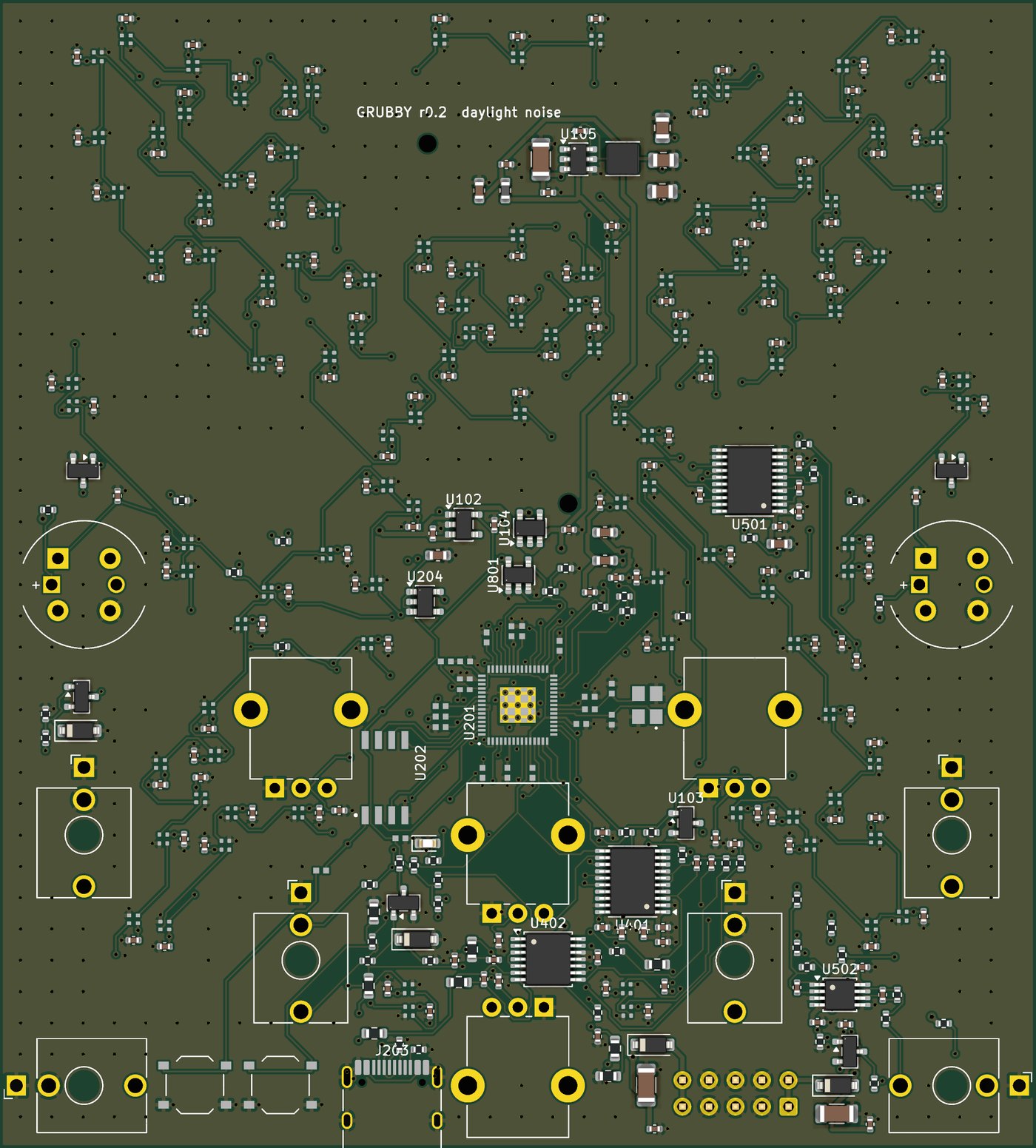
The routed main board's front as KiCad renders it: green, gold pads, 113 tiny RGB LEDs in the shapes of the fairy's wings, spread up to the top corners and down both sides, a few round her face and halo and under her sparkles; the 5 V regulator above her face, the DAC between the right wings' roots, the RP2350 in the middle among the knobs and jacks, the converter below it to the right.

Drag it or use the arrow keys to turn it; click it to take it apart.

Specs

Format

Width
20 HP
Depth
20.6 mm behind the panel, plus the power cable's plug
+12 V
about 220 mA with the fairy lit (her LEDs held to their cap), 90 mA dark (estimated)
−12 V
about 3 mA (estimated)
+5 V
not used: it makes its own 5 V from +12 V (447 mA at the LEDs' cap)
Controls
four knobs (CHOIR the big one, SPELL read in eight zones, HAZE, HELIUM), two lit buttons (SING, HOLD)
Lights
the fairy in thirteen cells (her wings' eight halves for the eight of her, the halo for the clock, her face and eyes for her own voice, the sparkles for the haze), 113 RGB LEDs held under 275 mA
The voice
one synthesised singer, up to eight copies and a ninth for SING

Inputs

NOTE
1 V an octave, 0 V on C3; her note, the lowest voice, to the nearest note, folded into F3 to E5
CLOCK
gate: each rise is a turn; unpatched, a slow pulse every 0.75 s
SING
gate: her own note an octave over NOTE while it's high
CHOIR
CV, added to the knob, 5 V the whole turn

Outputs

LEFT
audio, the choir's left side in the haze; alone, both sides in mono; a full choir peaks about 4 V (CHANT's shout about 5)
RIGHT
audio, the choir's right side in the haze

Engine

Brain
RP2350 at 192 MHz, both cores: this page's engine, the same arithmetic to the last bit, at 46.875 kHz
NOTE
read with 24 bits to ±6 V and calibrated, held to the nearest semitone
Gate to sound
about 4 ms, a fixed delay, the same for every gate
Power cycle
NOTE's and CHOIR's calibration kept; she wakes fresh