going up

every floor you call

20 HP

An arpeggiator that runs like an old lift. The notes you call are floors; it serves them in a lift's order, up through every call and back down, its doors opening on each. A chord becomes the lift going up and down, in the rhythm of its own shape.

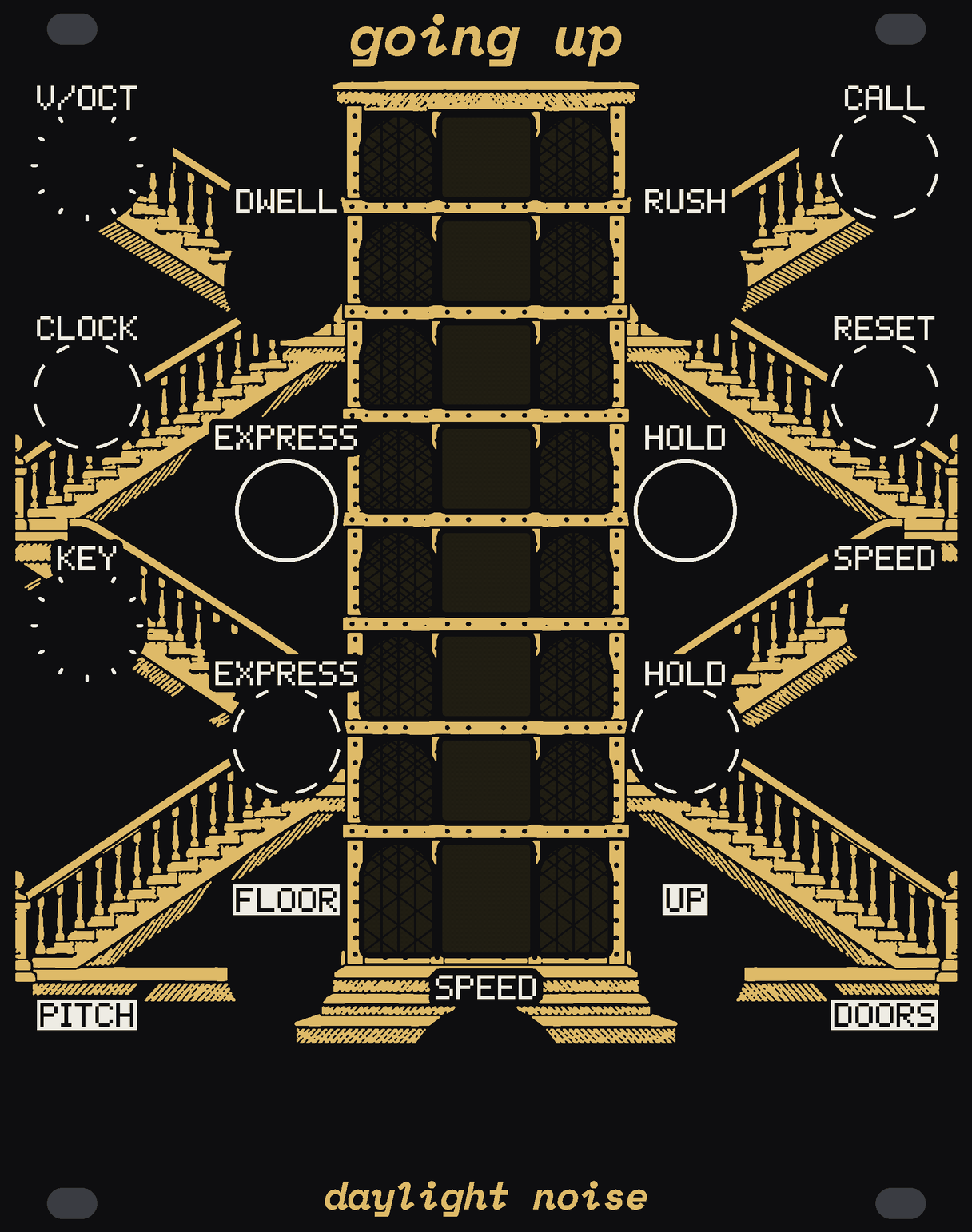
The GOING UP panel, black and gold: an old department store's stairwell drawn in bold gold ink, an open riveted iron lift tower up the middle with an ornamental cornice on top and stone steps at its foot, the stairs zig-zagging up either side of it, four flights a side, with their balusters, handrails and newel posts. Up the tower's middle the car's well is eight windows of bare glass, one a floor; beside it at every floor a round-headed landing doorway of bare glass behind a collapsible lattice gate drawn in black. SPEED, the big knob, at the foot of the tower; DWELL and RUSH by its top; EXPRESS and HOLD lit buttons over their gate jacks; V/OCT, CALL, CLOCK, RESET, KEY and SPEED in down the sides, PITCH and DOORS out at the foot corners, FLOOR and UP out beside the steps.

Turn a knob: drag it or tap either side of it, roll the wheel over it or use the arrow keys; a double click puts it back. Press HOLD to keep every call (press again to let them go), EXPRESS to serve every other one. The patches step on by themselves until you touch anything.

Synthesised here. GOING UP makes no sound: you're hearing a stand-in rack calling the lift with its chords, its clock in CLOCK, and the module's outs playing a vibraphone.

example patches

Everything GOING UP does here is its engine as designed, in your browser: the calls, the lift's order, its travel and its doors. The vibraphone, the strings, the bass and the brushes are a stand-in rack.

Calling the lift

The building has eight floors, the ground floor and one to seven, and each is a note: one octave of the major scale from KEY's note (with nothing in KEY, C). Each rising edge into CALL calls the floor of the note at V/OCT, snapped to the scale and folded into the octave. Its landing lights up and waits.

On its own it's a real lift: each call is served once and its floor goes dark, so a tune played in comes out in the lift's order instead of yours. Press HOLD and every call stays called, so the lift keeps going round them: a chord becomes an arpeggio, for as long as you like. Notes that come in together (less than a beat apart) are one chord; the next chord replaces it. Let HOLD go and each call is served one last time, then the arpeggio drains away.

The ride

Express and rush hour

What comes out

In a rack

Specs

Format

Width
20 HP
Controls
a big knob (SPEED), two knobs (DWELL, RUSH), two lit buttons (EXPRESS, HOLD)
Lights
24 windows on 34 RGB LEDs: the car's well and the sixteen landings
Replaces
an arpeggiator with a latch, a quantiser, a rhythm source, a glide and a direction gate
Parts
a demo for now: the line's knobs, jacks and buttons, no board yet

Inputs

V/OCT
1 V/oct, read as CALL rises
CALL
gate: a call on each rising edge
CLOCK
gate: a tick on each rising edge; empty, eight a second
RESET
gate: the car to the ground floor
KEY
1 V/oct: the ground floor's note
SPEED
CV: twice as fast a volt
EXPRESS
gate: every other call while high
HOLD
gate: the calls kept while high

Outputs

PITCH
1 V/oct, the floor served
DOORS
5 V while the doors are open
FLOOR
1 V/oct, the car's height, gliding
UP
5 V while going up