glass bridge

every fall shows the way

20 HP

A tune that learns its way across a bridge of glass. Players cross on your clock, playing the panes known so far and guessing the rest. Each wrong pane breaks and shows the next one a safe step, until the whole melody makes it across.

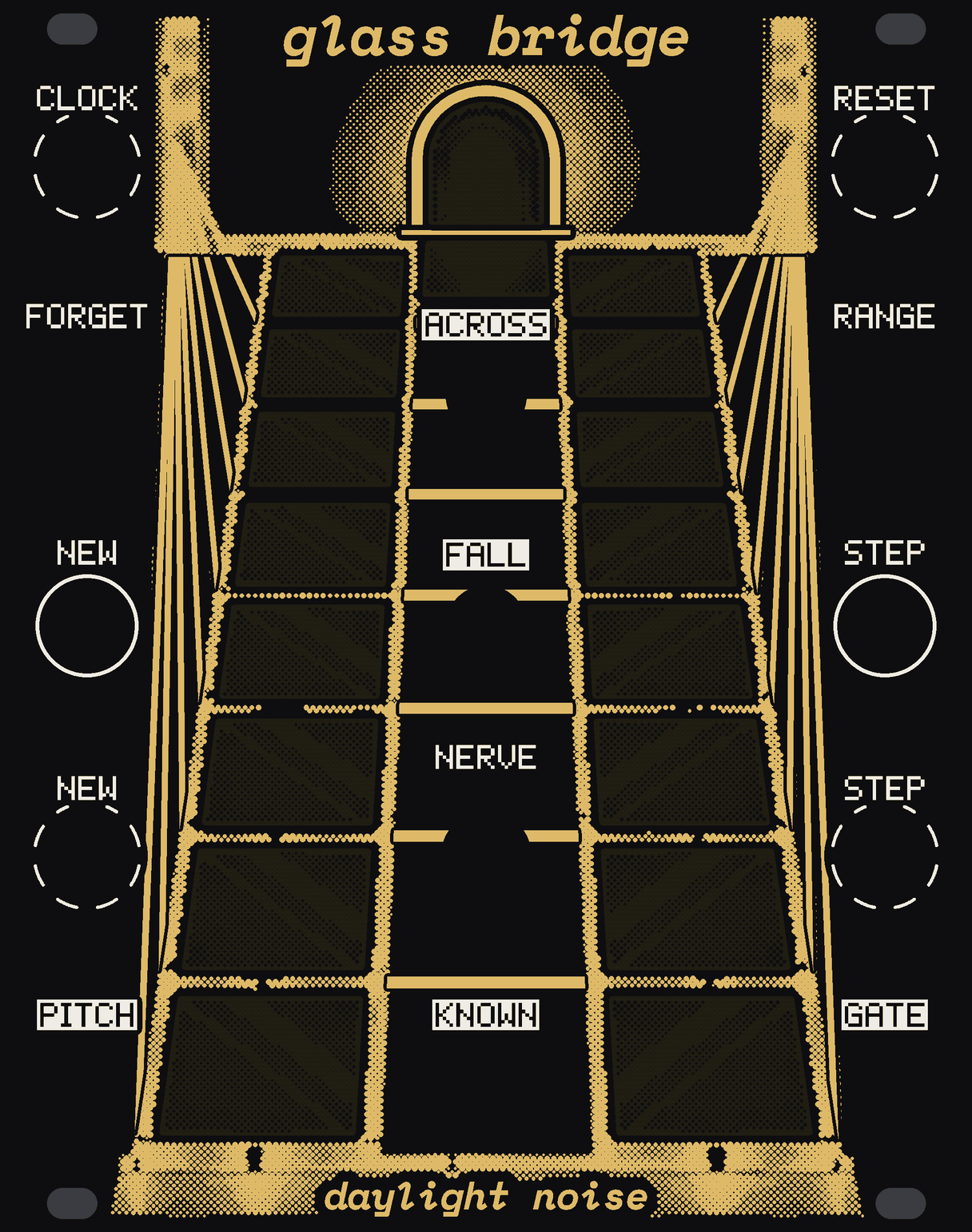
The GLASS BRIDGE panel, black and gold: a photograph in gold halftone of a cable-stayed glass footbridge at night, hung over a black void and seen from its near end, running up the panel to a lit arched doorway in the far wall under the name. Its deck is two lanes of eight glass panes in a gold steel frame, smaller as they go away, with stays fanning down to the rails from two pylons beside the door; the drop between the lanes holds a column of jacks and NERVE, the big knob. Each pane is bare glass for light, with two diagonal glints, as are the doorway and the pool of its light on the floor in front of it. The other jacks, FORGET, RANGE and two lit buttons stand beside the bridge over the void.

Turn a knob: drag it or tap either side of it, roll the wheel over it or use the arrow keys; a double click puts it back. Press NEW for a new bridge, STEP to take a step by hand; hold STEP and press NEW (or shift-click NEW) for the next scale. The patches step on by themselves until you touch anything.

Synthesised here. GLASS BRIDGE makes no sound: you're hearing a stand-in rack, its clock in CLOCK and the module's outs playing its bell, its glass and its strings.

example patches

Everything GLASS BRIDGE does here is its engine as designed, in your browser: the bridge, the players, the guesses, the falls. The bell, the strings, the drone, the hats and the breaking glass are a stand-in rack.

A tune that learns its way across

The bridge is eight pairs of glass panes, running up the panel from the near end at the foot to a lit doorway at the top. In each pair one pane holds and the other breaks. Every pane is a note.

Patch a clock into CLOCK and PITCH and GATE into a voice. Players cross a step a clock. Each one plays the panes already known, then has to guess. A good guess is a new note; a wrong one breaks, and that player is gone. But the fall shows the way: the other pane in that pair must be the safe one. So the next player gets one step further, and the next further still.

You hear the tune grow from its start, a note or two at a time, until someone gets all the way across. From then on it's the whole melody, every time round.

The walk

Nerve and forgetting

The notes

In a rack

Specs

Format

Width
20 HP
Controls
a big knob (NERVE), two knobs (FORGET, RANGE), two lit buttons (NEW, STEP)
Lights
18 windows on 58 RGB LEDs: the sixteen panes, the doorway and its light on the floor
Replaces
a generative sequencer, a probability gate, a quantiser and the logic to make them learn
Parts
a demo for now: the line's knobs, jacks and buttons, no board yet

Inputs

CLOCK
gate: a step on each rising edge; empty, a step every 0.32 s
RESET
gate: back to the near end
NEW
gate: a new bridge
STEP
gate: an extra step

Outputs

PITCH
1 V/oct, the pane the player stands on
GATE
5 V, long on a known pane, short on a guess
ACROSS
trigger: a player got across
FALL
trigger: a pane broke
KNOWN
0 to 8 V, a volt for each pair known