giddy

the ramp is the sound

20 HP

A rotating-speaker cabinet, both rotors. Press SPEED and the little horn whips up to speed in about a second while the heavy drum underneath takes four to catch it. You hear both get there, and watch them.

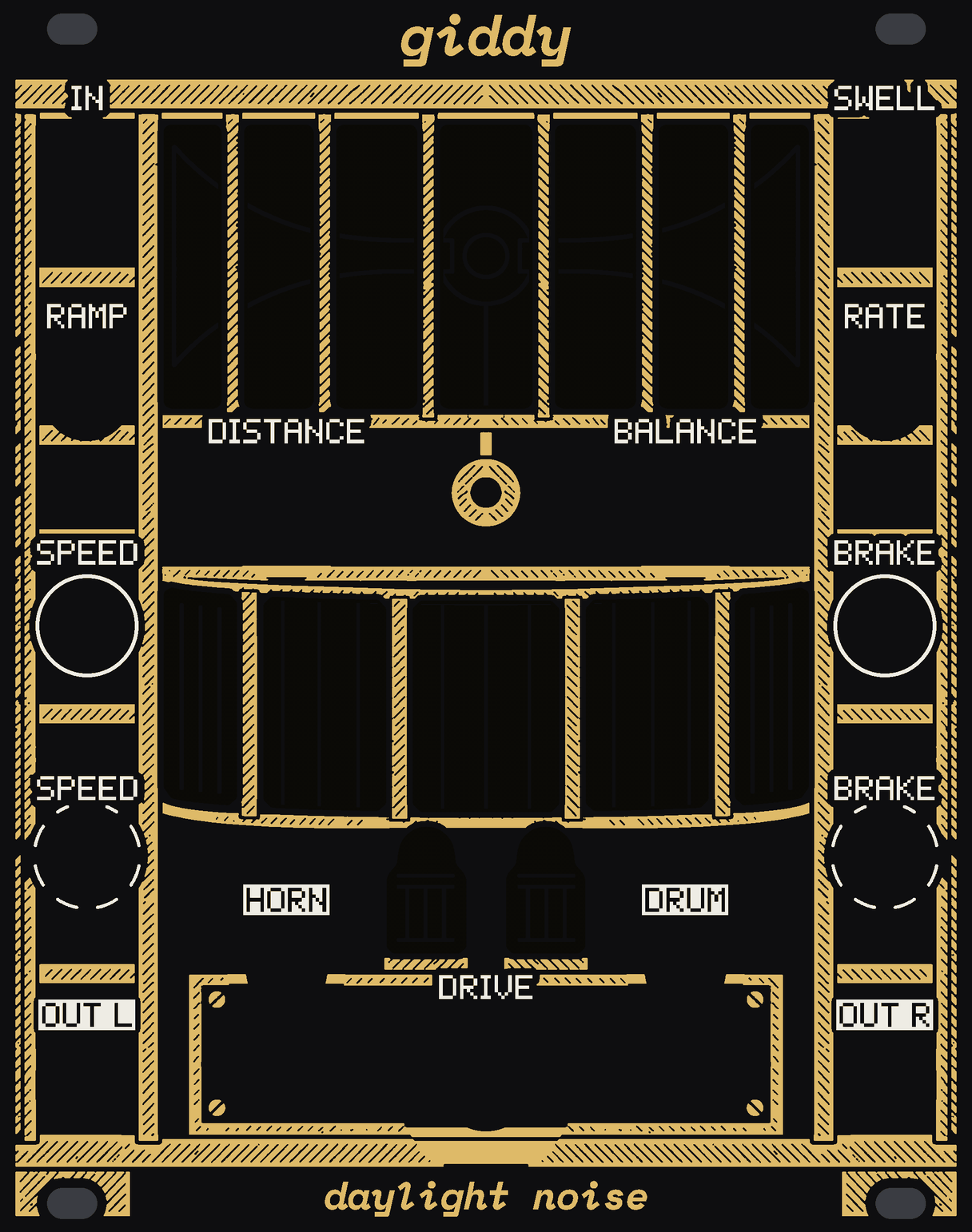
The GIDDY panel, black and gold: a tall wooden rotating-speaker cabinet seen from the front, filling the panel, drawn in solid gold with black ink hatching. Its side posts are ladders of gold rails with the jacks, the RAMP and RATE knobs and the SPEED and BRAKE buttons on their black panels. Across the top, seven tall glass gaps between thin gold louvre slats, a twin horn drawn in thin ink lines behind them, its hub in the middle and a bell at each end. A motor board below with a gold pulley between the DISTANCE and BALANCE knobs. In the middle, five glass panels between gold ribs, slatted in ink, curved top and bottom like the front of a round drum, narrower toward the sides. At the foot, an amplifier chassis with two glass valves standing over the big DRIVE knob, the HORN and DRUM jacks either side.

Turn a knob: drag it or tap either side of it, roll the wheel over it or use the arrow keys; a double click puts it back. Press SPEED and the cabinet changes speed; press BRAKE and it coasts to a stop. The patches step on by themselves until you touch anything.

Synthesised here, as the module would make it: the amp, the two rotors, the mics and the room, round a stand-in organ trio.

example patches

GIDDY here is its engine as designed, in your browser: it hears only what comes into its jacks. The organ trio, the beeps and the gates are a stand-in rack.

One cable, a cabinet

A sound into IN, OUT L and OUT R to your mixer. Inside, a little valve amp, then a split: the highs to a horn that spins, the lows to a drum that spins the other way. As the horn swings toward you it gets louder, brighter and a touch higher; swinging away, quieter, duller, lower. Two mics hear it at different moments, so it sways across the stereo. Made for an organ, it suits a piano, guitar or pad too.

Slow, fast, and the bit between

The amp

The mics

BRAKE, and the rotors as CVs

Specs

Format

Width
20 HP
Controls
five knobs (DRIVE, RAMP, RATE, DISTANCE, BALANCE), two lit buttons (SPEED, BRAKE)
Lights
the cabinet: seven louvre gaps, five drum panels and two valves, 60 RGB lights
Replaces
a rotating-speaker pedal, a valve drive, and two LFOs with weight
Here
a demo: the parts and the engine as designed, no board yet

Inputs

IN
audio: the sound into the cabinet
SWELL
CV: how much sound goes into the amp, 0 to 10 V (full with no cable)
SPEED
gate: SPEED the other way round while it's high
BRAKE
gate: BRAKE the other way round while it's high

Outputs

OUT L
audio: the left mic
OUT R
audio: the right mic
HORN
CV: where the horn is facing, ±5 V
DRUM
CV: where the drum is facing, ±5 V