garmonbozia

20 HP · keeps what hurts

It listens to whatever you feed it, all the time, and keeps only the moments that hurt: the loud, harsh ones, or the ones that fall and die away. Each becomes a kernel in a bowl of sixteen lights. FEED eats the oldest, played back at V/OCT, from a crisp stutter of your worst moments to all of them smeared into one sweet, sickly held sound. What's eaten is gone, and as the bowl empties, HUNGER rises.

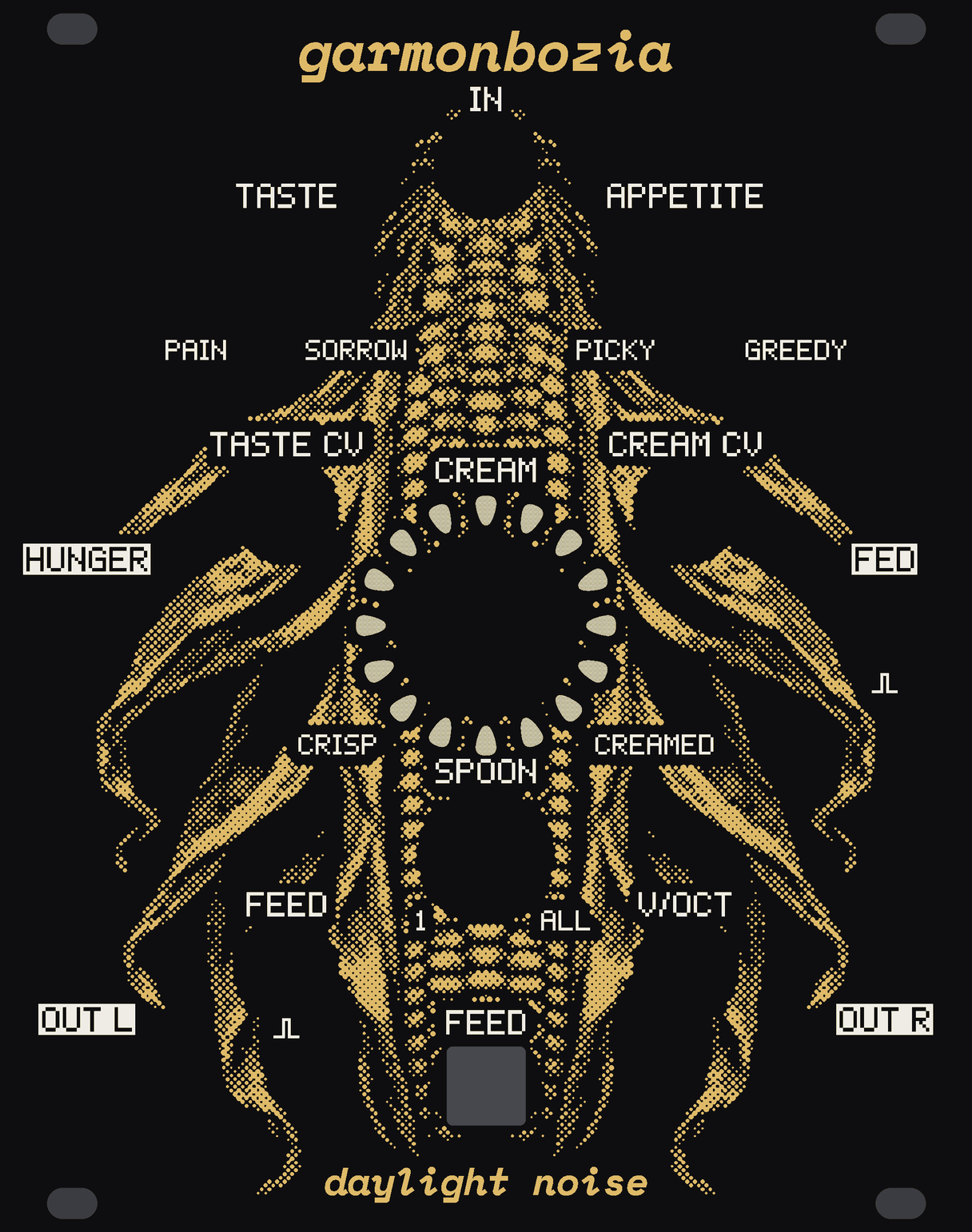
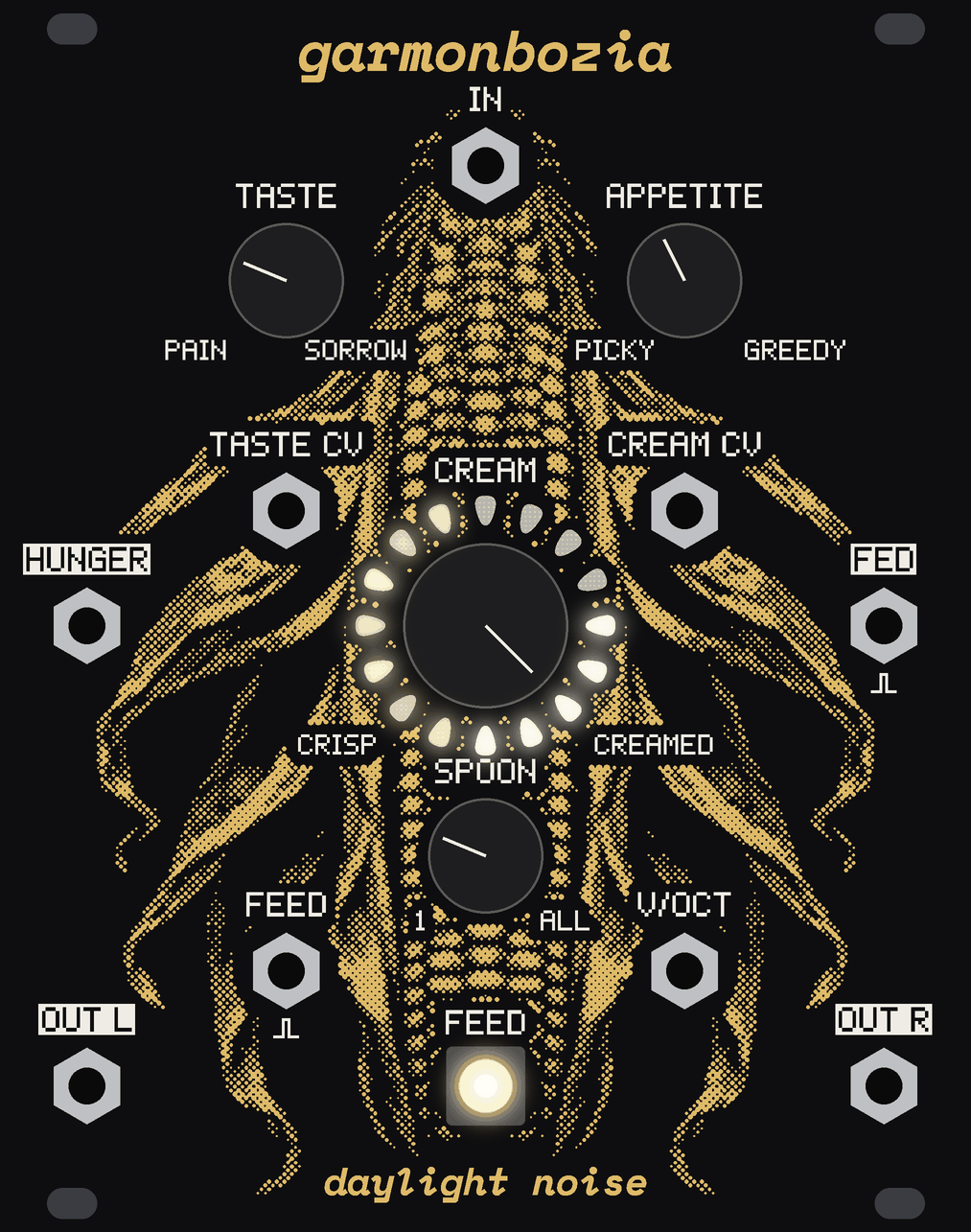
The GARMONBOZIA panel: an ear of corn standing down the middle in gold dots on black, its husk peeled back and splayed out either side like ribs, dry silk round IN at its tip. CREAM, the big knob, sits in the middle of the cob inside a ring of sixteen kernel-shaped windows. White labels for the knobs TASTE (printed PAIN to SORROW), APPETITE (PICKY to GREEDY), CREAM (CRISP to CREAMED) and SPOON (1 to ALL), the FEED button, and the jacks IN, TASTE CV, CREAM CV, HUNGER, FED, FEED, V/OCT, OUT L and OUT R. garmonbozia at the top, daylight noise at the bottom.

Turn a knob: drag it, roll the wheel over it or use the arrow keys; a double click puts it back.

Everything but the four spoken lines is made in the page as you listen. Headphones help.

example patches

The module's own engine, running in your browser: the firmware's detector, its bowl, its crisp and creamed playback and its lights, ported from its C and checked against it bit for bit. The drums, the bass, the pad, the stabs, the screams, the glides, the bell and the voices are stand-ins for the rest of a rack.
What it keeps

GARMONBOZIA listens to IN all the time and lets most of it go. It keeps a moment only when it hurts, and TASTE says what it hungers for.

APPETITE is how bad a moment must be before it's taken: PICKY keeps only the worst, GREEDY nearly everything. A moment starts when the score crosses APPETITE's line and ends when it has stayed well under it for a moment, so one long scream is one moment, not ten. A clean, steady tone, however loud, is never taken.

The bowl

Each moment it keeps becomes a kernel: the sound itself, cut from just before the moment started to where it ended, 30 to 400 ms. It drops into the bowl, sixteen kernel-shaped windows round CREAM, lit from behind as bright as it hurt.

The bowl fills clockwise from the top and is eaten from its oldest, so what's in it is always one lit arc. With all sixteen in, it takes nothing more until it's fed. FED fires a trigger each time it takes one.

Feeding

FEED is a lit button and a gate in. Each press, or each rising edge at the gate, serves a SPOON of kernels, the oldest first: one, a few, or all of the bowl. They play at V/OCT the way a sampler plays: at 0 V each comes back at the speed it was taken, a volt up twice as fast and an octave higher.

Served kernels burn bright while they play and go dark when they're done. What's eaten is gone. A new FEED cuts off what's still playing from the last one, and a FEED on an empty bowl does nothing.

Cream

CREAM is the big knob, and CREAM CV is added to it. At CRISP the spoonful plays back whole, one kernel after another: a stutter of your worst moments. Turning up, each starts before the last has ended, their edges soften and they smear into each other.

At CREAMED they're blurred into one sweet, sickly held sound: their spectra averaged, the strongest partials drawn out of the noise, and played back as a steady wash, wide across the stereo, for as long as FEED is held. Let go and it fades. There's no dry signal: OUT is only what it serves.

Hunger

HUNGER is a CV out: 0 V with the bowl full, half a volt more for every kernel missing, 8 V when it's empty. Patch it into a distortion's drive, a filter's resonance or a delay's feedback, and the emptier the bowl, the more your patch hurts.

If what it hurts goes back into IN, it feeds itself. Patch HUNGER into the drive on your drums and FEED it faster than clean drums can fill it: the bowl empties, the drums break up, broken they're worth taking, the bowl fills, and the drive eases off again.

The panel

Twenty HP, every part on the line's staggered grid and mirrored about the middle. The art is an ear of corn standing down the middle in one hard light, gold on black, its husk peeled back and splayed out either side like ribs, dry silk round IN at its tip. CREAM sits in the middle of the cob, its sixteen kernels lit a pale corn yellow round it.

Inside

The GARMONBOZIA panel with FEED held: four kernels already eaten and dark, a spoonful of five burning bright, the rest of the bowl lit softly.

Drag to look around. Lift the panel: the baffle stays on the board, a black ring round CREAM's pot with a cell under each kernel, its LED at the foot. One RP2350 does it all: one core listens and plays, the other works out each kernel's spectrum and the held sound, with the last few seconds of IN and the bowl itself in 8 MB of memory beside it.

Specs

Format

Width
20 HP
Depth
21 mm behind the panel, to the top of the power header
+12 V
about 120 mA, 180 mA at the most (the bowl at its cap, FEED lit)
−12 V
about 10 mA
+5 V
not used; 10-pin header
Panel
1.6 mm FR4: ENIG gold through black mask, white labels, sixteen kernels of bare board
Controls
4 knobs, CREAM's big, SPOON in sixteen steps; FEED, a lit button

I/O

IN
audio, ±5 V with room to ±9; 100 k
FEED
gate, high past about 1.1 V; 100 k
V/OCT
1 V an octave, 0 V the speed each kernel was taken at, −4 to +4 V
TASTE CV, CREAM CV
±5 V, a tenth of the knob's travel a volt; 100 k
OUT L, OUT R
±5 V, softly to ±8 V at most; 1 k; OUT R summed into OUT L while unpatched
HUNGER
0 V with the bowl full to 8 V empty, half a volt a kernel; 1 k
FED
5 V for 10 ms each kernel taken; 1 k

Engine

Brain
RP2350, both cores, 46.875 kHz, 32-bit float
Converters
PCM1808 in, PCM5102A out, on one I2S clock
Memory
8 MB PSRAM: the last 2.8 s of IN and the sixteen kernels
Kernels
sixteen, 30 to 400 ms each, 16-bit
Light
16 RGB LEDs, one behind each kernel, their current capped at 100 mA
Firmware
over USB-C or the debug header, on the back

Nothing's for sale yet.

GARMONBOZIA is designed, its board is laid out and its firmware builds. The numbers here are the design's and the engine's, not measurements, and there's no date.