fringe

it feels you walk in

20 HP

A wavefolder made of light. A real laser, split in two and bounced off two mirrors on piezo discs: your sound moves the mirrors, and what comes back is a cosine of how far they've gone. It's the most sensitive thing in your rack. LOCK holds it dead still, or lets the room play it.

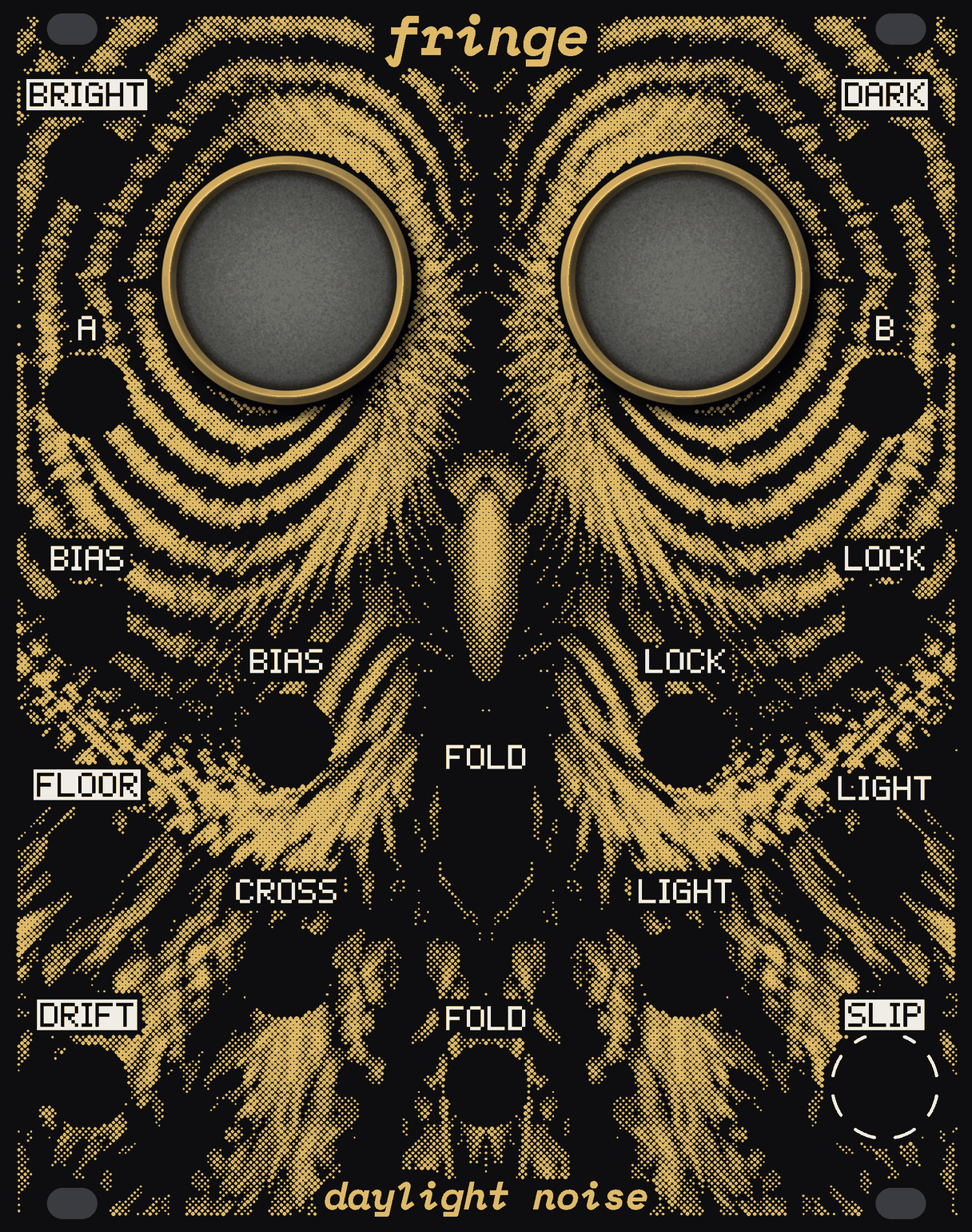
The FRINGE panel: black, with a great grey owl's face in gold on it, the rings of its feathers centred on two round brass-rimmed windows of ground glass where its eyes are. Knobs FOLD, BIAS, LOCK, CROSS and LIGHT, and eleven jacks.

Knock on it: press anywhere on the panel, or tab to it and press Space; harder near the windows. Warm it: rest the pointer near the windows, or hold a press, and wait. Turn a knob: drag it or tap either side of it, roll the wheel over it or use the arrow keys; a double click puts a knob back. The patches step on by themselves until you touch something.

Headphones: the two sides are opposites. Listen plays the patch from its top, or from where you've got to if you've touched anything.

example patches

The real one reads the real room through a real beam of light. A browser has no laser and no floor, so here a small model stands in for the optics and the mirrors, and an invented room for the air, the footsteps, the doors and your hand. The fold, the servo and the rings are worked out from the same formula as the module's. The rack you can hear is a stand-in too, and it holds DARK back by a third of a millisecond, so a phone's one speaker doesn't cancel the pair.

The fold

The laser's split in two, each half bounces off a mirror, and they meet again. Where the paths match they add; move a mirror 165 nanometres and they cancel. Glue that mirror to a piezo disc, drive it with your sound, and your sound goes through a cosine. Small signal: clean. Bigger: it folds. It can't go past the light it has, so however hard you drive it, it gets no louder and nothing clips. A triangle comes out as a vowel, a saw as hard sync, a sine as FM.

The light

There are no LEDs on it. A beam splitter has two exits, and each window is one of them: the same rings in negative, because where one's bright the other's dark. The rings are the sound's own light: the dark spot at the middle is where the part you hear left for the photodiode. One ring born there is one whole fringe, two folds. Past what the eye can follow they fade, vanish, and come back the other way round as FOLD goes up. It's a Class 1 product, enclosed: the beam stays sealed in its block, and what reaches the glass is spread thin and ground.

The room

A warm hand near a window, a breath, somebody walking past, a kick coming up through the floor: all of it moves the mirrors or the air between them by a fraction of a wavelength, and the fold leans, even harmonics swapping with odd.

What comes out

Specs

Format

Width
20 HP
Controls
5 knobs, a panel to knock on
Laser
enclosed, designed for Class 1, not yet tested

Inputs

A, B
audio, to the mirrors
LIGHT
audio or CV, to the laser
FOLD
CV, 1 V a tenth of the knob
BIAS
CV, 1 V half a fringe
LOCK
CV or gate, 0 to 5 V

Outputs

BRIGHT, DARK
audio, about ±5 V
FLOOR
audio, 0.2 V a nanometre
DRIFT
CV, ±5 V, 1 V a fringe
SLIP
trigger, 5 V