fireflies

swarm finds its beat

20 HP

Sixty fireflies, each a lit window with a chime of its own. Woken, they blink at random; every flash nudges the ones that see it, and they fall in step, in clusters and then as one: a clock and a chord grown out of noise.

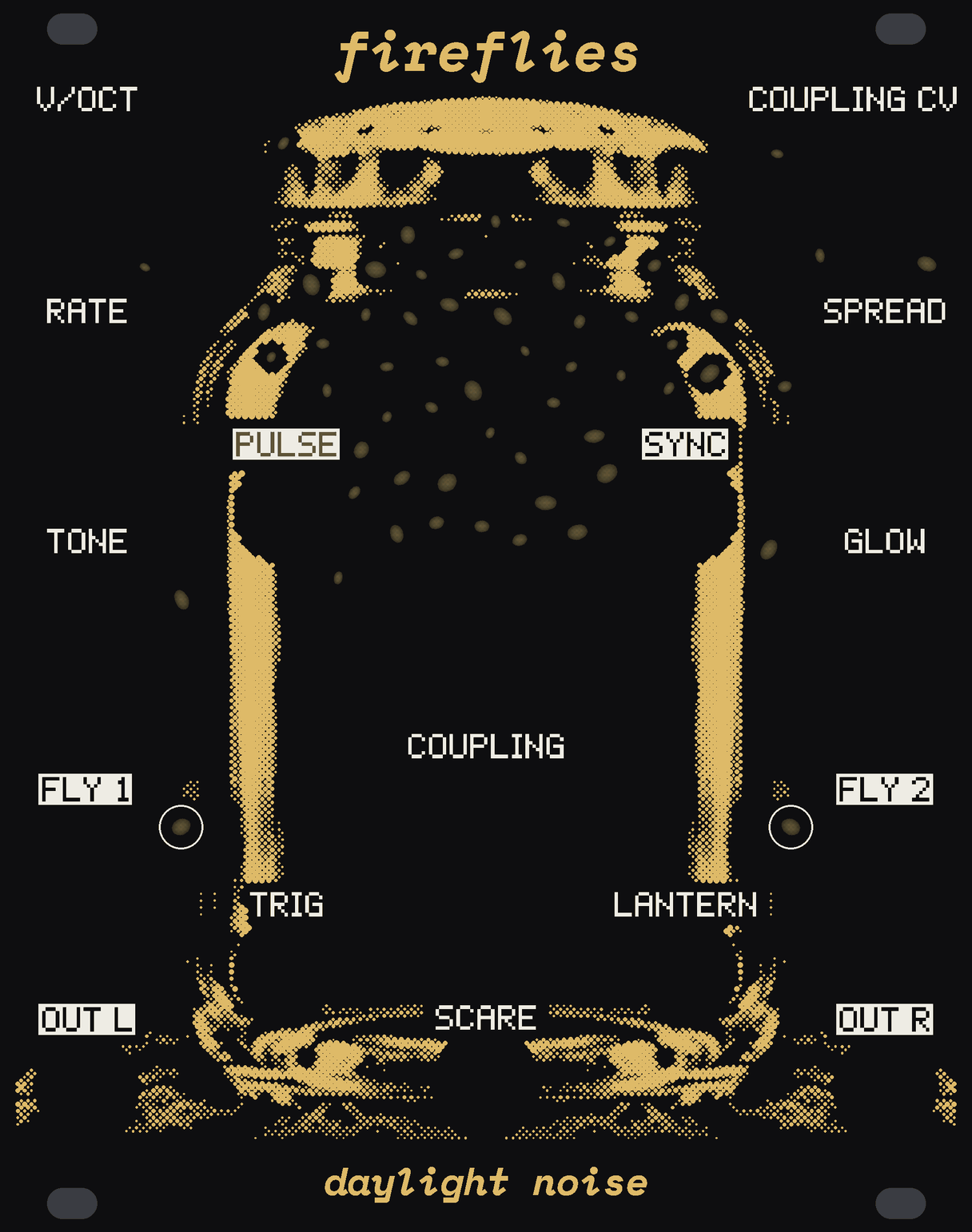
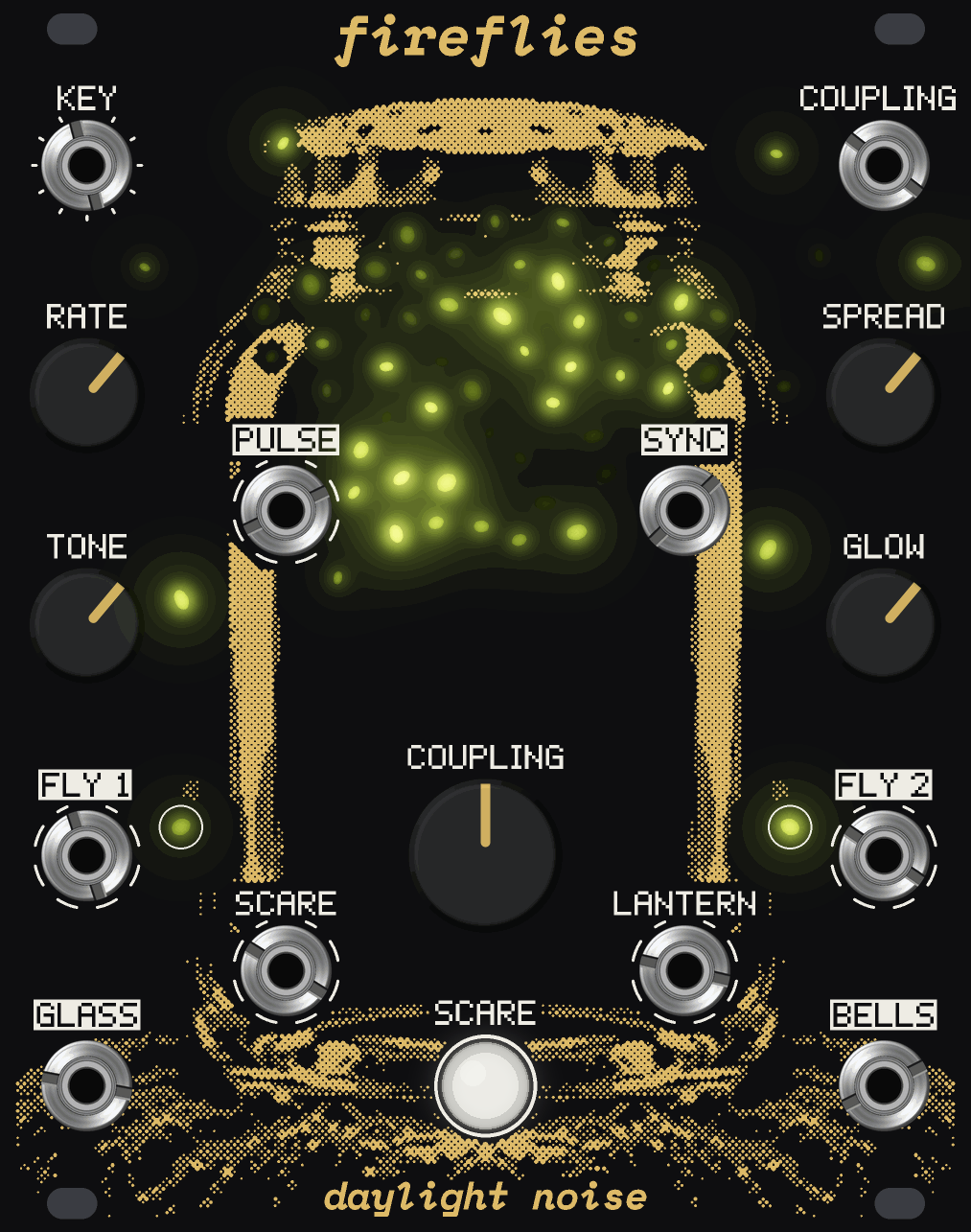
The FIREFLIES panel: black, with an old glass jar with a punched lid drawn in black ink on solid gold the whole panel tall, its crimped lid, neck rings and shining walls hatched in ink, standing on tufts of moss at the foot. Sixty little oval windows of bare circuit board rise as a plume up the middle of the jar, a few strays out among the parts; the two beside FLY 1 and FLY 2 are ringed in white. White labels: KEY, RATE, TONE, FLY 1 and GLASS down the left; COUPLING, SPREAD, GLOW, FLY 2 and BELLS down the right; PULSE and SYNC beside the swarm; COUPLING under it, with SCARE and LANTERN either side; twelve white ticks round KEY's jack and a ring of white dashes round FLY 1's, FLY 2's, SCARE's, LANTERN's and PULSE's; SCARE's lit button, its cap milky white, at the foot. fireflies at the top, daylight noise at the bottom.

Turn a knob: drag it or tap either side of it, roll the wheel over it or use the arrow keys; a double click puts it back. SCARE is a button to press; it lights at every scare.

The chimes are FIREFLIES's own. The banjo, the washtub bass, the feet on the porch and the crickets round them are made in the page as you listen.

example patches

The swarm, its lights and its chimes here are FIREFLIES's own firmware, running in your browser: when each one flashes, which ones it nudges, what it rings, what its LEDs show. Everything round it is a stand-in for the rest of a rack.
Finding each other

Each firefly keeps its own time and flashes when it runs out. Every flash nudges the ones that see it, the near ones most: a little later if they've just flashed, a little sooner if they were about to. That's all it takes. Neighbours fall in step first, little clusters flashing together; then the clusters pull each other in, until the whole swarm flashes as one, as the real ones do in the Great Smoky Mountains. None keeps perfect time, so left alone they drift apart again.

The chimes

Every flash rings its firefly's note, a struck glass bell, pitched by its height on the panel and panned by where it sits, left to right. At random they're a shimmer of single bells; in clusters, fragments of chords; as one, a single chord on a clock. Sixty at once are fuller and a little louder than the shimmer, never sixty times as loud.

Scare and lantern

Press SCARE and the scare rises from the button up through the swarm in half a second. Each firefly it reaches startles, flashes once, bright, hides in the dark a moment and comes back at random. Everything they'd found is gone, and they start finding each other again. The button flashes white at every scare, from its jack too, and fades as the scare rises.

Patch a clock into LANTERN and every beat is a flash they all see, brighter than all of them together. They gather round it, take its tempo and flash on its beat; a clock twice their pace and they flash on every other one. The lantern itself makes no sound and no light.

What comes out

PULSE fires whenever half the swarm flashes at once: nothing at random, the odd one in clusters, and once they're one a steady clock, a pulse every flash, at any RATE. Patch it to a drum machine and the beat grows out of the shimmer.

Inside

The FIREFLIES panel as the swarm forms clusters: the gold jar, its sixty windows, some lit warm yellow-green in little groups, with its knobs on.

Drag it or use the arrow keys to turn it; click it to take it apart.

Specs

Format

Width
20 HP
Depth
20.8 mm behind the panel, to the top of the power header (estimated)
+12 V
about 95 mA, up to about 290 mA with the swarm lit as one (estimated)
−12 V
about 5 mA (estimated)
+5 V
not used; 10-pin header
Controls
5 knobs, one big; a lit button

I/O

KEY
V/OCT, read from −2 to +8 V, 1 V an octave, G3 at 0 V; every bell rings up to about +3.9 V, higher the top ones go silent in turn, and over +6.8 V none ring
COUPLING
±5 V, half the knob
SCARE, LANTERN
a rising edge through about 1.2 V; a 1 ms trigger is enough; LANTERN 10 to 1,200 BPM; a quicker clock is read at every second edge, or fewer
GLASS, BELLS
the chimes, left and right: about 0.5 to 0.7 V RMS in use, peaks to 4 V, never past it
SYNC
0 to 8 V, 16 bits
PULSE, FLY 1, FLY 2
5 V, 8 ms

Engine

Brain
RP2350, both cores, 46.875 kHz, 32-bit float
Swarm
60 fireflies, stepped 1,000 times a second
Bells
60, three partials each, tuned by TONE and KEY
Light
60 RGB LEDs behind the windows, 366 frames a second, their current capped
Firmware
over USB-C, at the board's bottom edge, or the debug header on its back