field

20 HP · filter

Six resonant bands, drawn as six rings of lit glass round the big knob. Patch a second sound into STRIKE and it puts up a wall against the first: clockwise it cuts its own shape out of IN, so a kick punches a hole in a pad exactly its shape; counter-clockwise, IN sounds only where it does. Turn RES up and the six bands ring on their own, a six-note chord. The rings ripple when it's struck.

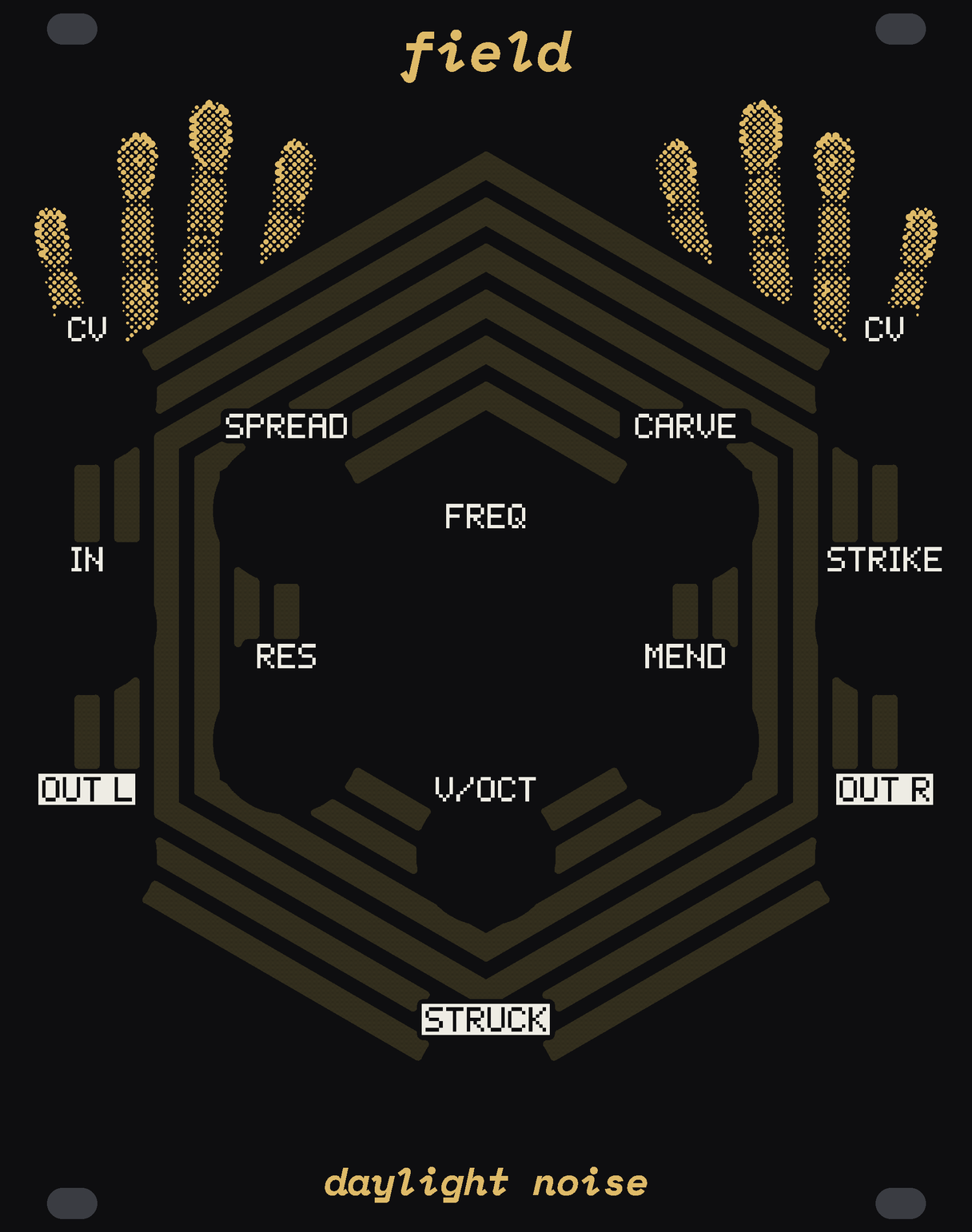
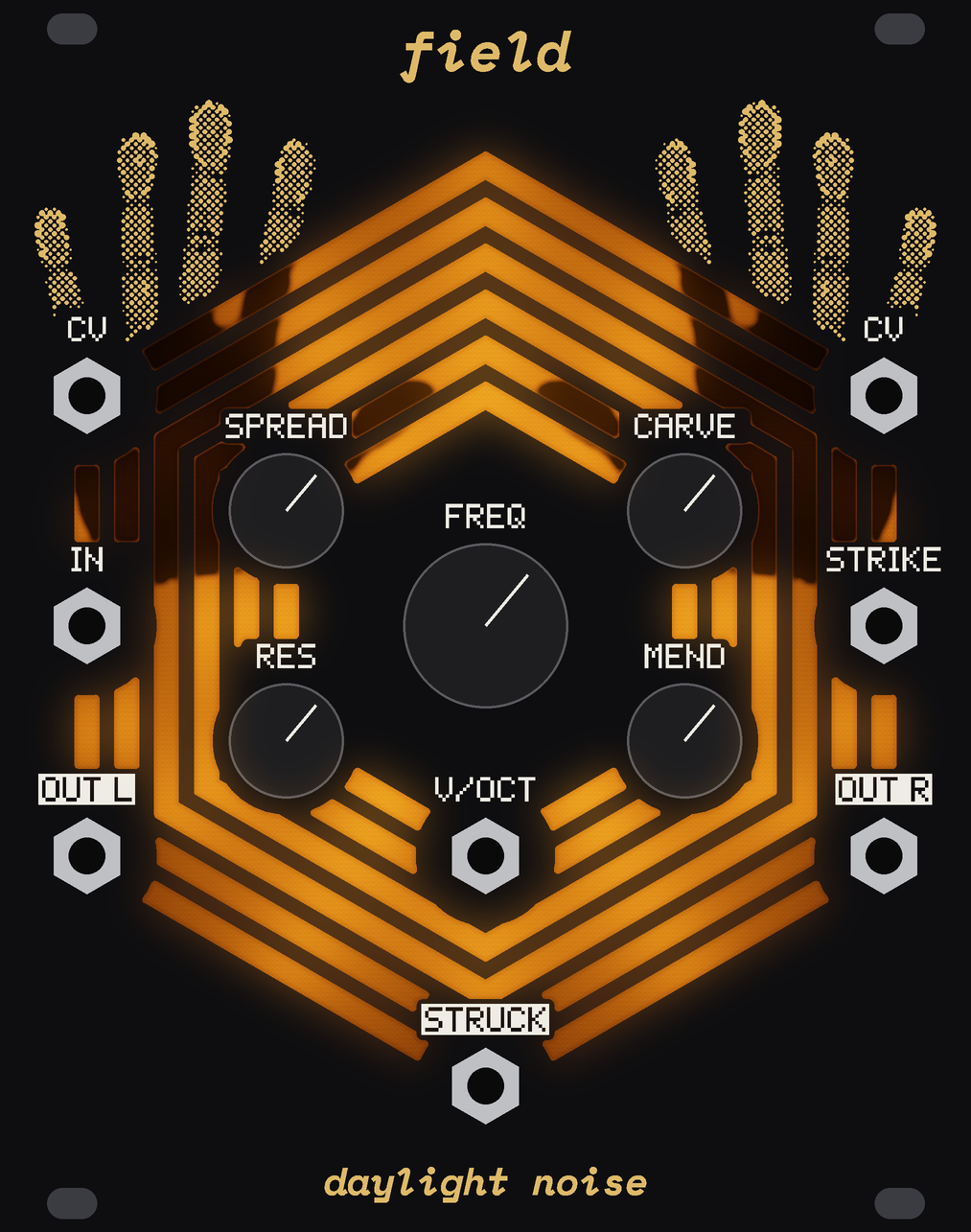
The FIELD panel: black, six nested hexagonal rings of bare glass round the big FREQ knob, broken round every knob and jack, each glowing orange with its band's level. Above the rings, the fingers of two hands pressed flat against the glass, in gold dots; the palms are printed on the back of the panel and show only as shadows in the lit rings. White labels: SPREAD and CARVE, RES and MEND on the innermost ring's corners, the CV, IN, STRIKE and OUT jacks down the sides, V/OCT and STRUCK below. field at the top, daylight noise at the bottom.

Turn a knob: drag it, roll the wheel over it or use the arrow keys; a double click puts it back.

Everything is made in the page: the patches' sources and FIELD itself. Headphones help: odd bands left, even right.

example patches

The module's own engine, running in your browser: the firmware's six bands, the wall, STRUCK and the rings' light, ported from its C and checked against it bit for bit. The rings on the panel are lit by it, as the LEDs behind them will be.
Six bands

Six band-pass filters side by side, the innermost ring the lowest. With RES down they split IN into six bands and what's left between them, and put it all back together: the outs are IN, untouched, until something rings or strikes. Turn RES up and the bands narrow and lift into peaks at their six frequencies; past the top of its travel they ring on their own, a steady six-note chord, and FIELD is a voice.

The wall

STRIKE has six bands of its own, at the same six frequencies. However loud STRIKE is in each one decides how much of IN gets through in the same place. CARVE says which way.

Outs

The panel

The six rings are the panel itself: hexagons of bare fibreglass, no copper and no mask, every knob and jack mounted through them, each ring broken round each part and each label so the labels read on black, lit or not. That leaves 27 pieces of glass, each over its own channel of a black printed baffle with its own LEDs, 54 in all. Each ring glows with its band's level; a strike sends a ripple out from the innermost to the outermost in about 120 ms, and the rings it cut stay dark until MEND lets them back.

Above the field, the fingers of two hands pressed flat against the glass from the other side, in exposed gold, from a photograph. Their palms are printed on the back of the panel, black over copper: in room light they can't be seen at all, and when the rings light up they're a shadow in the glow.

Inside

The FIELD panel, its rings lit, with its knobs on.

Drag to look around. Lift the panel to see the baffle's channels. Nothing has been made yet: the board is drawn plain until its renders are in.

Specs

Format

Width
20 HP
+12 V
about 120 mA, 200 mA with the field fully lit (the design's estimate)
−12 V
about 10 mA
+5 V
not used; 10-pin header
Panel
1.6 mm FR4: bare glass rings, ENIG gold through black mask
Controls
5 knobs, no switches

I/O

IN
audio, ±5 V with room to ±9; 100 k
STRIKE
audio, the same; normalled to IN
V/OCT
all six bands, 1 V an octave, −2 to +8 V
CV
SPREAD's and CARVE's, ±5 V
Outs
OUT L, OUT R: ±5 V into 1 k; OUT R summed into OUT L while unpatched
STRUCK
0 to 8 V, 1 k

Engine

Brain
RP2350, 46.875 kHz, 32-bit float
Converters
PCM1808 in, PCM5102A out, on one I2S clock
Bands
six on IN, six on STRIKE
Light
54 RGB LEDs behind 27 pieces of glass, their current capped
Firmware
over USB-C or the debug header, on the back

Nothing's for sale yet.

FIELD is designed and its firmware builds. Nothing has been made, so the numbers here are the design's and the engine's, not measurements, and there's no date.