fever

watch it fall

20 HP

Each clock drops a ball into a board of lit pegs, and where it lands is the voltage: a bell round where you aim. The pegs it hits clear, so every board starts in long rolls and ends coming home.

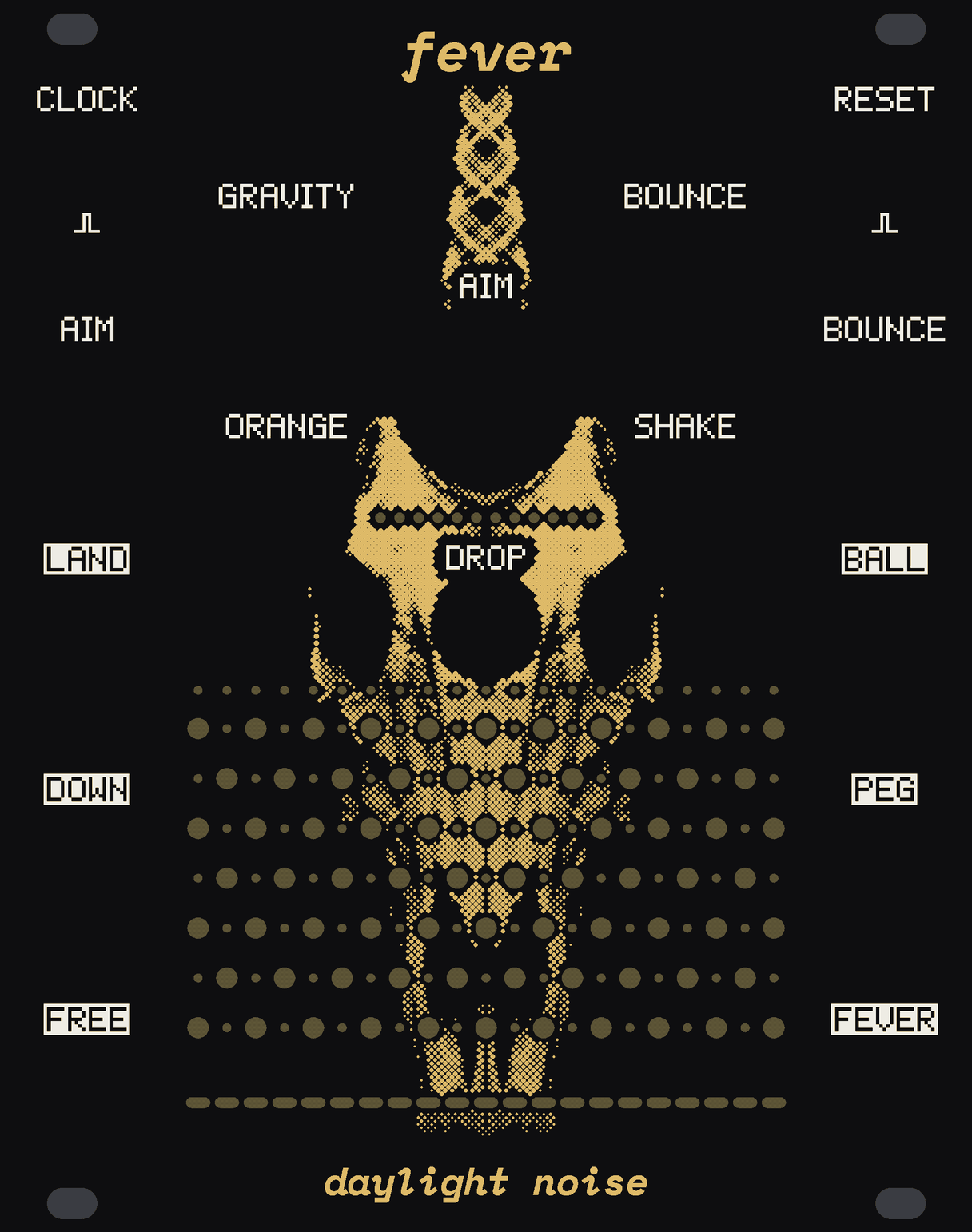
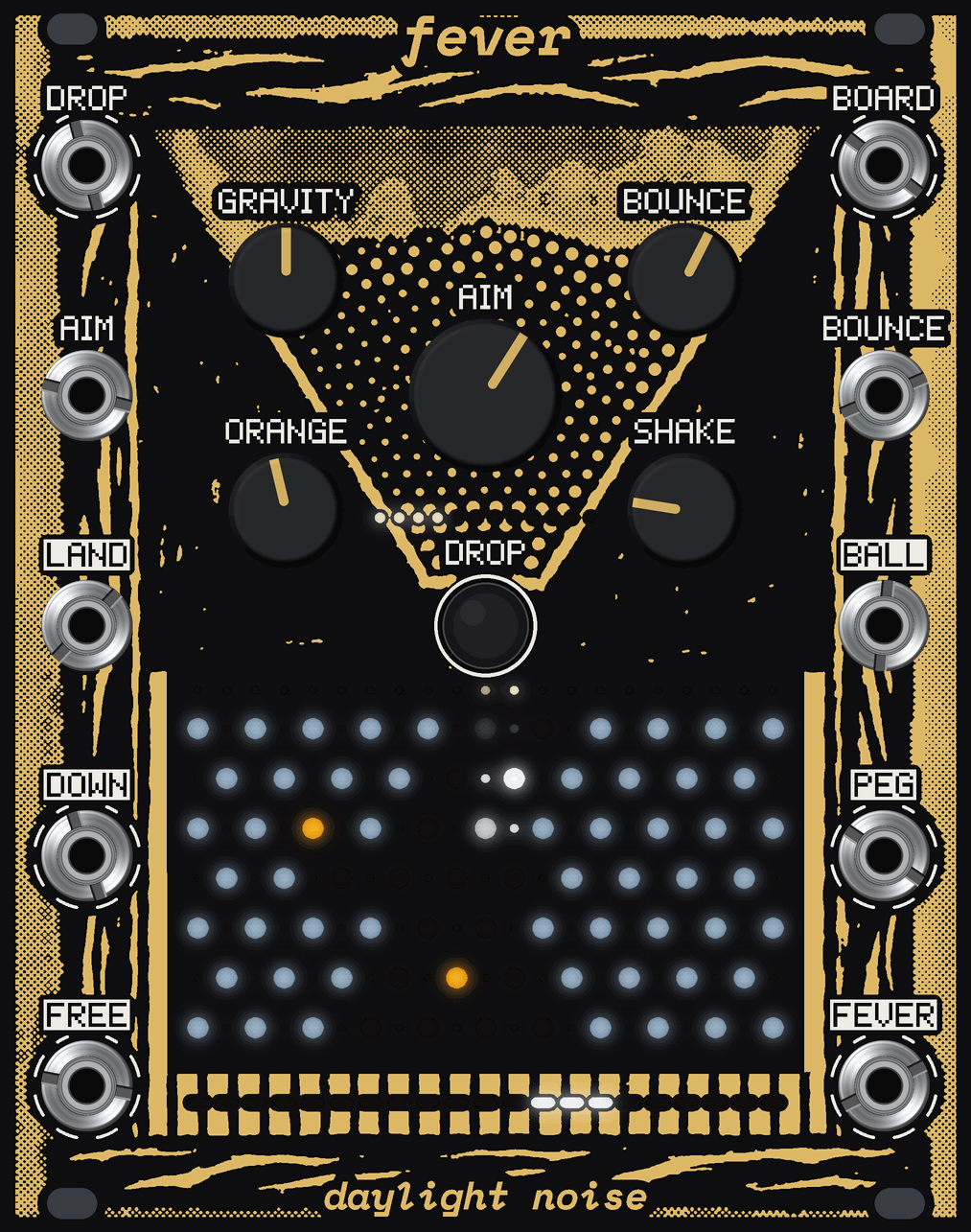
The FEVER panel: black, with a gold print of an old wooden ball-drop board filling it, its rails down both sides and across the top and the foot, a hopper heaped with gold balls narrowing to the DROP button, and under it a black board of small round windows of bare circuit board in staggered rows, slots along its foot. The big AIM knob in a square of four smaller ones, GRAVITY, BOUNCE, ORANGE and SHAKE, sits in the hopper. The jacks DROP, BOARD, AIM and BOUNCE in the top corners, LAND, BALL, DOWN, PEG, FREE and FEVER down the sides, a dashed white ring round DROP, BOARD, DOWN, PEG, FREE and FEVER. fever at the top, daylight noise at the bottom.

Turn a knob: drag it or tap either side of it, roll the wheel over it or use the arrow keys; a double click puts it back. DROP is a button to press. The patches step on by themselves until you touch anything.

The board, the balls and their lights are FEVER's own. The bronze orchestra round it, its gongs, its hand drum and the keys its outs strike, is made in the page as you listen.

example patches

The board, the balls, the pegs and every out and light here are FEVER's engine, the module's own code, running in your browser. The orchestra, the drum's clock and the sequencer are a stand-in for the rest of a rack.
The drop

A ball drops from where AIM points and falls through seven rows of pegs, bouncing off them and off the walls. Where it lands is the voltage. It falls the way a real ball falls, so each one lands near the last but never quite on it.

The pegs

A peg a ball hits lights up, and clears when the ball lands. The first balls of a board roll long; by the last, the pegs round AIM are gone, and the balls fall straight through and land home. Eight balls, then every peg comes back.

Fever

Some pegs are orange. Hit the last one and it's fever: time slows on that ball, the foot of the board splits into five buckets, and the board goes up like fireworks. Five balls later, a new board and new orange pegs.

What comes out

Inside

The FEVER panel with a ball falling through the board of pegs, the gold print of the ball-drop board round it, its knobs and DROP on.

Drag it or use the arrow keys to turn it; click it to take it apart.

Specs

Format

Width
20 HP
Depth
20.8 mm behind the panel
+12 V
about 70 mA dark, 155 mA with a full board at rest, 210 mA at the most (estimated)
−12 V
about 6 mA (estimated)
+5 V
not used
Controls
5 knobs (AIM's big), a button

I/O

DROP
the clock in: a ball on every rise past about 0.9 V, safe to ±12 V; empty, each ball drops as the one before lands
BOARD
a trigger, past about 0.9 V: a new board
AIM, BOUNCE
CVs added to their knobs, ±5 V the whole way; safe to ±12 V
LAND
0 to 5 V across the board, held; 16-bit, calibrated, reaching 5.18 V
BALL
0 to 5 V, the ball's height, new every half millisecond
DOWN, FREE
0/5 V triggers, 5 ms
PEG
0/5 V, 2 ms at every peg hit, half a millisecond low between two
FEVER
a 0/5 V gate, high through the fever

Engine

Brain
RP2350, 2,000 steps a second, 32-bit float
The board
74 pegs, up to four balls at once, eight a board
Light
201 RGB LEDs, 125 frames a second
Power cycle
it wakes to a new board; only the calibration is kept