festoon

the lights are talking

20 HP

A voice made of a string of old coloured bulbs. Each bulb is one of the note's partials, as bright as it sounds. Turn up PRESENCE and something else starts to play them; press CALL and it answers.

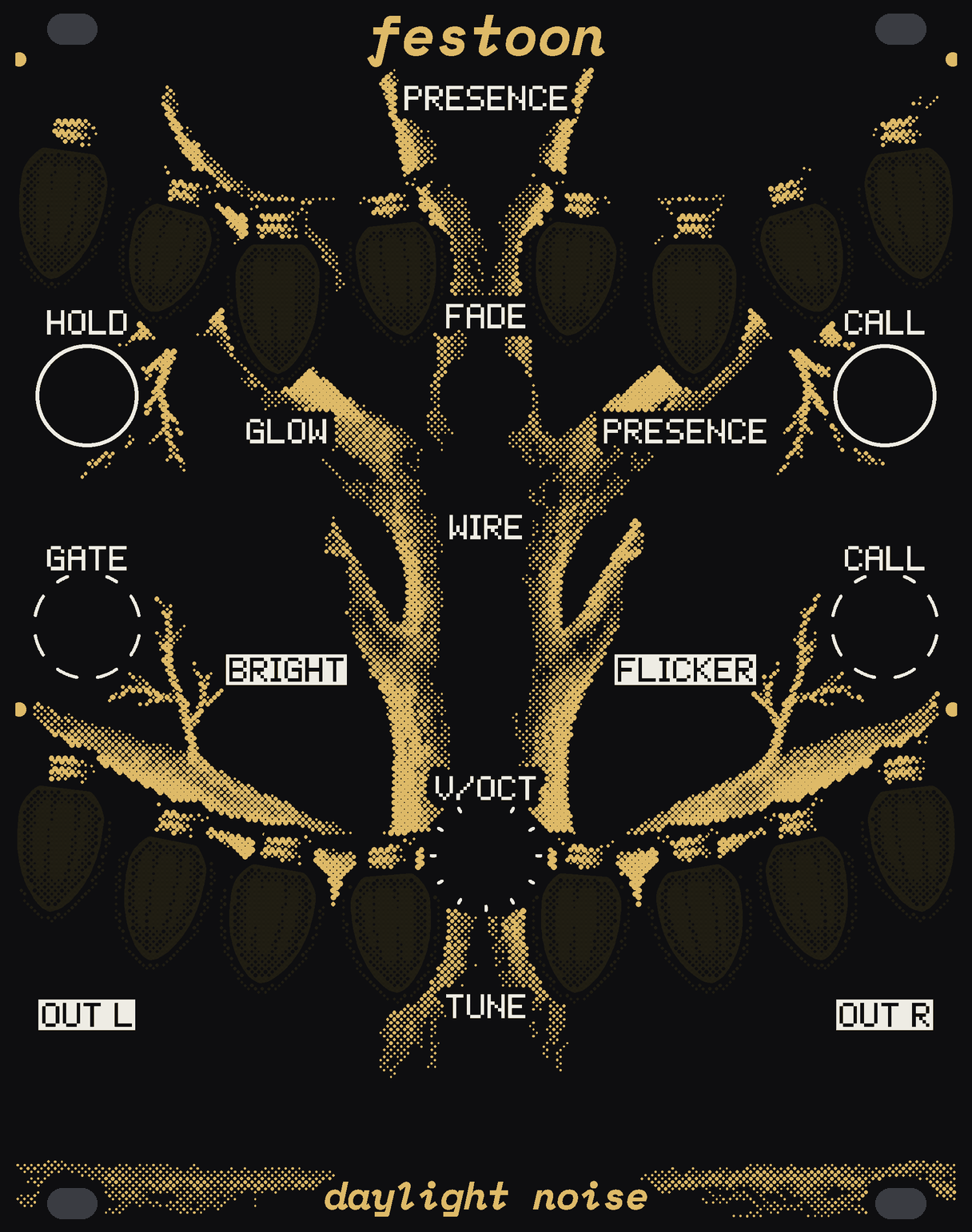
The FESTOON panel, black and gold: a photograph of a bare tree at night, its trunk up the middle and its limbs reaching out to the edges, the bark lit gold only where the bulbs light it, black on its far sides. A string of sixteen old coloured bulbs on black flex hangs between its limbs in two rows of scallops, eight along the top from corner to corner and eight low down, each bulb a faceted glass cone in a small socket, hanging a little its own way: red, green, amber, blue, pink in turn. WIRE, the big knob, sits in the trunk; FADE above it, GLOW and PRESENCE either side; HOLD and CALL buttons by the top row's ends; the jacks down both sides and the spine.

Turn a knob: drag it or tap either side of it, roll the wheel over it or use the arrow keys; a double click puts it back. Press HOLD to keep the string lit as a drone, CALL to ask it something. The patches step on by themselves until you touch anything.

Synthesised here, as the module would make it: the bulbs, the breath, the answers, with a stand-in rack round them.

example patches

Everything FESTOON does here is its engine as designed, in your browser: the sixteen partials, the breath, the flares and runs, the answers. The felt piano, the round bass, the soft drums, the room and the sequencer playing it are a stand-in rack.

A note, taken apart

Every note you hear is a stack of pure tones: the note itself and, above it, quieter tones at twice its pitch, three times, four times and on up. Those are its partials, and how loud each one is makes the note sound dark or bright, hollow or reedy, like glass or like a bell.

FESTOON makes its note from sixteen of them, and each one is a bulb on the string. Bulb 1, top left, is the note. The string runs along the top, down the right side and back along the bottom to bulb 16, the highest. Each bulb is as bright as its partial is loud, so you can see the sound: a dark note lights the first few bulbs, a bright one the whole string.

The string

Something on the other side

In a rack

Specs

Format

Width
20 HP
Controls
a big knob (WIRE), four knobs (FADE, GLOW, PRESENCE, TUNE), two lit buttons (HOLD, CALL)
Lights
sixteen bulbs, two LEDs each, in their own colours
Replaces
an additive oscillator, a tone morph, and a source of movement
Parts
a demo for now: the line's knobs, jacks and buttons, no board yet

Inputs

PRESENCE
CV, adds to PRESENCE: 5 V is the whole turn
V/OCT
1 V an octave, 0 V on C4 (plus TUNE)
GATE
gate: strikes the string, lets it go when it falls (unpatched: each new note strikes it)
CALL
gate: a rise asks it something, as the button

Outputs

BRIGHT
CV, 0 to 8 V: where the light is along the string
FLICKER
trigger, 8 V, 5 ms: each bulb something else lights
OUT L
audio: the note and the warm bulbs (the whole voice with nothing in OUT R)
OUT R
audio: the cool bulbs