fault

what fits goes in

20 HP

DIG cuts a hole in the rock in the shape of whatever is playing. From then on, every sound that fits it is taken out of the mix and into the rock, where it sinks, slower and lower and stretched out of shape, and goes on sounding. The mix is always a little emptier than what you played.

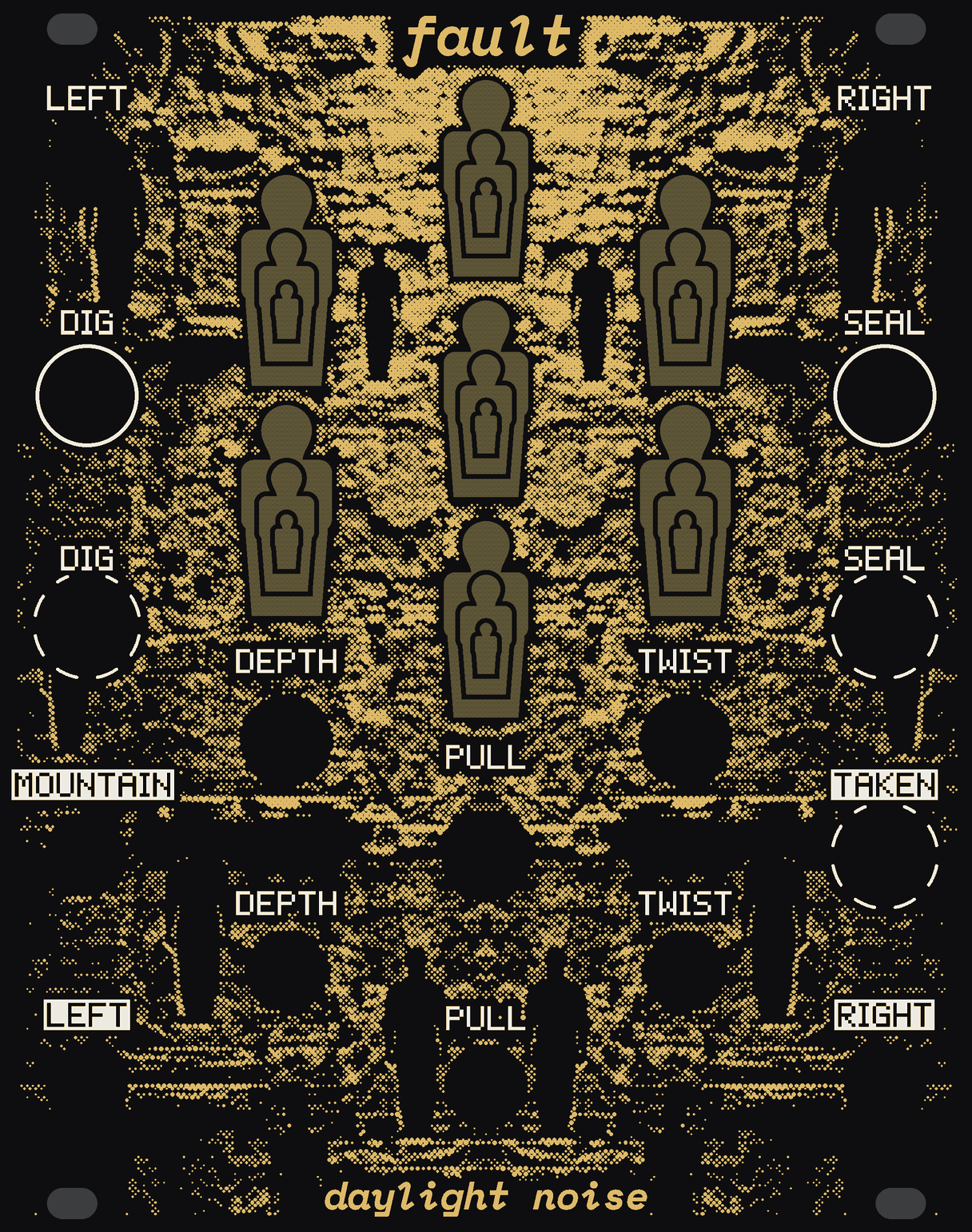
The FAULT panel: black, with gold dots of a sheer rock face at night, ledges and strata, dark figure-shaped holes cut all over it. Seven of the holes are windows of bare circuit board in the shape of a standing figure, each with a smaller figure inside it and a smaller one inside that, in a cluster under the name. LEFT and RIGHT in at the top corners, DIG's and SEAL's buttons over their jacks down the sides, DEPTH and TWIST under the cliff with the big PULL knob between them, MOUNTAIN and TAKEN out down the sides, the DEPTH, TWIST and PULL jacks under the knobs, the LEFT and RIGHT outs at the foot. fault at the top, daylight noise at the bottom.

Turn a knob: drag it or tap either side of it, roll the wheel over it or use the arrow keys; a double click puts it back. DIG and SEAL are buttons to press. The patches step on by themselves until you touch anything.

A dark loop in D minor, the whole mix through FAULT. Listen plays the patch from its top.

example patches

Everything FAULT does here is its engine as designed, running in your browser. The loop is a stand-in rack. A hole here keeps four seconds of what it takes; the module's keep twelve.

Cutting holes

The cliff holds seven holes, cut from the top down. A hole is cut in the shape of what's playing over the next tenth of a second: its outline across the spectrum, its pitch, its body. What it takes is what was new in that shape, so a hole cut on a chord over a bass takes the chord and leaves most of the bass.

What fits

Every moment of sound is held up against every hole. The same sound again fits its hole exactly; other sounds fit it less, by how much their shapes differ. The best fitting hole takes it if the fit is close enough, and the mix loses exactly what the rock gets: the part of the sound in the hole's shape, bin by bin.

Into the rock

What's taken plays on inside its hole from the moment it's taken, starting at the mouth just as it was and sinking: slower, lower, darker and fainter, until it lies where DEPTH says and loops there for good. Older takes melt into the hole's bed, one held sound breathing at the bottom. Nothing comes back up. Each hole's light falls inward as what it holds goes deeper, from its mouth to the small figure at its end.

What comes out

Specs

Format

Width
20 HP
Controls
a big knob, 2 knobs, 2 lit buttons

Inputs

LEFT, RIGHT
audio, ±5 V; RIGHT takes LEFT when it's empty
DIG, SEAL
triggers, rising past 1 V
CVs
PULL, DEPTH, TWIST: added to the knobs, 5 V the whole way

Outputs

LEFT, RIGHT
audio, exact to ±7.5 V, soft past it
MOUNTAIN
audio, mono
TAKEN
gate, 0/5 V, high while taking