expedition

20 HP · drone

A drone that never comes back the same: a family of copies, each made from another and bent a little in the making. It keeps what it becomes, and a trace of whatever you feed it, through every power cut.

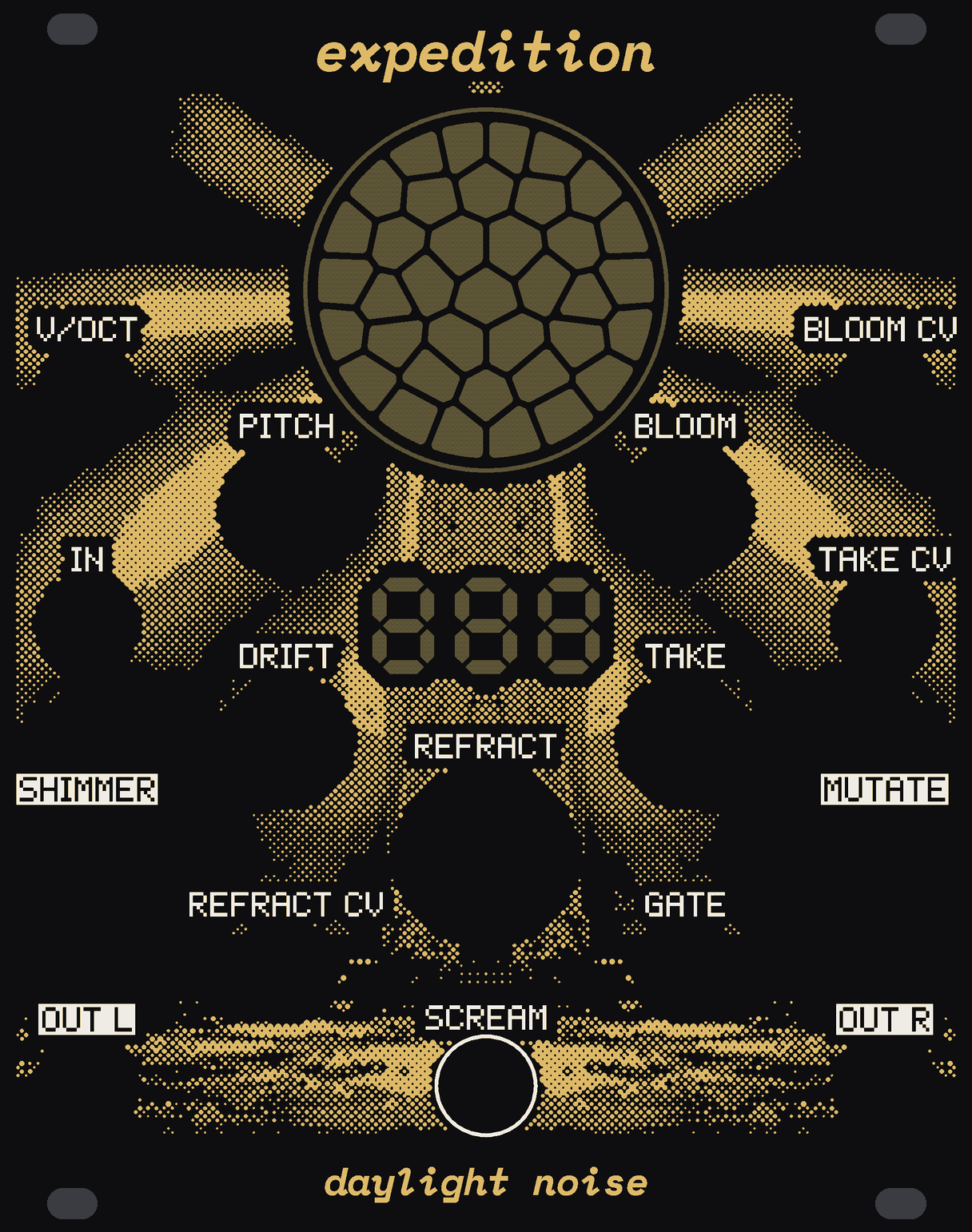
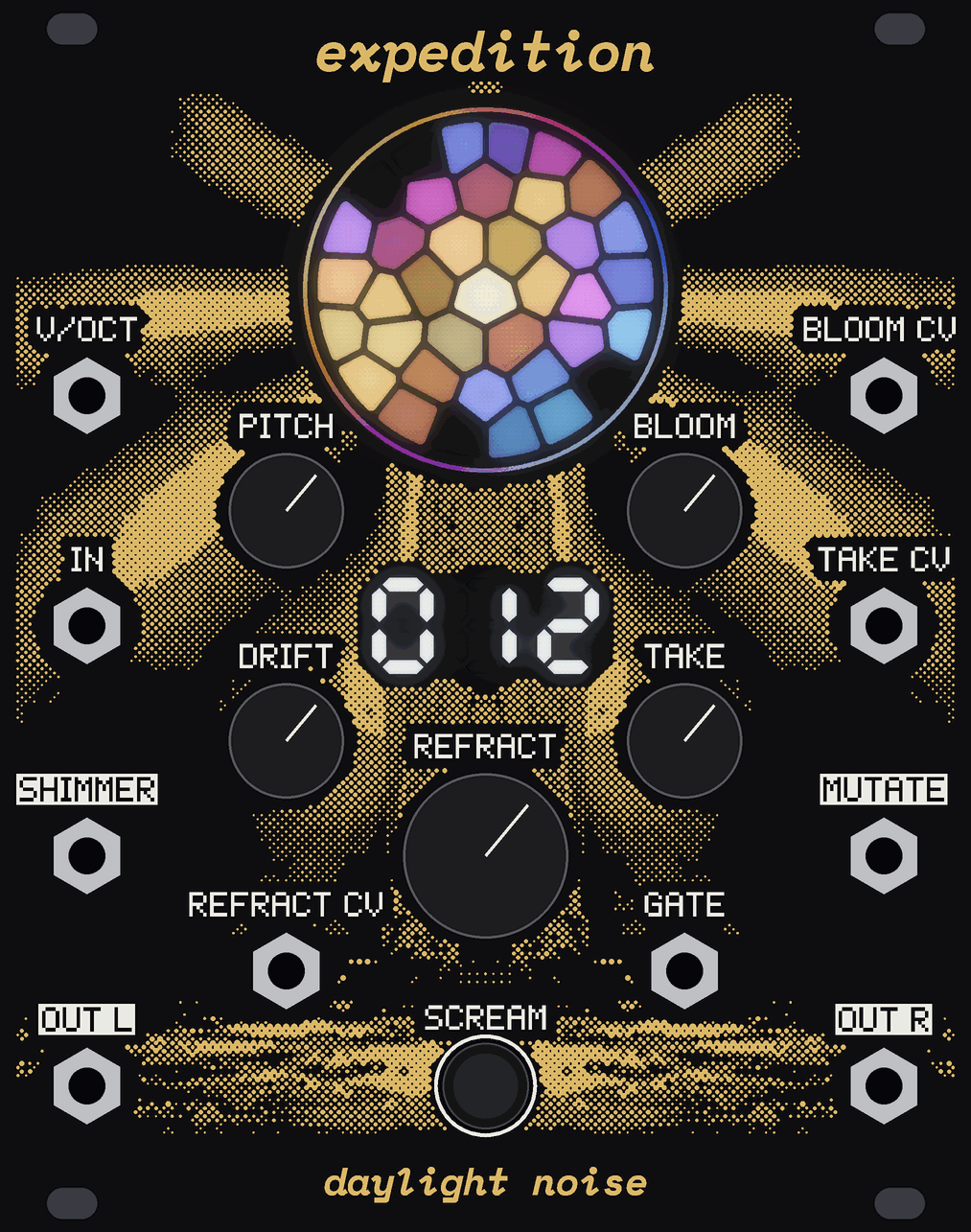
The EXPEDITION panel: black, with a lighthouse in gold dots down the middle. Its lamp is a round window under the name, cut into 37 cells of bare circuit board in rings round one in the middle, with a thin ring round them all; the lamp's beams spread out through mist across the panel, and the tower stands on a beach above the maker's mark. Under the window, three seven-segment digits. White labels: V/OCT and BLOOM CV, IN and TAKE CV, SHIMMER and MUTATE, OUT L and OUT R down the edges; the knobs PITCH and BLOOM, then DRIFT and TAKE, either side of the tower; REFRACT, the big knob, in the middle, with REFRACT CV and GATE either side; SCREAM at the foot. expedition at the top, daylight noise at the bottom.

Turn a knob: drag it, roll the wheel over it or use the arrow keys; a double click puts it back. Hold SCREAM to bring back something it took; a tap plays it once.

The drone is EXPEDITION's own. The voice, drums and bell it's fed, and the rest of the rack, are made in the page as you listen. Two patches keep what they feed it, for good.

example patches

The Shimmer, the readout and the drone here are EXPEDITION's own firmware, running in your browser to the same bits as the module: the copies, their bends, what it keeps and when it screams. This page keeps your unit, and each visit is its next expedition.
The family

Thirty-seven copies, one to a cell of the Shimmer: the first voice in the middle, its six copies round it, then theirs, and theirs. Each copy sits at a clean ratio to its parent, an octave up or down, a fifth, a fourth or unison, and carries a bend of its own. Its cell is lit the colour of how far it has been bent from the first voice: pale on a new unit, every colour of an oil film on an old one.

Bloom and drift

BLOOM brings the family in ring by ring, in an order each unit is born with. DRIFT remakes it while it plays: a copy, more often from the outer rings, gets a new bend near its old one, and now and then a new ratio, and glides there. Between remakes the bends breathe slowly, which is what you see moving in the cells.

What it keeps

IN is always heard through the family: every copy is also a resonator at its own pitch, so whatever comes in rings through it. TAKE is how much of it stays, for good. The strongest partials of IN pull nearby copies onto them, so a unit fed on a voice ends up tuned to it; and while IN is loud it keeps a fragment of a second or two, in a memory of twelve seconds, the oldest overwritten. The ring round the Shimmer brightens while it's keeping.

Expeditions

EXPEDITION keeps everything through a power cut: what it has become, its fragments, its count. Each power-up is a new expedition, counted on the readout under the Shimmer, and on the way in the whole family and every fragment are copied once more, a little more bent each time. Two units fed different things drift apart, and after a while no two sound alike. There is no reset.

This page keeps one too. Your first visit was expedition 1 of a unit of your own, and each visit since is the next. The patches that feed it change it for good.

The panel

Twenty HP, every part on the line's staggered grid and mirrored about the middle. The art is a lighthouse: the Shimmer is its lamp, its beams going out through the mist across the panel, its tower standing down the middle on a beach.

Inside

One four-layer board sits 10 mm behind the panel, with the jacks, the knobs, SCREAM's switch and 78 RGB LEDs on its front and everything else on its back. A printed black block between them gives every cell of the Shimmer, its ring and each segment of the readout a chamber of its own. An RP2350 runs the family 46,875 times a second on both its cores, and a small FRAM keeps the unit through every power cut. V/OCT and SHIMMER can be calibrated over USB with a meter.

The EXPEDITION panel twelve expeditions in: the Shimmer's cells lit in oil-film colours, its ring glowing, the readout reading 012, with its knobs on.

Drag to look around. Lift the panel to see the baffle's chambers, lit from the LEDs on the board.

Specs

Format

Width
20 HP
Depth
about 21 mm behind the panel, to the top of the power header (estimated)
+12 V
about 115 mA with the lights dark, about 260 mA at the LEDs' cap (estimated)
−12 V
about 6 mA (estimated)
+5 V
not used; 10-pin header
Panel
1.6 mm FR4: 59 bare glass windows, gold through black mask
Controls
5 knobs and SCREAM's button

I/O

V/OCT
1 V an octave, −2 to +8 V
IN
audio, ±5 V (±9 V before it clips)
REFRACT CV
±5 V across REFRACT
BLOOM CV
±5 V across BLOOM
TAKE CV
±5 V across TAKE; over 2.5 V, keep this now
GATE
SCREAM while it's high (over about 1.2 V)
OUT L, OUT R
audio, under 6 V peak
SHIMMER
0 to 8 V, slow
MUTATE
5 V, 10 ms, at each remake

Engine

Brain
RP2350, both cores, 46.875 kHz, 32-bit float
Memory
2 Mbit FRAM: the family, the count and 12 s of fragments, saved every second
Light
78 RGB LEDs behind the windows, their current capped
Firmware
over USB-C or the debug header, on the back