exclamation

what was that noise?

20 HP

It walks a patrol and listens. Make enough noise and “!” fires on the next bar: the loop drops into double time, breaks down into fragments, builds back nervously, then goes back on patrol. Each part of the arc has its own gate, so it can rearrange the rest of the rack.

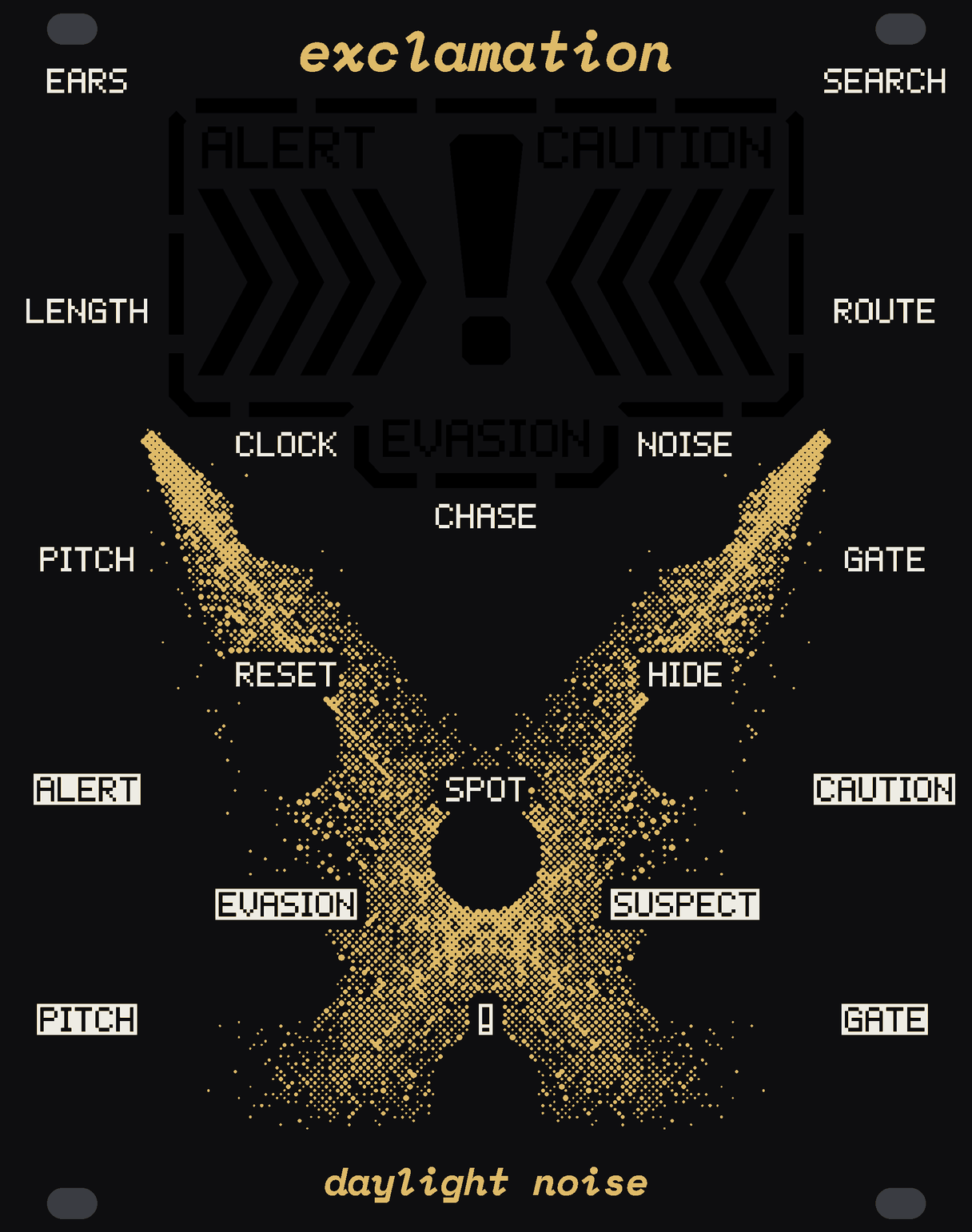
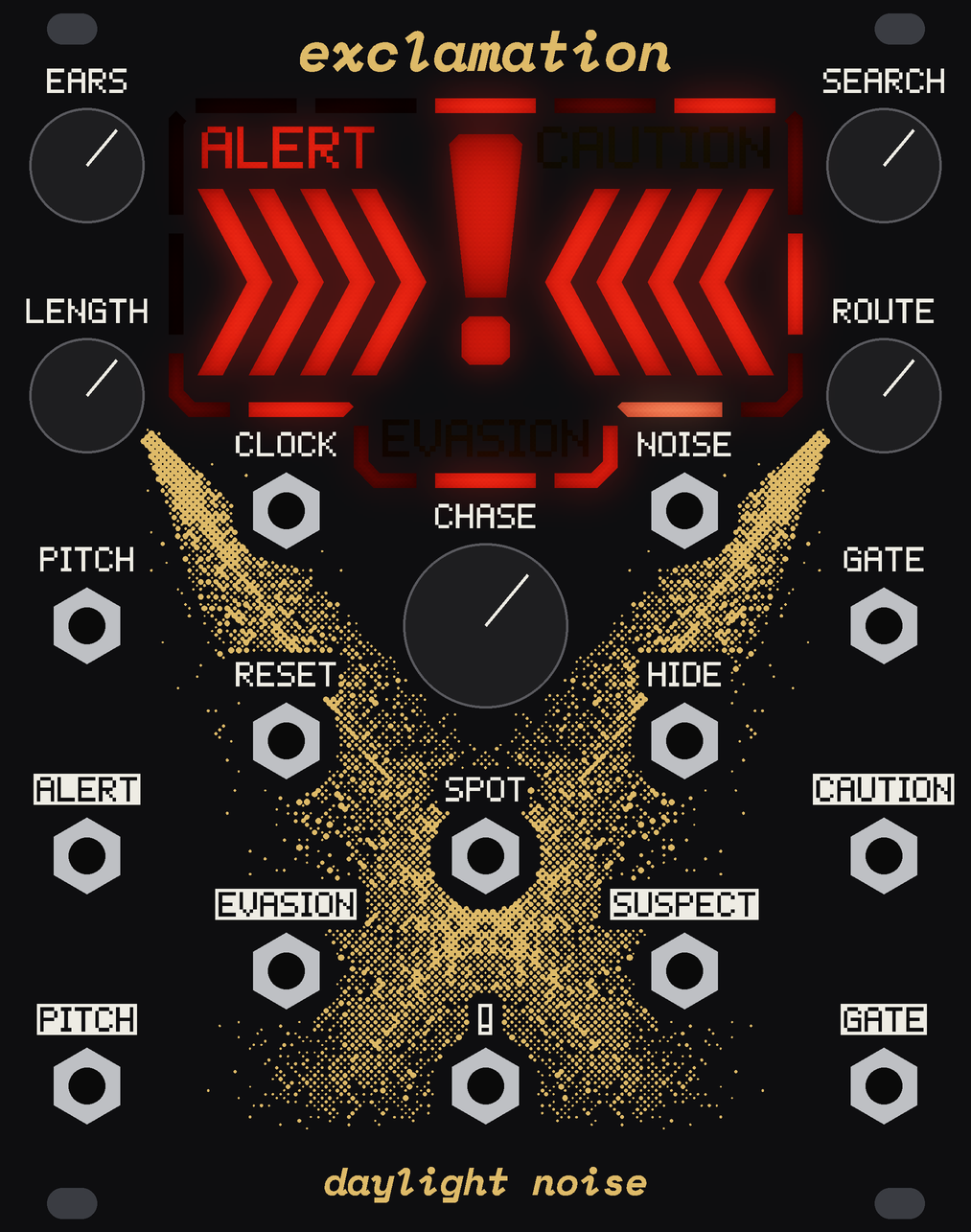
The EXCLAMATION panel: black, with a screen of bare glass under the name. Sixteen dashes run round the screen's edge, the patrol's steps; inside them a big exclamation mark, four chevrons either side pointing in at it, and the words ALERT and CAUTION in solid pixel letters at the top corners, EVASION below the exclamation mark. Under the screen, two searchlight beams in gold dots, full of fog and rain, cross on the SPOT jack. White labels: EARS, SEARCH, LENGTH and ROUTE round the screen, CHASE on the big knob, the TREAD, NOISE, PITCH, LEARN, POST, HIDE and SPOT jacks, and the outs ALERT, EVASION, CAUTION, SUSPECT, PITCH, PATROL and !; white dashes ring the gate jacks and white ticks the two PITCH jacks. alert at the top, daylight noise at the bottom.

Turn a knob: drag it or tap either side of it, roll the wheel over it or use the arrow keys; a double click puts it back.

Nothing plays until you press it. Each patch starts again from its first bar.

example patches

The module's own engine, running in your browser: the firmware's rules, ported from its C and checked against it bit for bit, lighting the screen cell by cell as the LEDs behind it are. The rack round it is a stand-in, scored like a tense film cue in C#: strings or low brass on its outs, a big drum, toms and ticks, a low pulse on the clock, a brass stab on "!", all in a big hall and all synthesised here.
Patrol

EXCLAMATION takes a step for each pulse at TREAD, the clock in, and counts sixteen steps to the bar, from the first pulse or from POST, the reset. On patrol it walks a loop of LENGTH steps, 1 to 16, round the edge of the screen in green, clockwise from the top. Each note lights its step as it plays.

Listening

Anything at NOISE can give you away: a drum, a gate, audio. Each hit, a sharp rise past 1 V, adds to suspicion, louder hits more, up to 5 V. The chevrons either side of the "!" close in from the outside as it rises.

When the meter fills, the dot of the "!" blinks: it has heard you and is waiting for the bar. On the next bar line "!" fires, unless HIDE is high there and it only heard noise. The "!" out is a trigger, always on a downbeat.

The arc

After "!" the loop plays out three parts, each a whole number of bars, and goes back on patrol. SEARCH sets how long they take, in six steps: 2 + 1 + 1, 2 + 2 + 2, 4 + 2 + 2, 4 + 4 + 4, 8 + 4 + 4 and 16 + 8 + 8 bars.

What comes out

Inside

The EXCLAMATION panel, its screen lit at ALERT, with its knobs on.

Drag it or use the arrow keys to turn it; click it to take it apart.

Specs

Format

Width
20 HP
Depth
21 mm behind the panel, to the top of the power header
+12 V
about 90 mA, 170 mA with the screen at its brightest (the design's estimate)
−12 V
about 5 mA
+5 V
not used; 10-pin header
Controls
5 knobs, no switches

I/O

Gates in
TREAD (the clock), POST (the reset), HIDE, SPOT: high above about 1.2 V
NOISE
audio, drums or gates, ±10 V
PITCH in, LEARN
a line to learn: 1 V an octave, −2 to +8 V; a gate
PITCH out
1 V an octave, −2 to +8 V, 16 bits; linear from −1.92 to +8.12 V; −2 V for a few ms at power-on
PATROL
2.5 V a ghost note, 5 V a note, 8 V an accent
Gates out
ALERT, EVASION, CAUTION, !: 0 or 5 V
SUSPECT
0 to 8 V

Engine

Brain
RP2350, 16 kHz, 32-bit float
Timing
a clock pulse to a new note within about 0.1 ms (under 1 ms while it learns a line)
Light
44 RGB LEDs behind 29 windows, their current capped
Firmware
over USB-C or the debug header, on the back