entire history

16 HP · output

An output that never stops recording. Line out to the room, headphones for you, and everything that passes through goes onto a card, a day and more of it. When something good happens, go back for it in the headphones while the room carries on, and keep it.

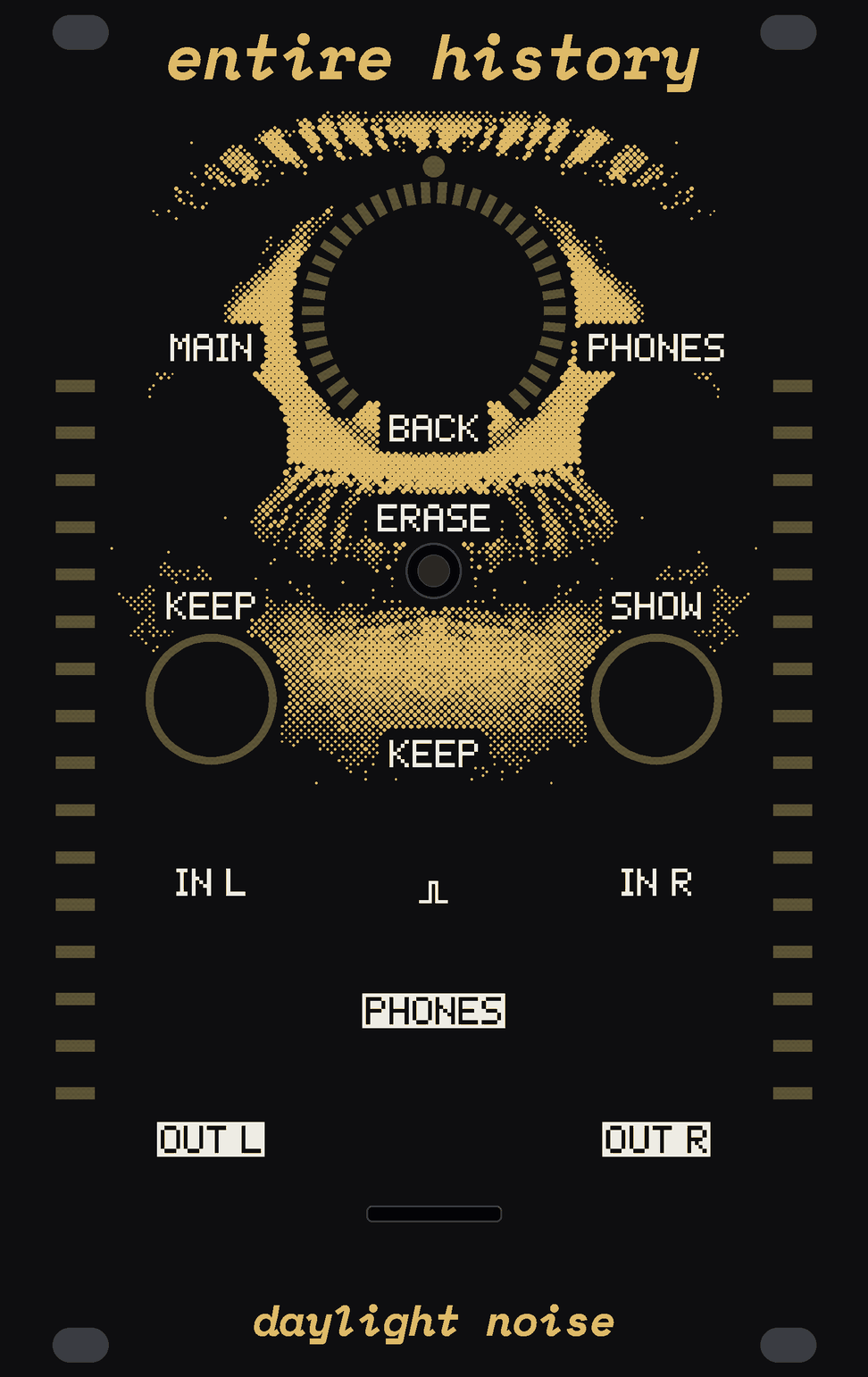
The ENTIRE HISTORY panel: black, with one eye close up in gold dots across its top, lashes fanned out under the name. The big knob BACK is the eye's pupil, ringed by 36 small windows of bare circuit board, its iris, with a round window above for the record light. MAIN and PHONES either side, ERASE in a small well under the eye, the buttons KEEP and SHOW in rings of their own, the KEEP jack, IN L and IN R, PHONES, OUT L and OUT R at the foot, a card slot between them, and a column of sixteen small windows down each side for the meters. entire history at the top, daylight noise at the bottom.

Turn a knob: drag it, roll the wheel over it or use the arrow keys; a double click puts it back. KEEP and SHOW are buttons to press, and ERASE is one to hold for three seconds. The patches step on by themselves until you touch anything.

What you hear is the headphones. The recording, the replay and the lights are ENTIRE HISTORY's own; the set going into it is made in the page as you listen.

example patches

The ring, the replay, KEEP's WAV and the lights here are ENTIRE HISTORY's engine as it's designed, running in your browser. The page keeps the last three minutes, 16-bit, in memory (35 MB); the module keeps a day and more on its card. The set and the hand on the controls are a stand-in for the rest of a rack.

Always recording

Everything that comes in goes out to the room, and onto the card as it goes: 24-bit, 48 kHz, about a gigabyte an hour. The card is a ring. A 32 GB card holds 26 hours before the oldest hour is written over; switch off and the history is still there when you switch on. Nobody has to press record.

Going back

The ring of lights round BACK is the history: lit as far back as it goes, a window further each time it doubles, a second ago next to now, an hour most of the way round, a day at the far end. Turn BACK and the headphones rush back through it, like tape spooling, and play on from where you stop. The room hears none of it.

Keep it, show it

Found it? Keep it. From the mark to now goes onto the card as a WAV of its own, named with the time, while the recording carries on; the stretch you kept glows warm on the ring. Or play it to the room.

Erase

Hold ERASE and the ring drains from its oldest end. At three seconds the history is gone. Let go sooner and it all comes back. It's set down in a well, so a knuckle or a cable can't reach it. What you kept stays kept.