enough

cut until it sings

20 HP

Patch in a busy line. ENOUGH keeps the notes that matter and sends them out at KEPT; every note it cuts comes out at SPARE, at its own pitch and time. One line becomes a melody and the part that fits round it, every note in one or the other.

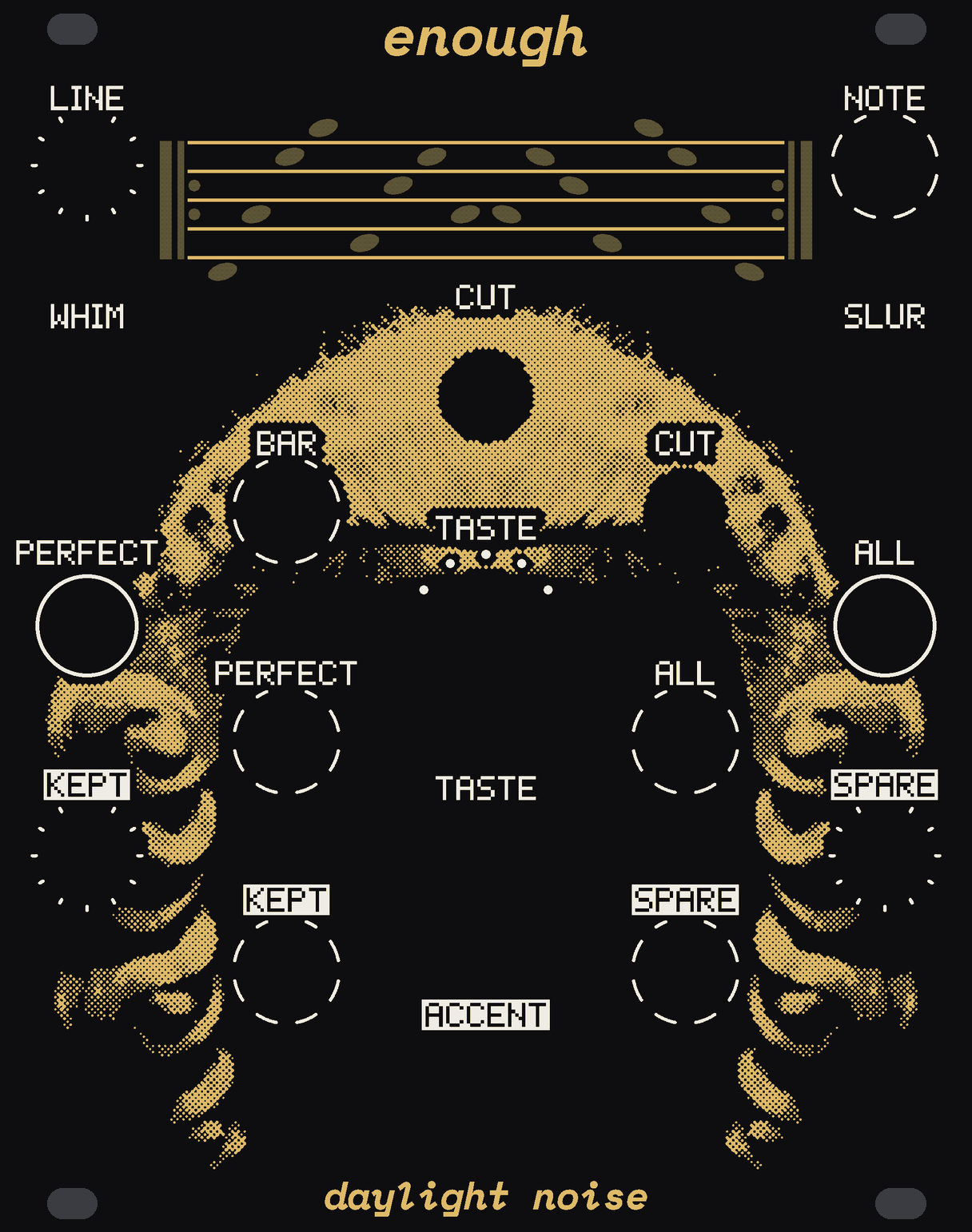
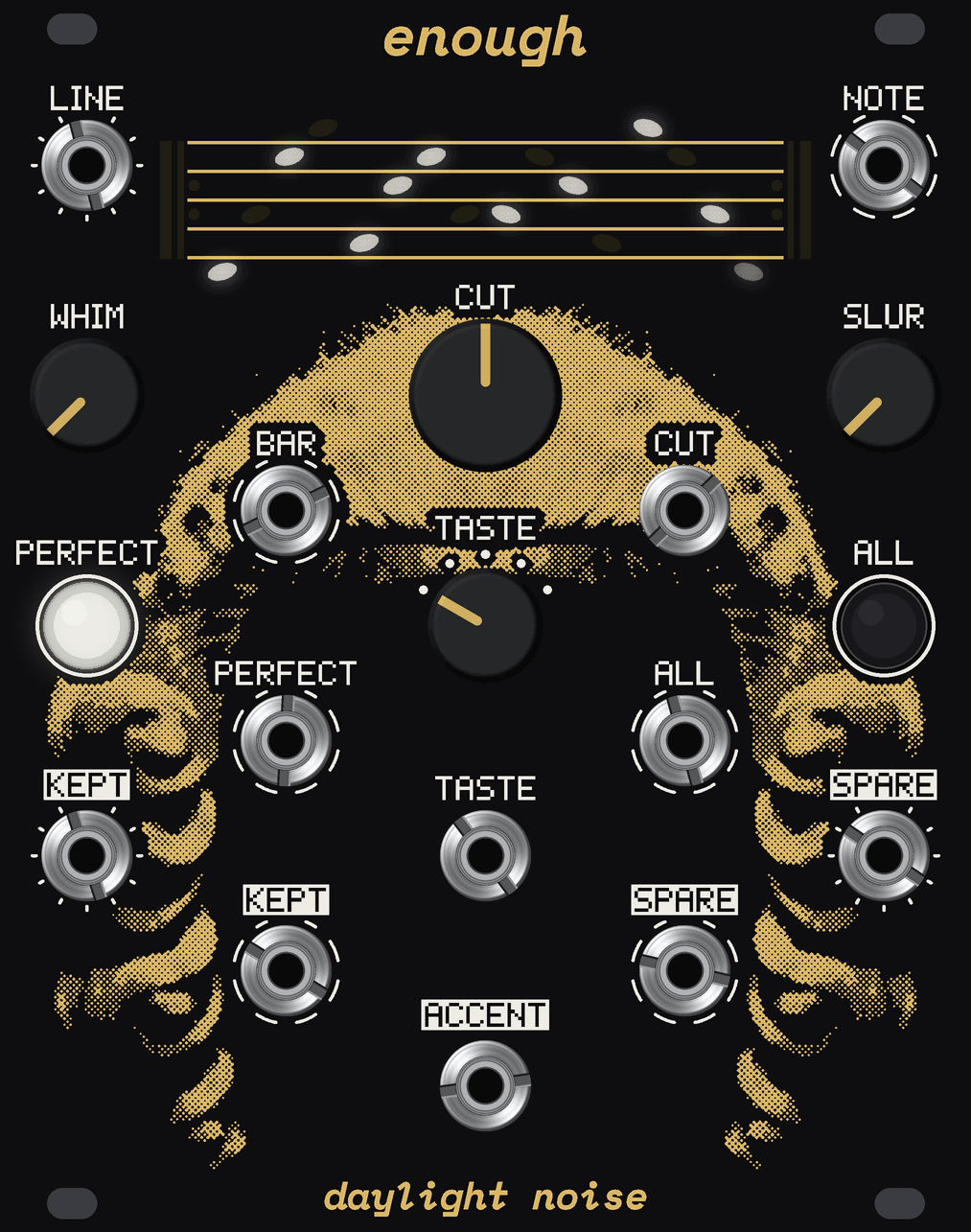
The ENOUGH panel: black, in gold dots a powdered wig on a stand with no face, its crown under the name and its rolled curls hanging down either side to the foot. Under the name a staff of five gold lines with sixteen note heads of bare circuit board and a repeat sign at each end. The big CUT knob in the wig's blank face, TASTE under it with five dots round it and its jack below; LINE and NOTE at the top corners, WHIM and SLUR either side of CUT, BAR and CUT's jack under them, the PERFECT and ALL buttons and their jacks, KEPT down the left and SPARE down the right, ACCENT at the foot. enough at the top, daylight noise at the bottom.

Turn a knob: drag it or tap either side of it, roll the wheel over it or use the arrow keys; a double click puts it back. TASTE clicks from stop to stop the same way; PERFECT and ALL are buttons: press PERFECT to hold the cut, again to let it go. The patches step on by themselves until you touch anything.

A dark groove in D minor, a busy arp into LINE and NOTE. KEPT plays a harpsichord-ish lead, SPARE a plucked string. Listen plays the patch from its top.

example patches

The notes heard, the weighing, the cut and every out and light here are ENOUGH's engine, the module's own code, running in your browser. The groove, the sequencer and the two voices are a stand-in rack.
What it keeps

It weighs every note the moment it starts, against the notes of the bar before it, and keeps the ones that weigh most. A line that repeats is cut the same way every bar. The staff under the name is the bar, a head a sixteenth: a kept note lights its head and leaves it lit, a cut one flickers past.

Holding it

The line in

What comes out

Inside

One board sits 10 mm behind the panel with everything on its front: the jacks, the knobs, TASTE's switch, both buttons, the 26 LEDs and the whole circuit, the USB-C in a notch in its left edge. Each window has its own white LED in a cell of a black printed baffle, so a kept note's head never lights the heads beside it. An RP2350 hears and weighs every note, three thousand times a second.

The ENOUGH panel half cut: the kept note heads lit on the staff under the name, the wig in gold dots round CUT and TASTE, its knobs, TASTE's switch and the PERFECT and ALL buttons on.

Drag it or use the arrow keys to turn it; click it to take it apart.

Specs

Format

Width
20 HP
Depth
20.8 mm behind the panel
+12 V
about 40 mA dark, 100 mA in use, 190 mA at the most (estimated)
−12 V
about 4 mA (estimated)
+5 V
not used
Controls
a big knob, 2 knobs, a five-way switch, a lit button, a button

I/O

LINE
1 V an octave, 0 V is C4, −6 to +6 V, read to the nearest semitone 1 ms after NOTE rises; a 24-bit converter, calibrated; safe to ±12 V
NOTE, BAR
gates, high past about 0.9 V, safe to ±12 V; unpatched, NOTE takes LINE's moves and BAR is sixteen notes
PERFECT, ALL
gates, high past about 0.9 V: PERFECT holds while high, ALL on each rise
CUT, TASTE
CVs: CUT added to its knob, 5 V the whole way; TASTE a stop a volt; safe to ±12 V
KEPT, SPARE
1 V an octave, −5 to +5 V (a note past that folds by octaves), 16-bit, calibrated; their gates 0/5 V
ACCENT
CV, 0 to 8 V, set as each note starts

Engine

Brain
RP2350, 3,000 steps a second, 32-bit float
Memory
the last 64 notes
Light
26 white LEDs, 100 frames a second
Power cycle
it wakes with no notes heard and nothing held; only the calibration is kept