enlarge

there's something in it

20 HP

It's always recording the last half minute. Pick a moment and enlarge it, up to sixty-four times slower at its own pitch, until a click is a hit and the hiss is weather. The biggest jump in it is the shot: it rings out each time the playback passes.

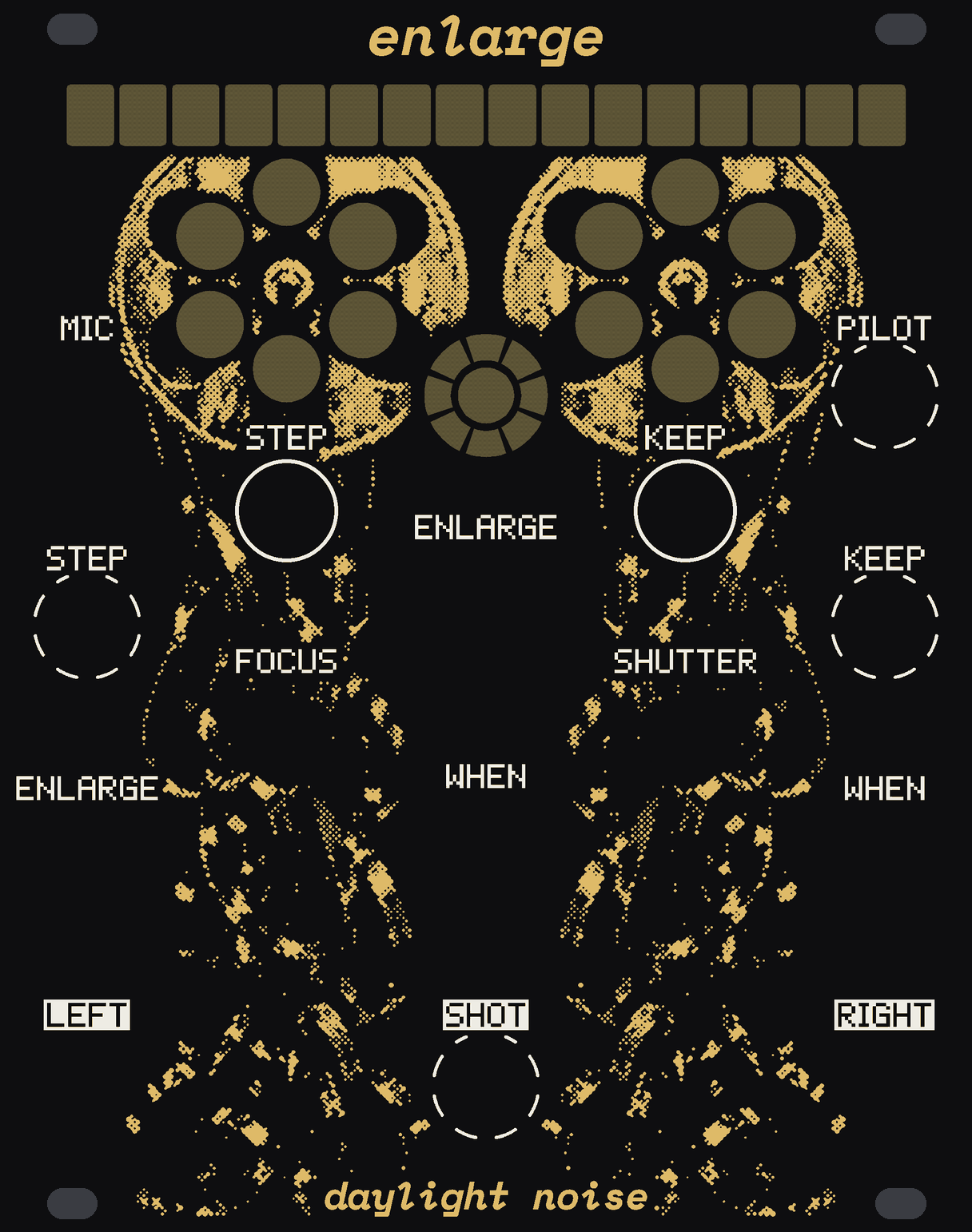
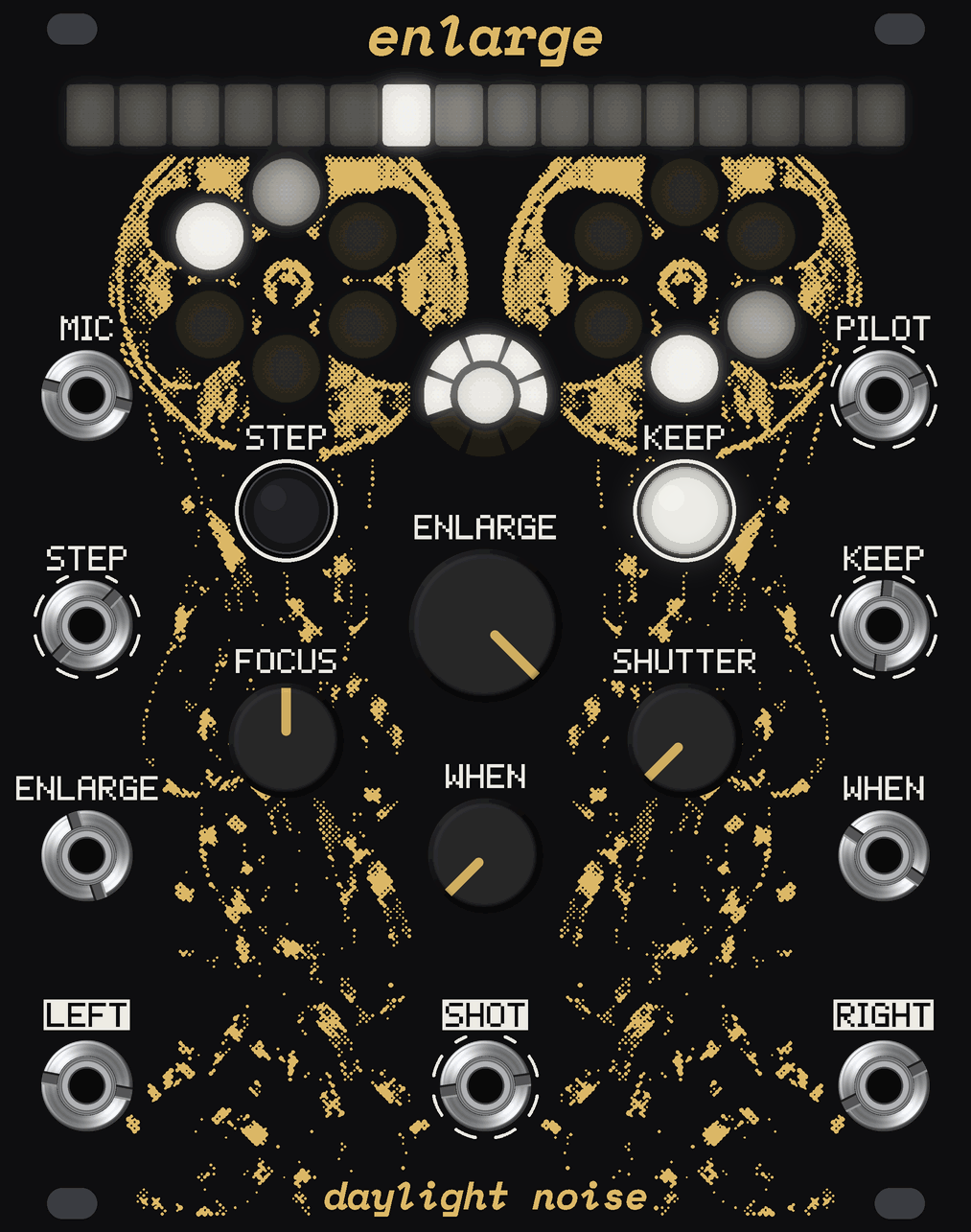
The ENLARGE panel: black, gold dots of two tape reels hanging in the dark with the tape spilling from under them in loops down to the foot. A strip of sixteen windows of bare circuit board runs across the top under the name; each reel's six round cutouts are windows, and a round window with a ring sits between the reels. MIC and PILOT at the sides, STEP and KEEP's buttons either side of the round window with their gates at the edges, the big ENLARGE in the middle, FOCUS and SHUTTER either side under it, WHEN under them, the ENLARGE and WHEN CV jacks at the edges, LEFT, SHOT and RIGHT at the foot. enlarge at the top, daylight noise at the bottom.

Turn a knob: drag it or tap either side of it, roll the wheel over it or use the arrow keys; a double click puts it back. STEP and KEEP are buttons: press STEP for one frame on, KEEP to stop the tape on this moment, and again to let it record. The patches step on by themselves until you touch anything.

A rack round ENLARGE: a dark song into MIC, its clock and a sequencer into the other jacks. Listen plays the patch from its top.

example patches

Everything ENLARGE does here is its engine as built, running in your browser. The song and the sequencer are a stand-in rack.
The tape

It records MIC onto half a minute of tape, always, so the moment you want has already happened. Pick it, and keep it if you want to stay with it.

Enlarging

The moment plays back slower and bigger, at its own pitch, a pass at a time. While the tape runs, each pass catches the moment again, WHEN ago; kept, it's the same moment round and round.

Frame by frame

The moment is sixteen frames, the strip across the top: the frame playing lit, the others by how loud they are, the shot's frame marked.

The shot

The shot is the biggest jump in the moment: not the loudest sound, the sharpest rise, often a click nobody heard. Past as it was, it rings out each time the playback passes it, longer the deeper you go.

What comes out

Inside

One board sits 10 mm behind the panel with everything on its front: the jacks, the knobs, both buttons, the 67 LEDs and the whole circuit, the USB-C in a notch in its left edge. Each window has its LEDs in its own cell of a black printed baffle, so a dark frame beside a lit one stays dark. The tape is 8 MB of memory beside an RP2350, which plays the grains on both its cores.

The ENLARGE panel in a dim room: a frame of the strip lit bright, the others glowing by their loudness, a cutout of each reel lit, the lens's core and ring lit as the shot rings out, its knobs, jacks and buttons on.

Drag it or use the arrow keys to turn it; click it to take it apart.

Specs

Format

Width
20 HP
Depth
20.8 mm behind the panel
+12 V
about 65 mA dark, 125 mA in usual play, 165 mA deep in, 260 mA at most (estimated)
−12 V
about 5 mA (estimated)
+5 V
not used
Controls
a big knob, 3 knobs, a lit button, a button

I/O

MIC
audio, ±5 V the tape's full scale (the converter's ±9 V); safe to ±12 V
PILOT
clock, high past about 0.9 V, safe to ±12 V; counts while it ticked in the last 2 s
STEP, KEEP
gates, high past about 0.9 V, safe to ±12 V; each rise a press
ENLARGE, WHEN
CV, added to the knobs, 5 V half the travel; safe to ±12 V
LEFT, RIGHT
audio, the enlargement, ±4.5 V at most (the converter's ±9.75 V), DC-coupled
SHOT
gate, 0/5 V, 20 ms

Engine

Brain
RP2350, both cores, at 46.875 kHz
Tape
32 s, 16-bit, in 8 MB of memory
Grains
up to 24 at once
Light
67 white LEDs behind 37 windows, 183 frames a second
Power cycle
the tape starts empty; only the calibration is kept