enfilade

the clock stops the dance

20 HP

Four parts go in: a bed, a bass, a beat and a lead. ENFILADE walks them through seven coloured rooms, each its own mix, a room every few bars. On the hour the clock strikes: everything stops dead, its bell rings the hour, and the dance comes back on the bar line.

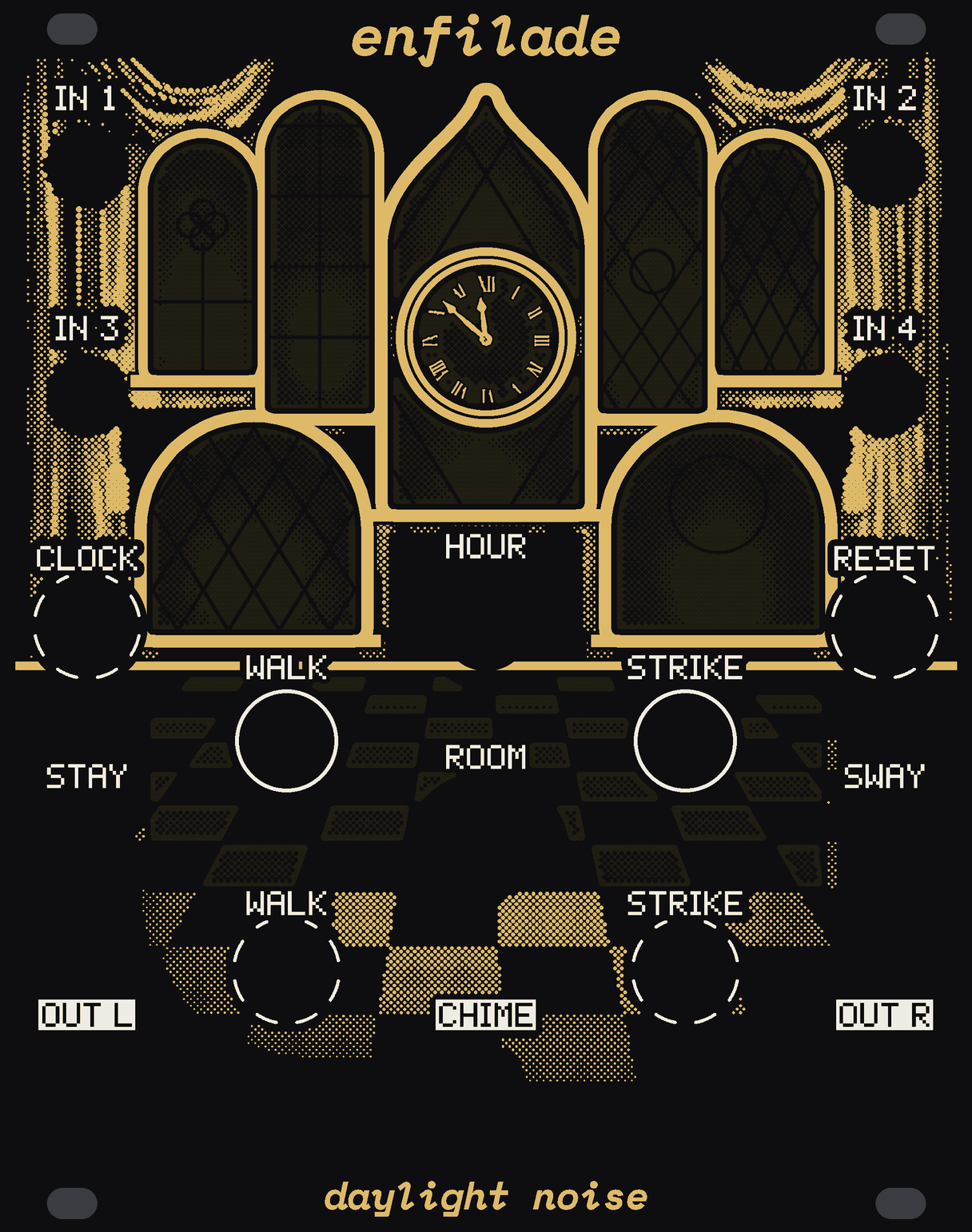
The ENFILADE panel, black and gold: an empty palace ballroom at night in gold halftone, heavy velvet curtains swagged at both sides. Seven round-headed leaded stained-glass windows in gilded frames stand on a black wall, broad ones low at either side, tall ones beside the middle, short ones at the outer top, each leaded differently, and in the middle a tall ogee-headed window with a clock's dial set in it, dark enamel with gilt Roman numerals and hands. Below, a polished marble chequer whose pale tiles nearest the wall are glass. ROOM, the big knob, stands on the dance floor and HOUR under the dial; STAY and SWAY are knobs at the sides; WALK and STRIKE two lit buttons on the floor over their jacks; the four ins at the top corners; CLOCK and RESET at the sides; OUT L, CHIME and OUT R at the foot.

Turn a knob: drag it or tap either side of it, roll the wheel over it or use the arrow keys; a double click puts it back. Press WALK and the revel walks into the next room; press STRIKE and on the next beat the clock strikes: every window goes dark and the dance stops. The patches step on by themselves until you touch anything.

Synthesised here. ENFILADE makes only its bell: the band is a stand-in rack, patched into its four INs, and you're hearing its OUT L and R.

example patches

Everything ENFILADE does here is its engine as designed, in your browser: the levelling, the rooms, the walk, the clock and its bell. The strings, the bass, the kit, the harpsichord, the room and the beeps are a stand-in rack.

The clock stops the dance

A loop that plays all four of its parts the same way forever isn't a track yet. A track starts thin, fills out, changes colour, builds, and somewhere in it the band stops dead and comes back in. Most people do that by hand, on four faders.

Patch your four parts into IN 1 to 4: a bed (pads, strings, a drone), a low part (the bass), a beat and a lead. Patch your clock into CLOCK, a pulse a beat. ENFILADE walks them through seven rooms, one after another, each room its own mix of the four. And every so many bars the clock strikes the hour: the whole lot stops on the bar line, the module's own bell rings, and the dance comes back in, together, on the bar line after the last stroke.

Seven rooms

The walk

On the hour

Midnight

In a rack

Specs

Format

Width
20 HP
Controls
a big knob (ROOM), three knobs (HOUR, STAY, SWAY), two lit buttons (WALK, STRIKE)
Lights
11 windows: the seven rooms' stained glass, the clock's dial and the floor's glass in three (86 LEDs)
Replaces
a four-channel stereo mixer, a scene arranger, a mute group and a long clock divider
Parts
a demo for now: the line's knobs, jacks and buttons, no board yet

Inputs

IN 1
the bed: sound up to ±10 V, levelled, then mixed as each room says
IN 2
the low part, the same way
IN 3
the beat, the same way
IN 4
the lead, the same way
CLOCK
gate: a pulse a beat over 1 V, 20 to 300 BPM, four beats a bar; 120 BPM with nothing in it
RESET
gate: dusk now; the next pulse is the night's first beat
WALK
gate: each rising edge walks the revel on a room
STRIKE
gate: each rising edge strikes the next hour on the next beat

Outputs

OUT L
the mix and the bell, left
OUT R
the mix and the bell, right
CHIME
gate, 5 V from the first stroke until the dance comes back