efrafa

a groove that breeds

36 HP

A drum pattern that lives, breeds and dies, and you play it with your fingers. Six rings of sixteen lit cells are a bar of six drums, and every few bars Life turns the warren. Hold the cells you want kept and the groove stays; what Life adds comes in as ghost notes, louder the longer it lives.

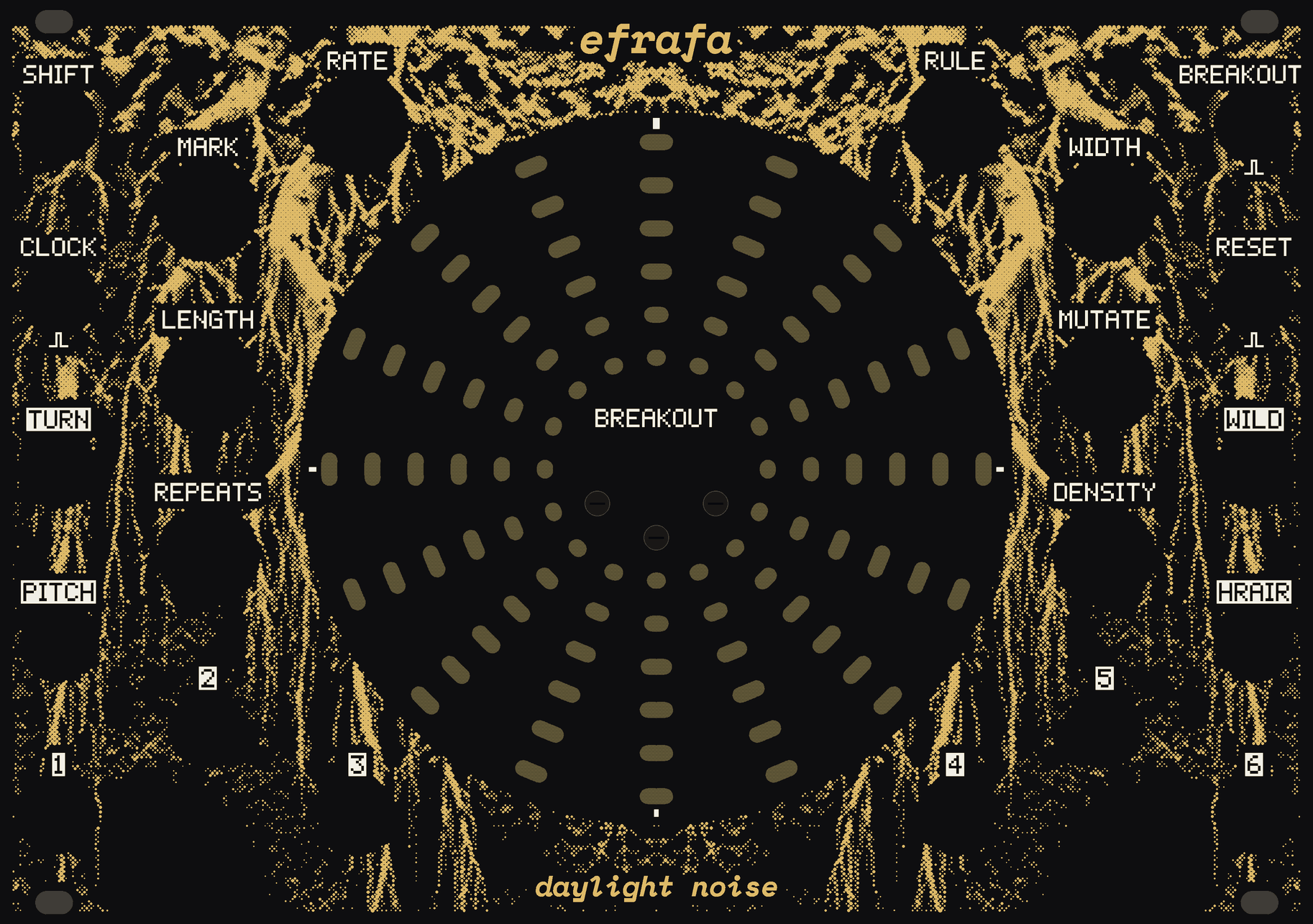
The EFRAFA panel: black, with a wall of earth in gold dots, pale roots hanging down through it round a round hollow in the middle. In the hollow, six rings of sixteen small windows of bare circuit board, the warren, and the BREAKOUT button at its heart. RATE, MARK, LENGTH and REPEATS to its left, RULE, WIDTH, MUTATE and DENSITY to its right; the jacks SHIFT, HOP (the clock), TURN and PITCH down the left edge, BREAKOUT, HOME (the reset), WILD and ACCENT down the right, and the six outs along the foot; thin white dashes round every gate and trigger, twelve ticks round PITCH. efrafa at the top, daylight noise at the bottom.

Turn a knob: drag it or tap either side of it, roll the wheel over it or use the arrow keys; a double click puts it back. The warren: click a cell to plant or kill it, drag round a ring to draw, drag out along a spoke to clear it, press and hold to hold it; a right-click or three fingers clear all but the held; or tab to it and use the arrows and Space. BREAKOUT is a button to press. The patches step on by themselves until you touch anything.

The warren and its lights are EFRAFA's own. The kit its rings play (ring 1 the kick, out to the open hat, each hit at the level ACCENT gives it), the bass, the glass, the crash and the pad round it are made in the page as you listen.

example patches

The warren, its law, the touch and every out here are EFRAFA's own engine, the module's firmware, running in your browser. The clock, the kit, the bass, the glass, the crash and the pad are a stand-in for the rest of a rack.
The warren

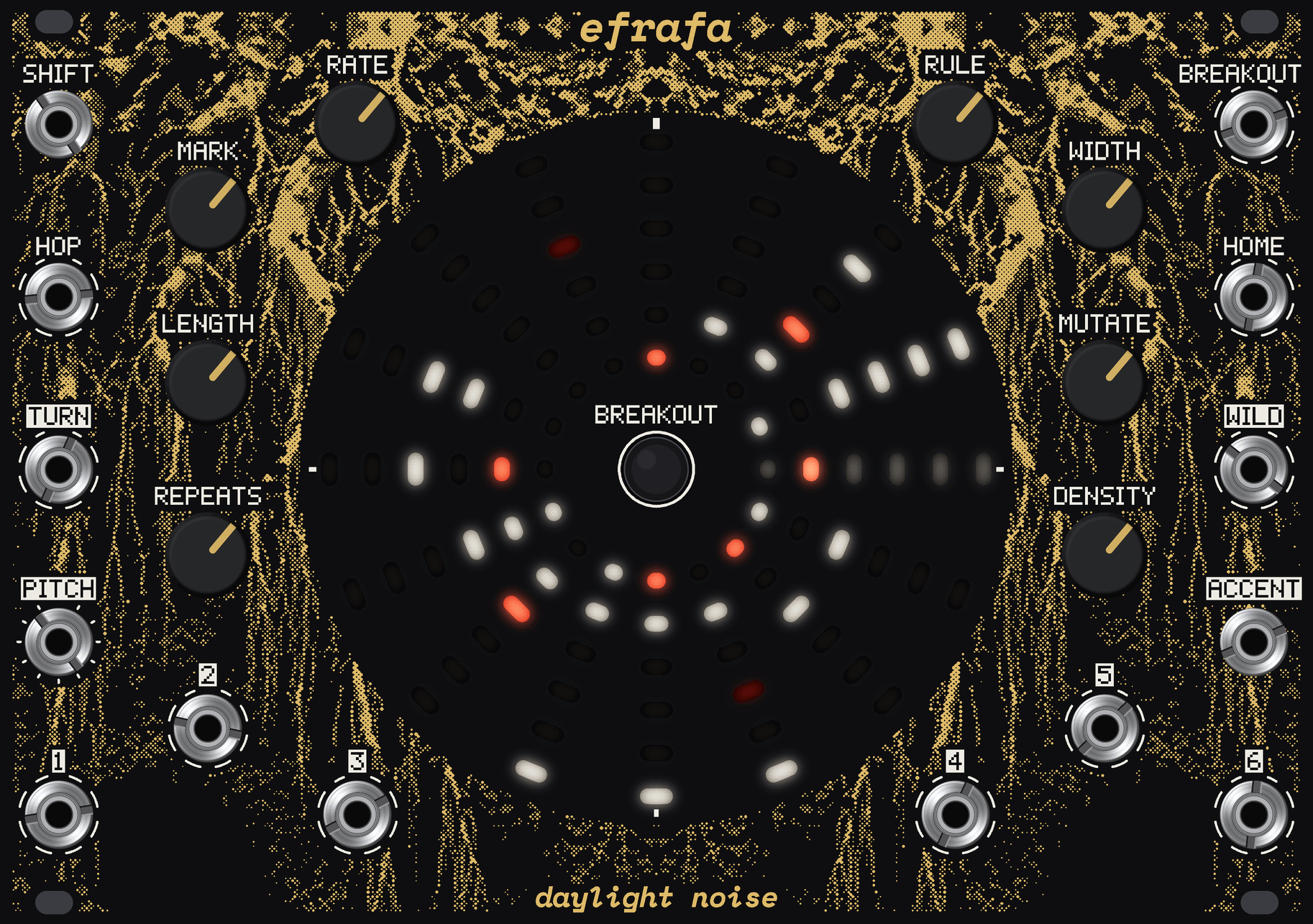
A ring is a lane with its own trigger out, a spoke is a step, step 1 at twelve o'clock. A hand sweeps round on the clock, and every live cell it passes fires its ring. The bar plays REPEATS times, then the warren turns: one generation of Life, each cell born, kept or dying by the cells round it: round the bar it wraps, from the outer ring to the inner it doesn't, so the open hat never breeds kicks.

Holding

Keep a finger on a cell for half a second and it's held: red and steady. A held live cell can't die, and nothing is born on a held empty one, a rest, which glows a faint red. Hold it again to let it go; nothing else touches it.

So you draw the backbone, the kick on 1 and 9 and the snare on 5 and 13, hold it, and Life breeds and dies round it: ghost notes, fills, hats. The groove survives.

Marks

Only the part of the bar that's out may change at a turn. The rest stays as it is, under curfew, dimmer, though its cells still count as neighbours. Empty cells in the part that's out glow faintly.

Breakout

Press BREAKOUT, at the warren's heart, or send a gate to its jack, and at the next bar line the warren turns with the law lifted: nothing under curfew, and the held cells free to die like any other. At the bar line after, every held cell is back where you put it. A fill on demand that always comes home. Hold the button or the gate and it turns free every bar until you let go.

The law

What comes out

Inside

The EFRAFA panel lit with a groove held: the warren's live cells white, the held ones red, with its knobs on.

Drag it or use the arrow keys to turn it; click it to take it apart.

Specs

Format

Width
36 HP
Depth
about 21 mm behind the panel, to the power header's shroud (estimated)
+12 V
about 145 mA in a groove, 255 mA at most with the lights at their cap (estimated)
−12 V
about 7 mA (estimated)
+5 V
not used
Controls
8 knobs; BREAKOUT, a button at the warren's heart

I/O

1 to 6, TURN, WILD
5 V triggers, 5 ms
PITCH
0 to 2 V, 1 V an octave, natural minor; 16 bits, calibrated
ACCENT
2, 4, 6 or 8 V, held from one step that fires to the next; 16 bits, calibrated
SHIFT
±10 V; 5 V takes the window once round the bar
HOP
clock in: a step a rising edge, up to 250 a second; RATE then /4 to x4. Empty: RATE runs 40 to 240 BPM in sixteenths
HOME, BREAKOUT
reset and gate ins: rising edges
Gates in
high over about 1.1 V

Engine

Brain
RP2350, 2,000 ticks a second
Touch
a grid of copper just behind the panel, 96 points read about 100 times a second by a chip of their own; up to five fingers, or a palm
Light
96 RGB LEDs, one under each window, their current capped
Firmware
one file over USB-C updates both chips