ear trumpet

hear the one you want

20 HP

A stereo focus drawn as an ear trumpet. Feed it a stereo mix and point it: the part sitting where it points comes forward, and everything else steps back, quieter and softer. Take that part out instead, or pull it out on its own.

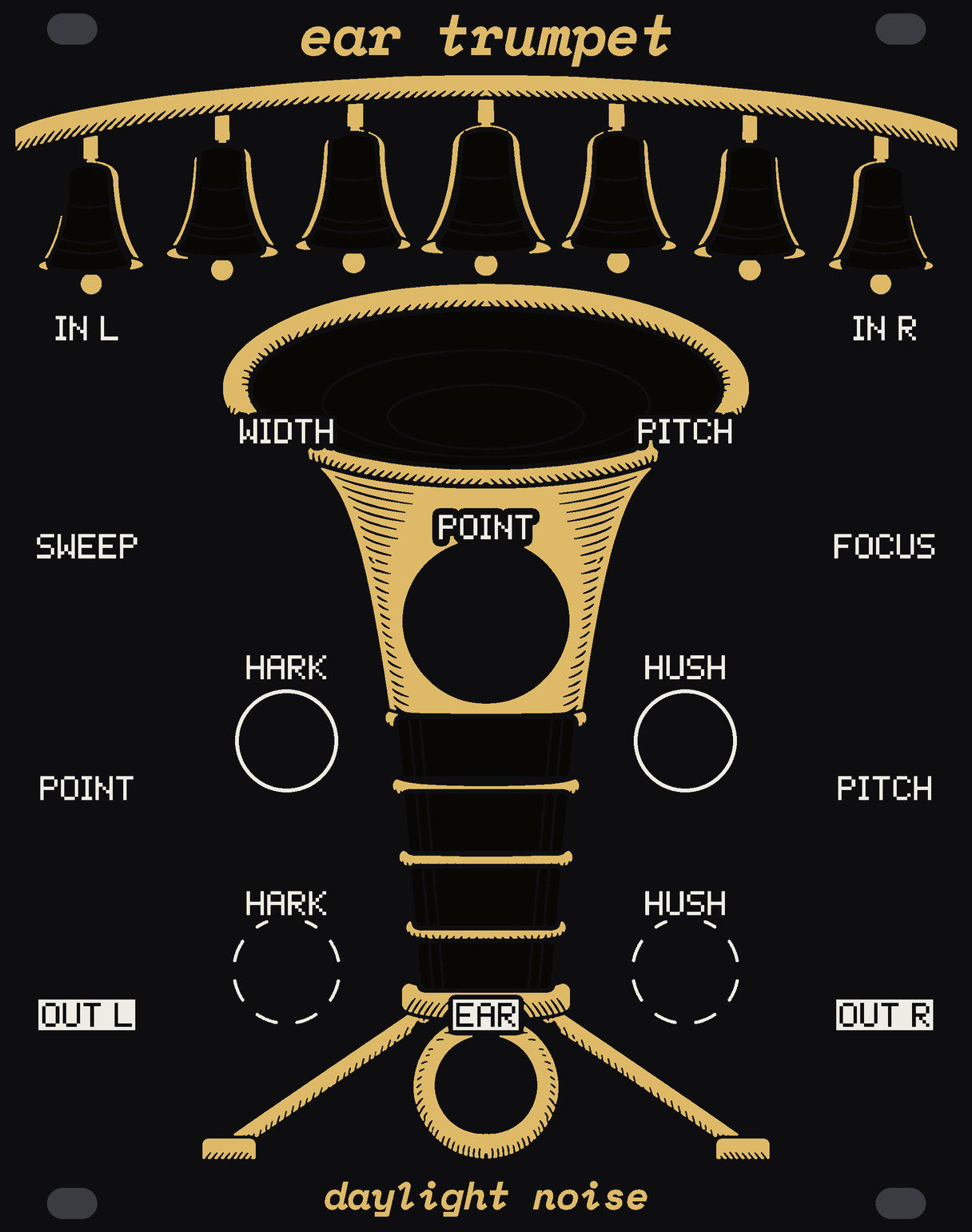
The EAR TRUMPET panel, black and gold: a brass ear trumpet drawn as a hand-inked illustration, standing up the middle of the panel on a small three-legged stand. Its wide mouth, ringed with a rolled rim, opens at the top, the glass of its throat drawn with two rings going down into the tube; its flared bell narrows past the big POINT knob into a tube with four glass bands between brass rings, down to a round earpiece that is the EAR jack. Across the top a gently arched yoke carries seven bells, the middle one the biggest, each a window of glass with its lip drawn in fine black lines. The jacks run down both edges.

Turn a knob: drag it or tap either side of it, roll the wheel over it or use the arrow keys; a double click puts it back. Hold HARK to hear only the beam, hold HUSH to take its part out. The patches step on by themselves until you touch anything.

Synthesised here, as the module would make it: the whole band goes through it, as it would in a rack.

example patches

EAR TRUMPET here is its engine as designed, in your browser: it hears only what comes into its jacks. The band and the beeps are a stand-in rack, all of it going through the module.

One cable each side, and point it

A stereo mix into IN L and IN R (a band, a stem, the end of your patch), OUT L and OUT R to your mixer. In a stereo mix every part has its place between left and right: the guitar a little left, the hats a little right, the bass in the middle. EAR TRUMPET splits the sound into about five hundred narrow slices of pitch, about 190 times a second, and works out where each slice sits by how loud it is on one side against the other.

Then it points. Whatever sits where it points is kept and lifted; whatever sits anywhere else is set back: quieter, darker, its hits softened, so the part you're pointing at stands in front. With every knob at noon it listens to the middle, about three bells wide, and sets the sides 15 dB back. Everything stays where it was between left and right.

The bells are the field

PITCH, SWEEP and FOCUS

HARK, HUSH and EAR

What it can and can't pull apart

It finds parts by where they sit, so it works best on mixes panned by level, as most are. In the first patch each part comes forward by 14 to 18 dB against the rest of the band; the part beside it comes partly along, because where two parts share a slice of pitch the slice lands between them. Anything wide by nature (a stereo reverb, a chorus) comes through a little in every beam, and two parts in the same place and range, like the kick and the bass, come together.

It's 21 ms late with every setting: nothing on a mix or a stem, but don't mix it back with its own dry sound.

Specs

Format

Width
20 HP
Controls
five knobs (POINT, WIDTH, PITCH, SWEEP, FOCUS), two lit buttons (HARK, HUSH)
Lights
seven bells, the mouth and four bands: 37 LEDs
Latency
21.3 ms at 48 kHz
Replaces
a mid/side encoder and decoder with an EQ each side, a VCA mixer to duck the rest, a filter to narrow it by pitch
Here
a demo: the parts and the engine as designed, no board yet

Inputs

IN L
audio: the left of your stereo mix
IN R
audio: the right; unpatched it takes IN L (a mono sound sits in the middle)
POINT
CV, added to POINT: 5 V the whole field
PITCH
CV, added to PITCH: 5 V a whole turn
HARK
gate: only the beam while high
HUSH
gate: the beam's part taken out while high

Outputs

OUT L
audio: your mix, refocused, the left
OUT R
audio: the right
EAR
audio: what's in the beam on its own, mono