dovetail

one tune, two players

20 HP

Play it a tune and two players split it between them on bronze gongs: each part full of gaps the other fills, together one unbroken stream round your tune, the pair tuned a hair apart so it shimmers.

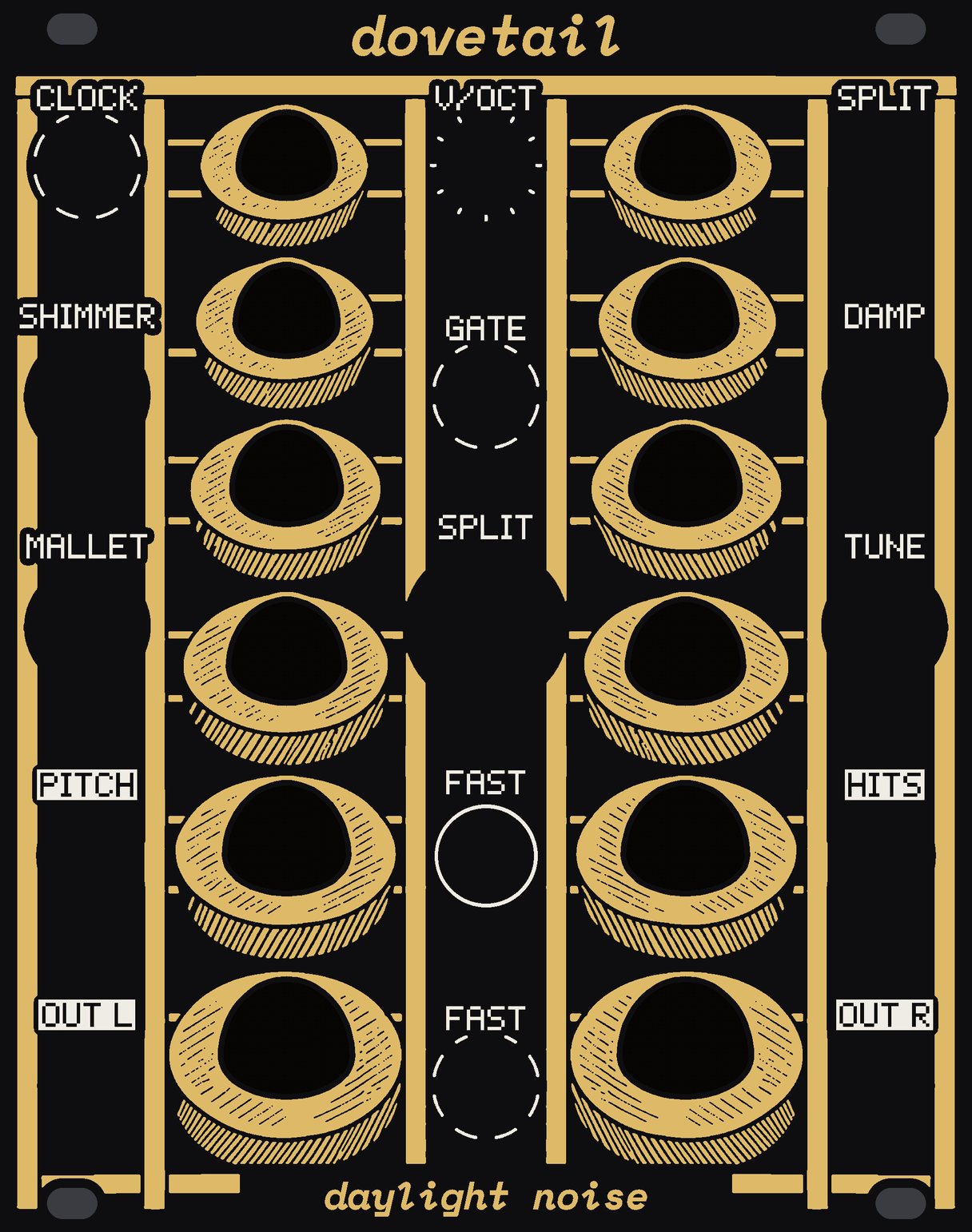
The DOVETAIL panel, black and gold: two columns of bronze kettle gongs drawn in bold gold ink, six a column, each resting on two cords across a plain wooden frame with its rails, its end posts and a beam across the top. The gongs get smaller from the foot to the top, each a round bronze kettle with a hatched rim and a raised boss of bare glass in its middle. SPLIT, the big knob, sits between the columns with V/OCT and GATE above it and FAST, a lit button, over its gate below; SHIMMER, DAMP, MALLET and TUNE knobs, CLOCK and SPLIT in, PITCH, HITS, OUT L and OUT R out down the frame's ends.

Turn a knob: drag it or tap either side of it, roll the wheel over it or use the arrow keys; a double click puts it back. Press FAST to double the strokes (press again to go back). The patches step on by themselves until you touch anything.

Synthesised here: both players and their twelve gongs, as the module would make them, with a stand-in rack playing the tune into it.

example patches

Everything DOVETAIL does here is its engine as designed, in your browser: the split, both players' gongs, the pair's beat and the damping. The sequencer, the hand drum, the big gongs, the low bars, the beat and the harp are a stand-in rack.

Two players, one tune

There are two players, the left and the right, and each has six bronze kettle gongs: the five notes of DOVETAIL's scale from the bottom up, and the first again an octave higher at the top. At noon on TUNE those are C, D, E flat, G and A flat. Play a tune into V/OCT and GATE and each note is snapped to the nearest gong; whatever you play, it comes out on the gongs' notes.

Neither player plays your tune. They split it: strokes fall on every pulse of CLOCK (a sixteenth, say), and each stroke goes to one player or the other, so each part is full of gaps and the two together are one unbroken stream. The right player takes the notes above your tune, the left the notes below it, and on every new note they meet on your note's own gong. It's how two players can play faster than either could alone.

Splitting the tune

The pair

Hands and mallets

What comes out

In a rack

Specs

Format

Width
20 HP
Controls
a big knob (SPLIT), four knobs (SHIMMER, DAMP, MALLET, TUNE), a lit button (FAST)
Lights
12 windows, the gongs' bosses, on 16 RGB LEDs
Replaces
a figure maker, a quantiser and two struck-metal voices
Parts
a demo for now: the line's knobs, jacks and buttons, no board yet

Inputs

V/OCT
1 V/oct: the tune's note
GATE
gate: a new note on each rising edge
CLOCK
gate: a stroke each pulse; empty, from GATE
SPLIT
CV: added to SPLIT, 5 V the whole turn
FAST
gate: double time while high

Outputs

OUT L
audio, the left player
OUT R
audio, the right player
PITCH
1 V/oct, each stroke's note
HITS
8 V, 5 ms at each stroke