double top

aim for the twenty

20 HP

A riff thrown at a dartboard. Three darts a bar, each a note: you aim with the big knob, SKILL sets how far they scatter, and the board's numbers are scrambled, so a near miss leaps. When the score comes down to a double, the checkout fires a fill.

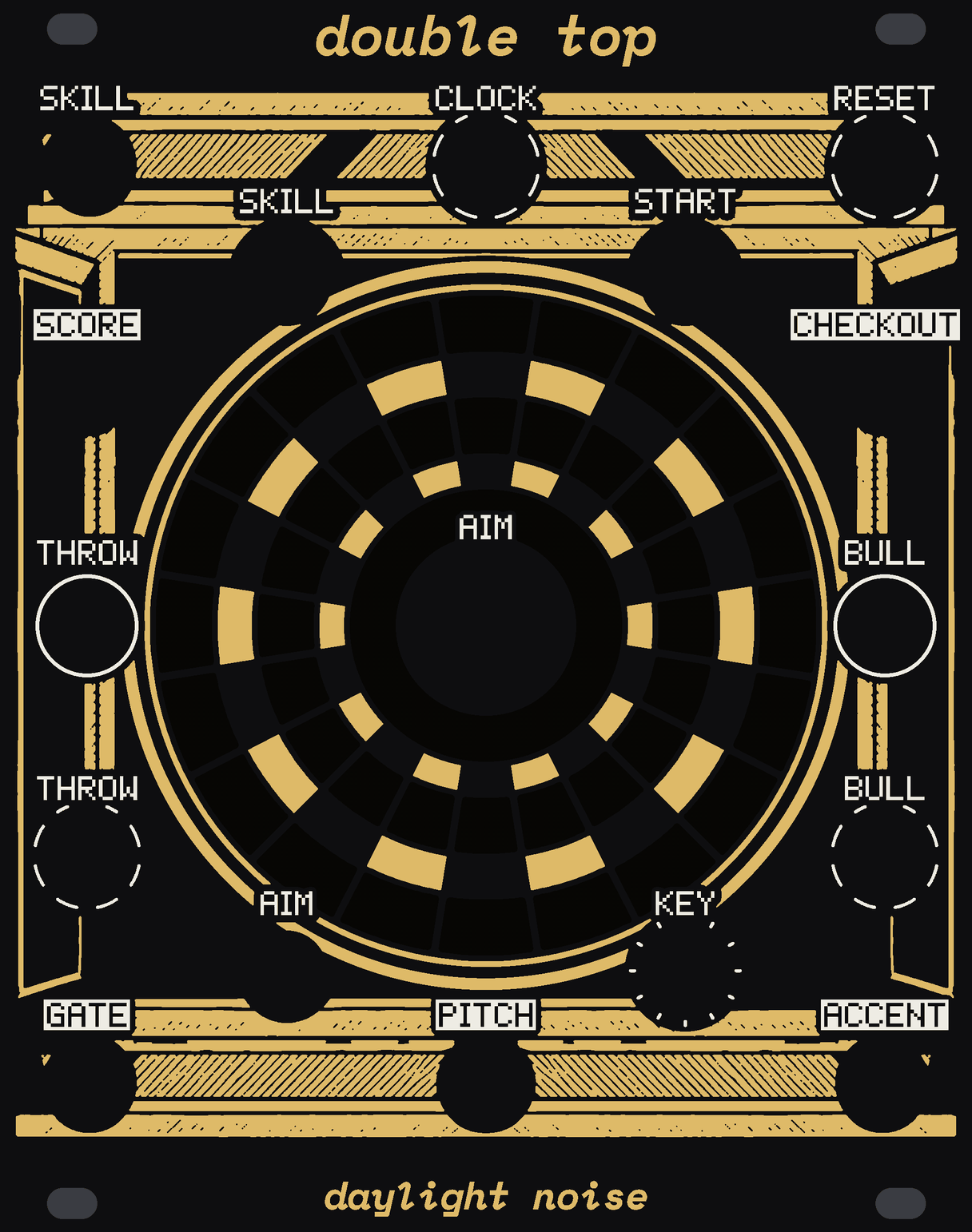
The DOUBLE TOP panel, black and gold: a pub dartboard in its wooden cabinet drawn in bold gold ink, a stepped cornice along the top, a plinth along the foot, and the cabinet's two doors opened either side, hatched like the wood. The board fills the middle: its single beds gold and black in turn, its treble ring and its double ring forty windows of bare glass, the bull a ring of glass round AIM, the big knob at the board's centre. SKILL and START sit on the board's rim at the top, the AIM and KEY jacks at its foot; THROW and BULL are lit buttons either side of it over their gate jacks; SKILL, CLOCK and RESET in along the cornice, SCORE and CHECKOUT out on the doors, GATE, PITCH and ACCENT out along the plinth.

Turn a knob: drag it or tap either side of it, roll the wheel over it or use the arrow keys; a double click puts it back. AIM's pointer is where the darts are aimed. Press THROW to throw the next dart now, BULL to send the next one at the bull. The patches step on by themselves until you touch anything.

Synthesised here. DOUBLE TOP makes no sound: you're hearing a stand-in rack, its clock in CLOCK and its chords' roots in KEY, the module's outs playing a guitar, and CHECKOUT the drummer's fills.

example patches

Everything DOUBLE TOP does here is its engine as designed, in your browser: the throws, the board, the score and the finish. The guitar, the bass, the drums and the piano are a stand-in rack.

The board

The twenty segments are in a real board's order round from the top: 20, 1, 18, 4, 13, 6, 10, 15, 2, 17, 3, 19, 7, 16, 8, 11, 14, 9, 12, 5. Each number is a note: the 1 is KEY's note, the 20 two octaves above it, the rest spread evenly between, so every note of two octaves of the scale is on the board somewhere. The scale is the major scale with its seventh flattened, the one rock and roll riffs are made of; with nothing in KEY it's on C.

Because the numbers are scrambled, neighbours are far apart in pitch. The 20 sits between the 1 (two octaves down) and the 5 (a fourth above KEY): aim at the top and every near miss is a leap. A treble is the same note, accented; a double jumps an octave; the bull is KEY's note, held; off the board is a rest.

The thrower

The game

What comes out

In a rack

Specs

Format

Width
20 HP
Controls
a big knob (AIM), two knobs (SKILL, START), two lit buttons (THROW, BULL)
Lights
41 windows on 48 RGB LEDs: the treble ring, the double ring and the bull
Replaces
a melodic sequencer, a quantiser, a random source, an accent sequencer, a slow envelope and a fill trigger
Parts
a demo for now: the line's knobs, jacks and buttons, no board yet

Inputs

CLOCK
gate: sixteenths, three darts a bar; empty, eight a second
RESET
gate: a new leg, the bar's first tick
KEY
1 V/oct: the scale's root, the 1 and the bull
AIM
CV: four segments a volt
SKILL
CV: a tenth of the turn a volt
THROW
gate: a dart on each rising edge
BULL
gate: the next dart at the bull

Outputs

PITCH
1 V/oct, the dart's note
GATE
5 V, a gate a dart
ACCENT
5 V on a treble
SCORE
8 V down to 0 V over a leg
CHECKOUT
5 V to the bar's end