dissolve

dissolve and arrive

20 HP

Send your sound across the room. It leaves DEPART as a cloud of sparkle, crosses over the top and comes back together at ARRIVE: an octave up if you like, or with pieces missing. A crossfader, a panner and a shimmer in one move.

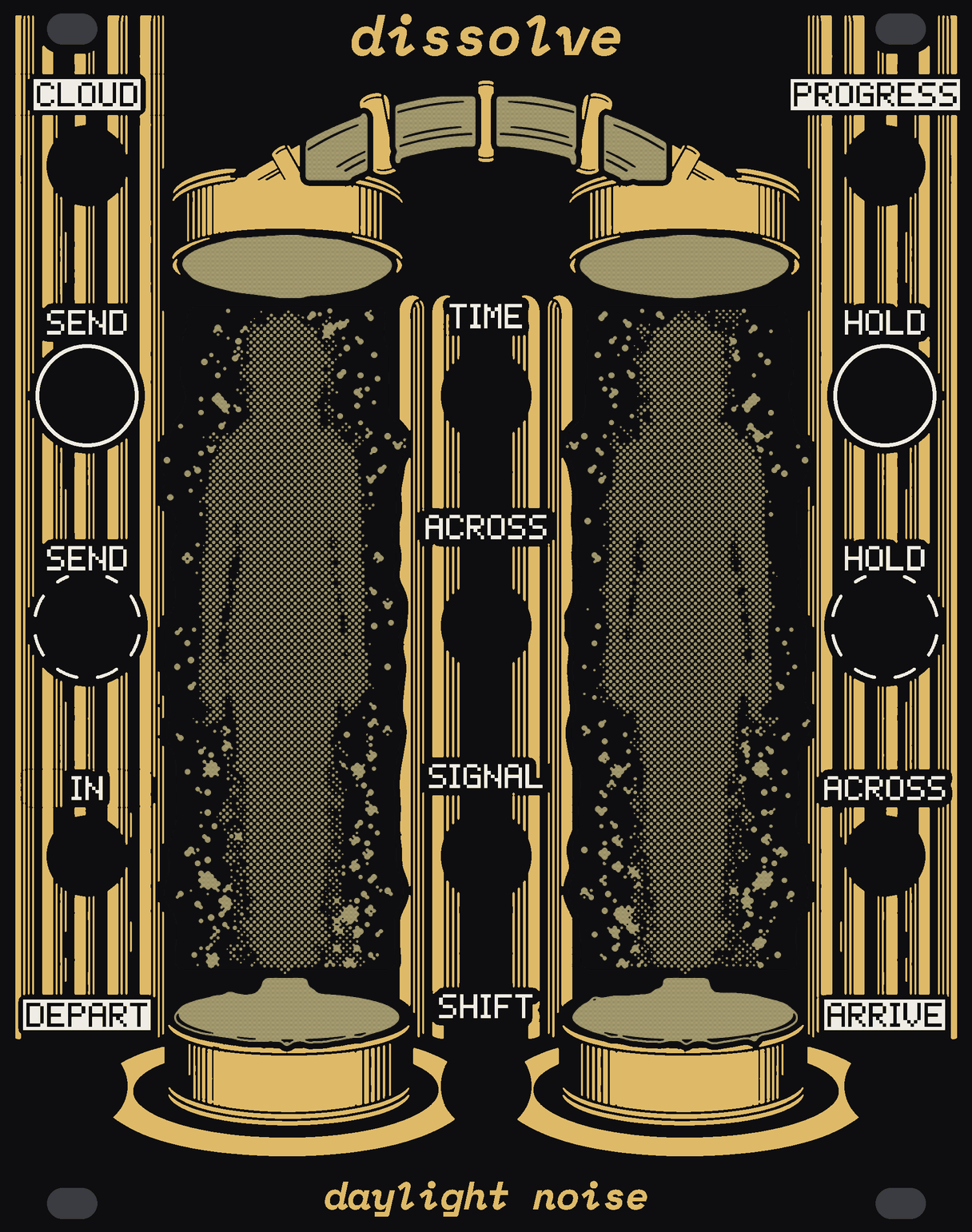
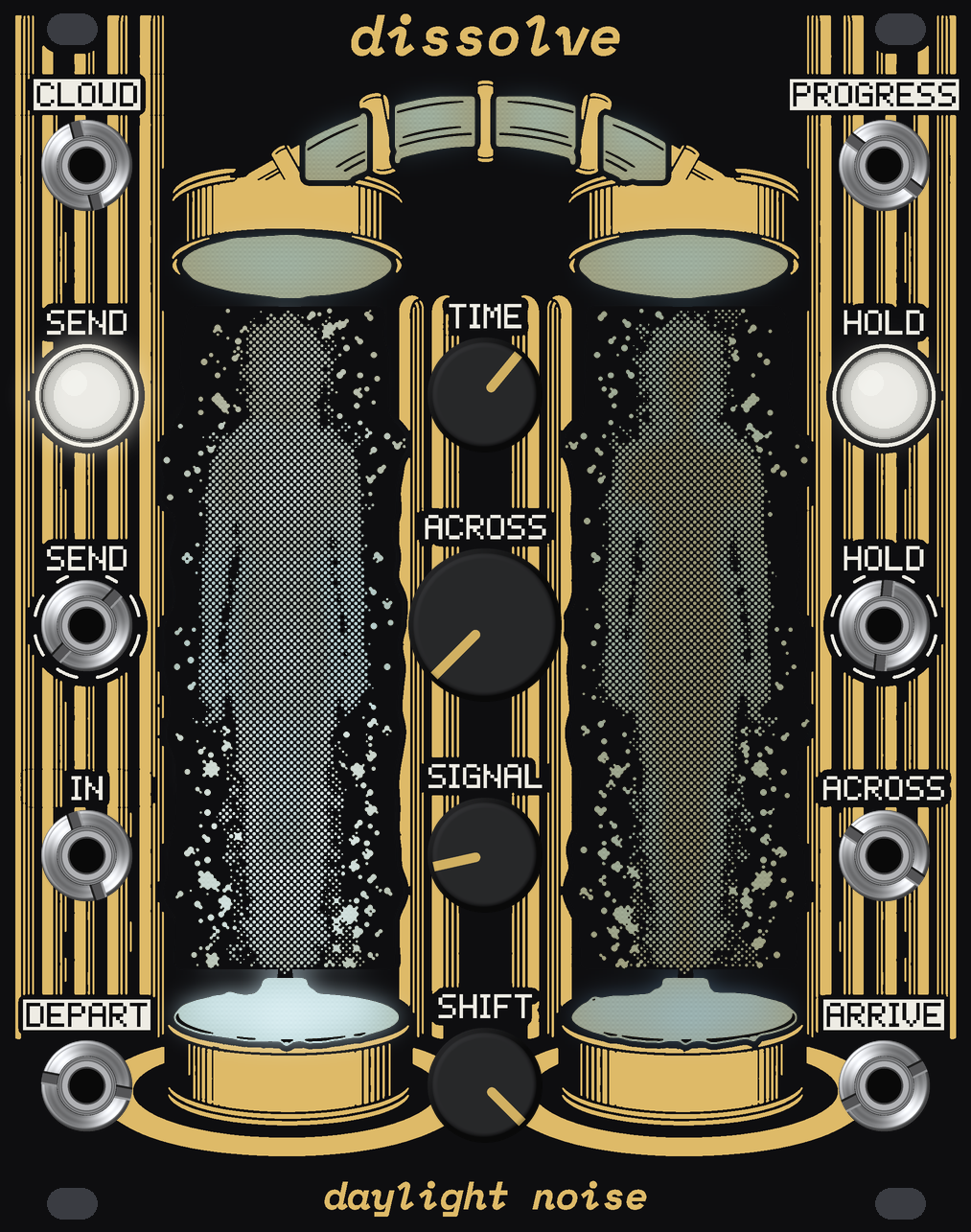
The DISSOLVE panel, black and gold: a dark round chamber filling the panel, drawn in ink, its brass solid gold, its outlines and hatching black: fluted walls down both sides, two turned brass pads on the floor, each under a lens in a brass drum, the two drums joined by a glass arch over the top under the name. On each pad stands a plain figure made of light, no face, its edges breaking into points of sparkle: the figures, the pads' glass tops, the lenses and the arch are bare glass for light. The four knobs run down the middle between the figures, the big ACROSS knob at the centre; the jacks and the SEND and HOLD buttons sit in the walls at the edges, the two outs at the foot printed DEPART, by the left pad, and ARRIVE, by the right.

Turn a knob: drag it or tap either side of it, roll the wheel over it or use the arrow keys; a double click puts it back. SEND sends the sound across; HOLD hangs the cloud.

The trip, the cloud, DEPART and ARRIVE, in your browser.

Pick a sound file or drop one here: its first minute goes into IN and stands at DEPART until you press SEND. It never leaves your computer.

example patches

Everything DISSOLVE does here is the module's own engine in your browser, and it hears only what comes into its jacks. The rest is a stand-in rack, unless you bring your own.
One cable, a trip

Your sound into IN, and DEPART (the left out) and ARRIVE (the right) to two mixer channels, left and right. With ACROSS fully left the sound stands at DEPART, a straight wire. Press SEND: it comes apart into grains, crosses over the top and locks back together at ARRIVE. Press it again and it comes home to DEPART.

SEND and TIME

ACROSS

SHIFT

SHIFT is the pitch it arrives at: an octave down fully left, the same at noon, an octave up fully right, smooth between. The sound arrives in tune; the trip home brings it back as it was.

SIGNAL

SIGNAL is the line between DEPART and ARRIVE. Fully left the sound arrives exactly as it left. Turned up, the cloud gets coarse and patchy and the sound arrives damaged until it's sent again: notes missing, a piece repeating, a wrong note, a crunch, lit pink.

HOLD

While HOLD is held (or its gate is high) the trip stops and the cloud stops listening: a frozen shimmer of that moment, for as long as you like. Let go and it carries on.

CLOUD and PROGRESS

Inside

The DISSOLVE panel playing: the figure on the left pad coming apart into sparkle as the sound leaves DEPART, the right pad's figure waiting by ARRIVE.

Drag it or use the arrow keys to turn it; click it to take it apart.

Specs

Format

Width
20 HP
Depth
20.6 mm behind the panel
+12 V
about 135 mA dark, 155 to 190 mA playing, 221 mA at the most (estimated)
−12 V
about 5 mA (estimated)
+5 V
not used
Controls
four knobs (ACROSS, TIME, SIGNAL, SHIFT), two lit buttons (SEND, HOLD)
Light
103 RGB LEDs under the figures, the pads, the lenses and the arch
Parts
380 on one side by machine; the rest by hand
Replaces
a crossfader, an auto-panner and a granular shimmer

Inputs

IN
audio to ±10 V, modular or line level
SEND
gate: each rising edge is a press
HOLD
gate: held while it's high
ACROSS
CV to ±10 V, added to the knob: 10 V the whole way

Outputs

DEPART
audio to 10 V: the left, where the sound sets out from
ARRIVE
audio to 10 V: the right, where it lands
CLOUD
audio to 10 V: the grains alone
PROGRESS
CV, 0 to 8 V: where the sound is

Engine

Brain
RP2350 at 240 MHz on both cores, 46.875 kHz: this page's engine, the same to the last bit
Converters
PCM1808 in, two PCM5102A out (DEPART and ARRIVE; CLOUD); PROGRESS a filtered PWM
Memory
301 KB of the chip's own; only a count of power-ons kept through power-off
Updates
over USB, the panel left on